2026 Trends in Public Speaking: AI’s Transformative Role

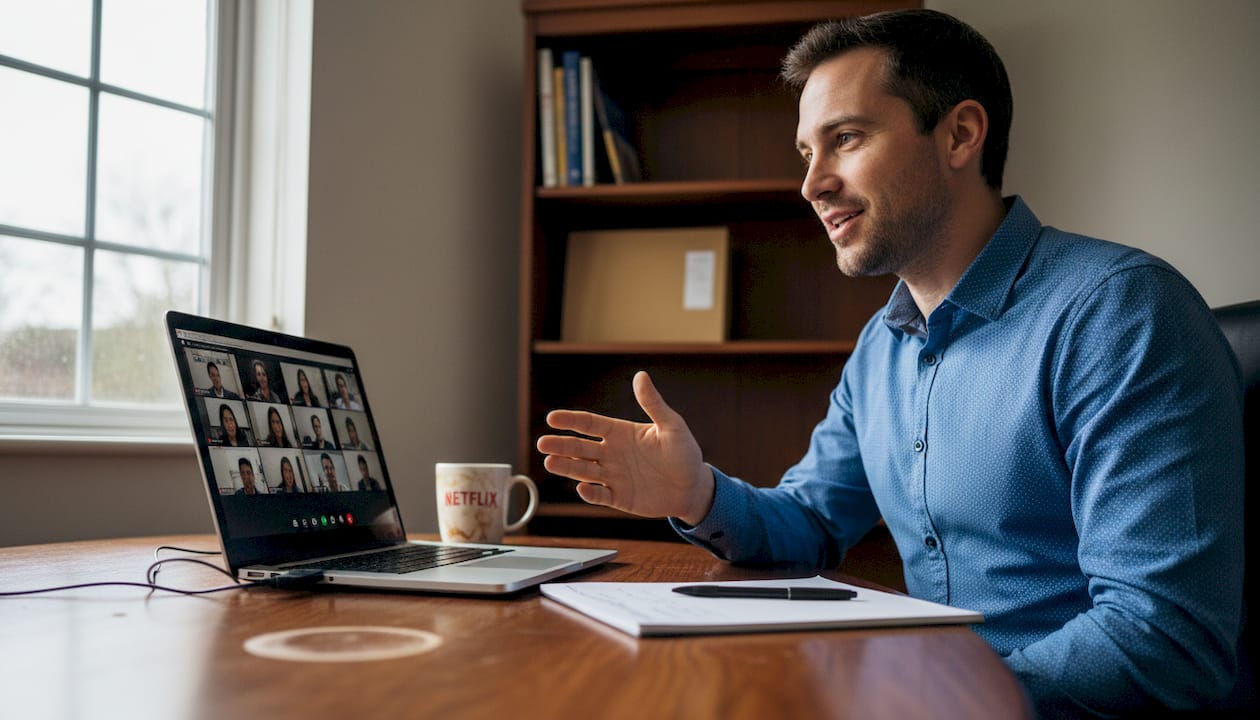
You step into a video call with colleagues scattered from Toronto to Mexico City, knowing your message must resonate across cultures and devices. For American and Canadian managers, the challenge of public speaking has changed. Formats now include live video, recorded pitches, and hybrid meetings, demanding fresh clarity and adaptability. Virtual and hybrid events are now integral to professional communication, and new AI-driven feedback tools reveal exactly how well you connect, paving the way for practical skill growth in every interaction.
Table of Contents
- Defining Public Speaking In 2026
- Emerging Technologies Shaping Delivery And Feedback
- Ai Analytics For Speaker Performance And Growth
- Shifting Audience Expectations And Engagement
- Adapting Styles For Global And Hybrid Communication
- Common Pitfalls And How To Avoid Them
Key Takeaways
| Point | Details |
|---|---|
| Evolving Definitions of Public Speaking | Public speaking now includes video calls, recorded pitches, and hybrid events, requiring professionals to adapt their communication skills across multiple formats. |
| Importance of Audience Engagement | Audiences expect interaction and responsiveness, making engagement a key component of effective presentations in 2026. |
| Real-Time Feedback and AI | AI technologies provide immediate, actionable feedback that enhances speaking performance, allowing for continuous improvement in communication skills. |
| Cultural Adaptability | Global communication requires an understanding of cultural nuances to effectively connect with diverse audiences in hybrid settings. |
Defining Public Speaking in 2026
Public speaking in 2026 looks fundamentally different from what it was a decade ago. It’s no longer confined to the boardroom or the conference stage. Today’s definition encompasses presentations via video call, recorded pitches for virtual audiences, hybrid events where some attendees are in the room and others join remotely, and asynchronous communication where your words need to land without the immediate energy exchange of a live audience. For corporate professionals in North America, this expansion matters because the skills that once served you at a quarterly town hall no longer tell the complete story of effective communication.
What defines public speaking in 2026 is less about where you’re speaking and more about your ability to connect with your message regardless of format. The core elements remain familiar: clarity, pacing, tone, and confidence. But the contexts in which you deploy these skills have multiplied. You might record a three-minute video message for your distributed team in the morning, present live to investors in the afternoon, and then deliver remarks at a virtual conference that evening. Each situation demands the same foundational skills applied in different contexts. Research on evolving instructional methods in digital learning shows that virtual and hybrid formats are now integral to how public speaking is taught and practised, reflecting these broader shifts in workplace communication.
The transformation extends beyond format. In 2026, effective public speakers understand that their audience’s attention is fragmented. They know that filler words like “um” and “uh” register differently on video than they do in person. They recognise that articulating thoughts clearly becomes even more critical when there’s no chance to read the room and adjust in real time. They’ve learned to use tools that provide immediate, actionable feedback on their delivery, moving beyond the vague “good job” or the painful silence after asking if there are questions. The definition of public speaking now includes a responsibility to understand your own communication patterns and actively work to improve them, not just once a year in a communication workshop, but continuously as part of your professional growth.
This shift means that public speaking is no longer something you do occasionally. It’s something you do constantly. Every video call where you’re sharing an update, every email where you’re making a persuasive case, every team meeting where you’re proposing an idea—these are all instances of public speaking in the broadest sense. The professionals who thrive in 2026 are those who’ve integrated speaking confidence into their daily work rather than treating it as a separate skill reserved for big presentations. They understand that whether speaking to five people or fifty, the fundamentals matter. They’ve moved from thinking of themselves as “not a natural public speaker” to recognising themselves as someone actively developing their communication capability.
Below is a summary of digital public speaking formats prevalent in 2026:
| Format | Description | Typical Audience Size | Key Challenge |
|---|---|---|---|
| Live video call | Real-time, interactive remote meeting | Small to large | Managing engagement |
| Recorded pitch | Pre-recorded presentations for asynchronous viewing | Any size | Ensuring clarity |
| Hybrid events | Mix of in-person and remote participants | Medium to large | Technical coordination |
| Asynchronous message | Text, video, or audio sent for later response | Variable | Maintaining connection |
Pro tip: Record yourself during your next team meeting or presentation and review one specific element—either your pace, your use of filler words, or your tone—rather than trying to critique everything at once. This focused approach helps you understand how you actually sound versus how you think you sound, which is where most corporate professionals discover their biggest growth opportunities.
Emerging Technologies Shaping Delivery and Feedback
The technologies transforming public speaking in 2026 aren’t science fiction anymore. They’re operational right now, integrated into how professionals practise and refine their delivery. When you step in front of a camera or stand before a room of colleagues, artificial intelligence is working quietly in the background, analysing everything from your speech pace to your hand gestures. The shift matters because feedback no longer requires waiting days for a colleague’s observations or booking time with an expensive speaking coach. Instead, AI provides real-time, personalised feedback on delivery elements like pacing, tone, and gesture analysis, enabling speakers to understand exactly what their audience experiences moment by moment. For corporate professionals juggling packed schedules, this instant feedback transforms how you prepare for high-stakes presentations or team meetings.
What makes these emerging technologies particularly valuable is how they complement rather than replace human coaching. Public speaking experts recognise that AI-assisted training tools automate technical feedback while hybrid models combining AI with human coaching produce the most effective learning outcomes. Think of it this way: AI catches the technical patterns you miss about yourself. You might believe you speak quickly, but AI shows you exactly where your pace accelerates and by how much. You think your tone sounds confident, but the technology reveals moments where your voice drops or becomes hesitant. This objective data becomes the foundation for real improvement. Meanwhile, a human coach or mentor helps you understand why these patterns exist and how to adjust them contextually. A presentation to your board might demand a different pace than a training session for new team members. AI identifies the patterns; human judgment applies the nuance.
For your daily work, this matters across multiple scenarios. When recording a video message for your distributed team, you can capture yourself, review the analysis, and rerecord before sending anything out. Before a client presentation, you can practise your opening remarks and get immediate feedback on filler words, which otherwise can undermine your credibility within the first 30 seconds. During a difficult conversation with a direct report, you might record the interaction (with their consent) and afterwards understand how your tone came across, whether you were truly listening, or if you interrupted more than you realised. The technology doesn’t judge; it simply shows you what happened. Your responsibility lies in deciding what to do with that information.
The practical effect is that speaking improvement accelerates dramatically. Rather than waiting until after a quarterly business review to hear feedback about your presentation, you get it immediately. Rather than booking a coaching session weeks away, you can invest 15 minutes today reviewing your own recording. The barrier to practising becomes nearly zero. Corporate professionals who embrace these tools report increased confidence because they’re no longer guessing about their impact. They know. And knowing allows you to adjust, improve, and approach your next presentation with genuine evidence that you’ve got this rather than just hoping for the best. The combination of immediate AI-driven feedback and the ability to act on it quickly creates a feedback loop that generates measurable progress over weeks rather than months.

Here’s a quick comparison of traditional and AI-assisted feedback methods for speakers:
| Feedback Method | Speed of Feedback | Type of Insight Provided | Personalisation Level |
|---|---|---|---|
| Human coaching | Delayed (days/weeks) | Subjective, context-specific | High |
| AI analytics | Instant | Objective, data-driven | Moderate |
| Hybrid approach | Rapid, iterative | Combines data with expertise | Very high |
Pro tip: Before your next important presentation, record a practice run and focus on just one metric from the feedback, such as eliminating filler words or maintaining a consistent pace, rather than trying to fix everything simultaneously. This targeted approach builds momentum and confidence faster than attempting wholesale communication overhaul.
AI Analytics for Speaker Performance and Growth
AI analytics in 2026 has moved beyond simply telling you whether you did well or poorly. Instead, it provides granular data about your speaking performance across multiple dimensions simultaneously. Imagine finishing a presentation and within minutes having access to precise measurements of your pacing, vocal variety, pause frequency, gesture patterns, and facial expressions. This isn’t speculation or subjective observation. This is objective data backed by machine learning systems that have analysed thousands of hours of successful and unsuccessful presentations. A multi-modal machine learning framework now evaluates speaker performance by analysing audio and video features such as facial expressions, gestures, and speech patterns, classifying speaker quality and providing actionable analytics to foster growth in professional contexts. For corporate professionals preparing for board presentations, client pitches, or team announcements, this means you’re no longer working from intuition about your performance.
What makes these analytics genuinely transformative is their specificity and actionability. Rather than receiving feedback that “your tone needs work,” you receive data showing exactly where your voice pitch dropped, by how many hertz, and for how long. Rather than hearing “you seem nervous,” you see metrics on your gesture frequency, hand positioning, and whether your facial expressions aligned with your message. The system can identify that you tend to rush through technical information whilst speaking more deliberately during your calls to action, or that your confidence visibly increases once you reach the Q and A section. This level of detail transforms vague coaching advice into a concrete roadmap. You know specifically what changed and can track whether your next attempt improves those exact metrics. Over time, AI-driven performance prediction provides data-driven, personalised feedback to enhance learning and speaker performance across predictive analytics and intervention strategies.
For your practical work, this means several things shift in your favour. When preparing for a critical presentation, you can run multiple practice sessions and watch your confidence metrics improve across attempts. You can identify which sections of your delivery need the most work and focus your practise time accordingly rather than spending equal energy on everything. You can compare your performance data across different contexts, understanding how your delivery changes when speaking to your executive team versus speaking to new team members. You can set specific growth targets, like reducing filler words from eight per minute to three, and track your progress week by week. The transparency of the data eliminates the guesswork from improvement. You’re not hoping you’re getting better; you’re watching yourself improve in real time.
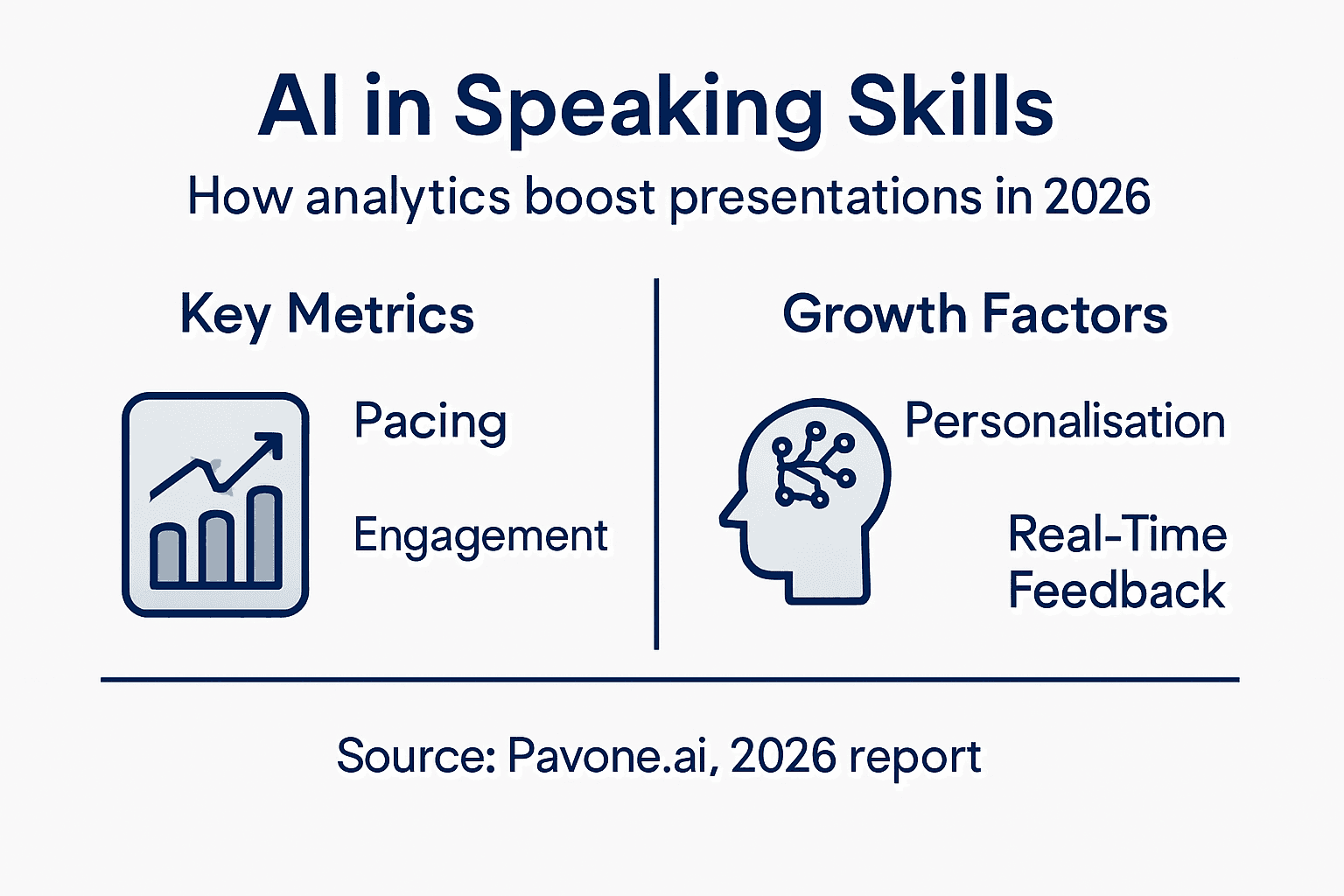
Corporate professionals often discover unexpected patterns in their data. Someone who thinks of themselves as a fast talker might discover they’re actually speaking at a reasonable pace but pausing infrequently, which creates the impression of rushing. Someone convinced they gesture too much might find their gesture rate is actually quite moderate but clustered in certain moments, creating awkward stillness elsewhere. Someone assuming their tone is monotonous might discover they actually have good vocal variety during storytelling but flatten their voice when presenting data. These discoveries matter because they redirect your improvement efforts toward what actually needs changing rather than perceived problems. You stop fighting imaginary battles and start addressing real gaps. When you combine these analytics with strategic practise, progress becomes measurable and momentum builds quickly. You approach your next presentation with concrete evidence of improvement, which shifts your mindset from anxious to prepared.
Pro tip: Start by reviewing one complete metrics dashboard after a recorded practise session and identify your single biggest outlier—the one metric significantly below your other measurements—then spend your next three practise runs focusing exclusively on that element before checking the full analytics again.
Shifting Audience Expectations and Engagement
Your audience in 2026 is fundamentally different from the one you addressed five years ago. They’re not content to sit passively whilst you deliver information. They expect interaction, real-time responsiveness, and the opportunity to shape the conversation. This shift applies whether you’re presenting to 500 people at a conference or five people in a meeting room. The traditional model of speaker as information authority and audience as silent recipients has fractured. Instead, audiences now favour active participation over passive viewership, with strategies emphasising two-way communication, feedback, and community-building to meet expectations for interactivity and authenticity. For corporate professionals accustomed to delivering polished presentations with minimal interruption, this represents a significant recalibration. Your success now depends partly on how effectively you facilitate engagement rather than simply how well you present information.
Understanding who your audience actually is matters more than ever. Future audiences increasingly prioritise interactive, inclusive, and hybrid formats, particularly younger and diverse populations who bring social and environmental values to their engagement decisions. This means a presentation that worked brilliantly in 2020 might fall flat in 2026 not because your content is weaker but because your delivery model doesn’t match audience expectations. A younger audience attending your webinar won’t simply tolerate a 45-minute monologue followed by five minutes of questions. They’ll expect genuine dialogue, opportunities to contribute ideas, and acknowledgment of their perspectives. An audience increasingly concerned with corporate social responsibility wants to understand not just what you’re saying but why it matters beyond profit margins. An audience accustomed to getting information through short-form video won’t reward lengthy preambles before you reach your point. These aren’t universal rules; they’re contextual realities you must navigate by understanding who’s actually in your room or on your video call.
What this means practically is that you’ll need to build flexibility into your presentations and meetings. Rather than following a rigid script, you develop a structure that allows for audience input at natural moments. Rather than treating questions as an afterthought, you anticipate them and weave potential answers into your narrative. Rather than assuming your audience’s concerns, you ask directly or research beforehand. When someone on a video call contributes an idea, you acknowledge it specifically rather than moving past it. When a team member challenges your approach, you treat it as an opportunity to strengthen your thinking rather than a threat to your authority. The corporate professionals who thrive in this environment are those who view audience engagement not as an add-on to their presentation but as central to it. They recognise that an interactive, responsive conversation will accomplish your goals more effectively than a perfectly delivered one-directional speech.
You’ll also find that your preparation shifts. Rather than practising your delivery alone, you’ll want to test your ideas with representative audience members beforehand. Rather than obsessing over slide transitions, you’ll focus on the questions you’re likely to face and how you’ll handle them thoughtfully. Rather than memorising your opening, you’ll develop an opening that genuinely invites your audience in and allows for natural conversation to follow. The technology supporting you, like AI-driven analytics, actually helps here because you can see where your pacing allows for questions, where your tone invites engagement versus shut down conversation, and where your language becomes too technical for your actual audience. You can adjust not just your delivery mechanics but your entire approach to communication.
Pro tip: Before your next presentation, replace at least two of your prepared statements with genuine questions to your audience and commit to genuinely listening to their answers rather than using their responses as a segue back to your planned content.
Adapting Styles for Global and Hybrid Communication
If your organisation spans multiple continents, your speaking style can’t be one-size-fits-all. A presentation approach that resonates with your Toronto team might completely miss the mark with colleagues in Singapore or Mexico City. The challenge intensifies when those audiences are watching simultaneously—some in conference rooms, others joining remotely from home offices across different time zones. The stakes are higher because misunderstanding compounds across distance and cultural contexts. Key cultural dimensions influencing communication styles include directness, context, formality, emotional expressiveness, and time orientation, requiring adaptability to communicate effectively in multicultural and hybrid settings. For North American corporate professionals, this often means adjusting communication patterns developed in direct, low-context environments where straight talk is valued. What works brilliantly in New York might feel abrupt in Tokyo or inappropriately casual in Berlin.
The mechanics of adaptation begin with understanding your actual audience composition. Before a global presentation, identify which cultures and regions are represented, what their communication norms typically favour, and what role they’re playing in your session. Are they decision-makers whose buy-in you need, or contributors whose input would enrich the conversation? Are they accustomed to hierarchical communication or flat organisational structures? Do they expect detailed context before conclusions, or prefer the headline first? Someone from a high-context culture might feel rushed if you jump straight to your main point without establishing relationship and background. Someone from a low-context culture might feel you’re wasting their time with excessive preamble. Neither is wrong; they’re simply different defaults. Your job becomes adjusting your natural style rather than forcing your audience to adjust theirs. This doesn’t mean becoming someone you’re not. It means conscious choices about pacing, structure, directness, and emotional expression. You might deliver the same core message but resequence it, adding more context for some audiences and streamlining for others. You might maintain your authentic personality whilst adjusting formality levels.
Hybrid communication adds another layer of complexity. Hybrid formats enhance behavioural, cognitive, and emotional engagement compared to purely virtual or in-person presentations, but only when you deliberately design for both modalities simultaneously. In-room attendees experience your physical presence, your movement, your spontaneous reactions. Remote attendees see you through a camera, hear you through speakers, and experience significant delay in many cases. Your eye contact with in-room participants might appear as you looking away from the camera to remote attendees. Your physical gestures might be completely invisible to someone joining via mobile phone. Your ability to read the room and respond to non-verbal cues from remote participants is severely limited. Successful hybrid communicators build this into their approach. They position themselves so they’re visible on camera whilst acknowledging in-room participants. They explicitly invite remote participants to contribute via chat or raised hand features. They periodically pause to ensure remote participants aren’t experiencing technical issues. They recognise that remote participants often feel like second-class attendees and actively work against that dynamic.
Practically, this means your preparation becomes more complex but also more intentional. Rather than assuming you’ll adapt on the fly, you plan your adaptations. You might write out your opening in multiple versions, selecting the one most appropriate for your specific audience. You might prepare examples from different regions and industries so different audience segments see themselves reflected in your message. You might practise your pacing with both synchronous and asynchronous audiences in mind. You might test your presentation on colleagues from different cultural backgrounds and get their honest feedback on whether your tone feels appropriate to them. You might build in redundancy so that important points are communicated both verbally and visually, ensuring people joining via audio-only still get the key information. The corporate professionals who excel at global hybrid communication treat it not as a constraint but as an opportunity. They recognise that authenticity combined with cultural awareness creates genuine connection across borders.
Pro tip: When presenting to a global hybrid audience, record a brief pre-presentation video where you greet remote participants specifically by region or timezone, acknowledge the time zone challenge, and commit to keeping energy high throughout, then start your live presentation with genuine curiosity about how people are experiencing it.
Common Pitfalls and How to Avoid Them
Most corporate professionals stumble over the same speaking mistakes repeatedly, often without realising they’re doing it. These aren’t failures of intelligence or preparation. They’re patterns that develop because nobody explicitly pointed them out or because you’ve heard contradictory advice that left you confused about what actually matters. Public speaking anxiety impacting speaker effectiveness varies by demographic factors, indicating that targeted interventions can mitigate common pitfalls like anxiety and lack of confidence. Understanding what goes wrong and why equips you to avoid these traps. The first major pitfall is overestimating how much your audience cares about perfection. You stumble on a word and feel like the entire presentation just collapsed. Your audience barely noticed. You forget a point you planned to make and internal panic sets in. Your audience has no idea you skipped anything. This gap between your internal experience and external reality creates unnecessary anxiety that actually undermines your delivery. When you’re worried about being perfect, your voice tightens, your pace accelerates, and your natural confidence disappears. The professionals who present most effectively have made peace with imperfection. They know that authenticity and connection matter infinitely more than flawless execution.
Another common pitfall is cramming too much information into too little time. You’ve prepared comprehensively, so you try to share everything. Your pace quickens because you’re running out of time. Your audience stops absorbing around minute ten because cognitive overload sets in. You finish feeling like you delivered everything whilst your audience leaves remembering almost nothing. The solution seems counterintuitive: share less. Identify your three core points and commit to those completely. Support them with strong examples rather than additional concepts. Build time for questions and conversation. Your audience will leave understanding your main message rather than confused by seventeen tangential ideas. This requires confidence that your core message is sufficient, which many professionals lack. They worry that sharing less makes them look unprepared when the opposite is true. Someone who can distil complexity into clear, focused points looks more competent than someone who overwhelms with information.
A third pitfall emerges specifically in virtual and hybrid settings. You focus entirely on the camera and forget about the actual people in the room with you. Or you address the in-person audience and completely ignore remote participants. Your energy drops halfway through because you’re not getting real-time feedback. Your tone becomes flat because you’re speaking to a machine rather than to humans. The fix requires intentional mental reframing. Before you start, remind yourself that real people are listening, whether they’re physically present or joining remotely. Make deliberate eye contact with people in the room but also regularly glance at the camera as if making eye contact with remote participants. Build in explicit moments where you invite remote participation. Monitor chat messages and acknowledge contributions. Ask direct questions and wait for responses. These small adjustments transform your delivery from mechanical to genuinely connected.
Fourth, many professionals underestimate how their non-verbal communication contradicts their words. You’re explaining confidence in your strategy whilst your body language suggests uncertainty. You’re asking for questions whilst your facial expression indicates you hope nobody actually asks any. You’re claiming this matters to you whilst your tone suggests it’s just another meeting. Your audience picks up on these contradictions instantly, and your credibility erodes. This is where tools providing objective feedback become invaluable. When you can see yourself on video and notice that your smile doesn’t match your message, or your posture communicates doubt, you can actually fix it. You can’t fix what you can’t see. The fifth pitfall is treating every presentation the same way. You use identical opening language for your executive team and your broader staff. You explain concepts at the same level whether your audience is technical specialists or general business professionals. You pace yourself the same way for a 15-minute update and a 60-minute deep-dive. Adaptation requires more work upfront but generates dramatically better outcomes. Spend time understanding who you’re actually addressing and adjust your language, examples, pacing, and depth accordingly.
Pro tip: Record yourself delivering a presentation you’ve given before, then watch it with the audio muted to assess what your body language is communicating independent of your words, noting specifically where your non-verbal communication either supports or contradicts your message.
Elevate Your Public Speaking with AI-Driven Insights Today
In the evolving landscape of public speaking outlined in “2026 Trends in Public Speaking AI’s Transformative Role” professionals face challenges such as managing fragmented audience attention, adapting to hybrid formats and cultural nuances, and obtaining precise feedback to conquer common pitfalls. Key pain points like eliminating filler words maintaining clarity and tailoring engagement strategies demand continuous improvement beyond traditional training.
Pavone.ai answers these challenges by offering a seamless platform where you can record and analyse your speech in real time to gain actionable feedback on pace tone clarity and gestures. Our AI-driven analytics empower you to identify your unique improvement areas build genuine connection with every audience and adapt confidently to diverse contexts. Experience the power of detailed vocal delivery insights combined with an intuitive dashboard to track your professional growth effortlessly.
Take control of your speaking success now with Pavone.ai’s personal coaching technology. Visit Pavone.ai to start your journey without any commitment or credit card required. Build authentic confidence master your delivery and transform how you communicate in every meeting presentation or virtual interaction by leveraging AI-driven personalised feedback crafted to your development needs.
Frequently Asked Questions
What are the key adaptations in public speaking due to AI technology in 2026?
In 2026, public speaking involves real-time, AI-driven feedback, allowing speakers to analyse their delivery, pacing, and non-verbal cues immediately. This accelerates improvement and enables them to adapt their communication style effectively.
How can AI analytics enhance my public speaking skills?
AI analytics provide detailed, objective data about your speaking performance, such as pacing, vocal variety, and non-verbal communication. This data helps you identify specific areas for improvement and track progress over time, making your practice sessions more focused and effective.
What are the common pitfalls to avoid in public speaking in a hybrid format?
Common pitfalls include neglecting audience engagement, misreading audience dynamics, and underestimating the impact of non-verbal communication. To avoid these, maintain eye contact with both in-person and remote participants, actively seek audience participation, and adjust your message depending on your audience’s composition.
How can I ensure my presentations resonate with a diverse audience?
To resonate with a diverse audience, it’s important to adapt your communication style to match cultural norms and engage participants. This includes recognising different expectations for formalities, pacing, and information delivery, allowing you to connect authentically with various audience members.
Recommended
Ready to practice?
Start improving your speaking skills with AI-powered feedback and analysis.
Try Pavone Free