
Benefits of Confidence in Speaking: Real Impact

You deliver a polished update in one meeting, yet find your thoughts tangled in the next. For professionals working in the SaaS industry, this contrast highlights how true confidence in speaking can transform not just presentations but daily team interactions. Mastering a positive emotional state rooted in belief in your own ability to communicate effectively is what bridges the gap between technical know-how and genuine influence, helping you lead conversations and advance your ideas even when anxiety threatens to hold you back.
Table of Contents
- What Confidence In Speaking Truly Means
- Core Benefits Across Workplace Scenarios
- How Confidence Influences Team Dynamics
- Reducing Anxiety And Managing Speaking Nerves
- Tracking Progress And Sustaining Improvement
Key Takeaways
| Point | Details |
|---|---|
| Understanding Confidence | Confidence in speaking is about believing in your communication ability, allowing for a meaningful connection with your audience. |
| Impact on Career | Genuine speaking confidence enhances visibility and credibility, directly influencing career advancement opportunities. |
| Team Dynamics | Confidence within teams boosts collective efficacy, leading to faster decision-making and higher performance. |
| Anxiety Management | Employ techniques like emotional regulation and preparation to manage nerves effectively, enhancing overall speaking performance. |
What Confidence in Speaking Truly Means
Confidence in speaking is not simply feeling comfortable when you talk. It’s a positive emotional state rooted in belief in your own ability to communicate effectively, regardless of the audience or context. For professionals in the SaaS space, this distinction matters enormously. You might deliver a flawless technical explanation to a colleague one moment, then freeze during a board presentation the next. The difference isn’t your competence—it’s your confidence level at that specific moment.
Self-confidence in speaking is fundamentally about trusting that you can express your thoughts clearly and engage meaningfully with others. When you’re confident, you’re not overthinking every word or obsessing over how people perceive you. Instead, you’re focused on the message itself and connecting with your audience. This is what separates someone who knows their material but struggles to articulate it from someone who can walk into a room and command attention. The real confidence isn’t arrogance or dismissing constructive feedback—it’s a calm certainty that you can handle questions, adapt your explanation on the fly, and recover gracefully if you stumble.
For SaaS professionals specifically, this confidence directly affects your career trajectory. You might have brilliant product insights or innovative solutions, but if you can’t communicate them persuasively, they stay locked in your head. When you develop genuine speaking confidence, several observable shifts happen. Your voice becomes steadier. You make better eye contact. You pause thoughtfully instead of rushing through sentences. You ask clarifying questions rather than assuming you’re being misunderstood. Research shows that students with higher self-confidence exhibit better engagement and speaking performance, and this principle holds equally true for professionals presenting to stakeholders, leading team discussions, or pitching to clients. The confidence you build compounds over time, creating a feedback loop where each successful presentation builds your foundation for the next one.
Understanding what true confidence means also helps you recognise when you’re faking it versus when you’ve genuinely developed it. Fake confidence often manifests as overcompensation—speaking too quickly, dominating conversations, or dismissing legitimate concerns. Genuine confidence allows you to be vulnerable. You can admit uncertainty about specific details whilst remaining assured about your overall expertise. You can listen actively to objections without feeling personally threatened. This nuance is crucial, especially in collaborative SaaS environments where credibility depends on honesty and intellectual humility as much as technical knowledge.
Pro tip: Record yourself presenting a 2-3 minute segment of your next talk using a tool that analyses your delivery patterns, then review the recording focusing specifically on moments where you felt most certain versus most anxious—this reveals exactly where your confidence gaps lie, giving you concrete targets for improvement.
Core Benefits Across Workplace Scenarios
Speaking confidence doesn’t operate in a vacuum. It shows up differently depending on where you are and what you’re doing. In a one-on-one conversation with your manager, confidence means you can articulate your accomplishments without underselling yourself or waiting for permission to speak. In a team standup, it means you communicate blockers clearly without apology. During a client call, it transforms how you present solutions—you’re not selling nervously, you’re advising confidently. The real power of speaking confidence lies in how it adapts across these distinct situations, each with its own pressures and expectations.
Consider what happens when you’re leading a technical discussion with stakeholders who may not understand your domain. Without confidence, you either oversimplify to the point of uselessness or use jargon that alienates half the room. With confidence, you adapt in real time. You read the room, adjust your pace, and make genuine connections with people who started out sceptical. This ability to articulate complex ideas clearly whilst remaining responsive to your audience is what separates a presentation that gets forgotten from one that drives action. In SaaS specifically, this translates directly to deal momentum, team alignment, and your professional reputation.
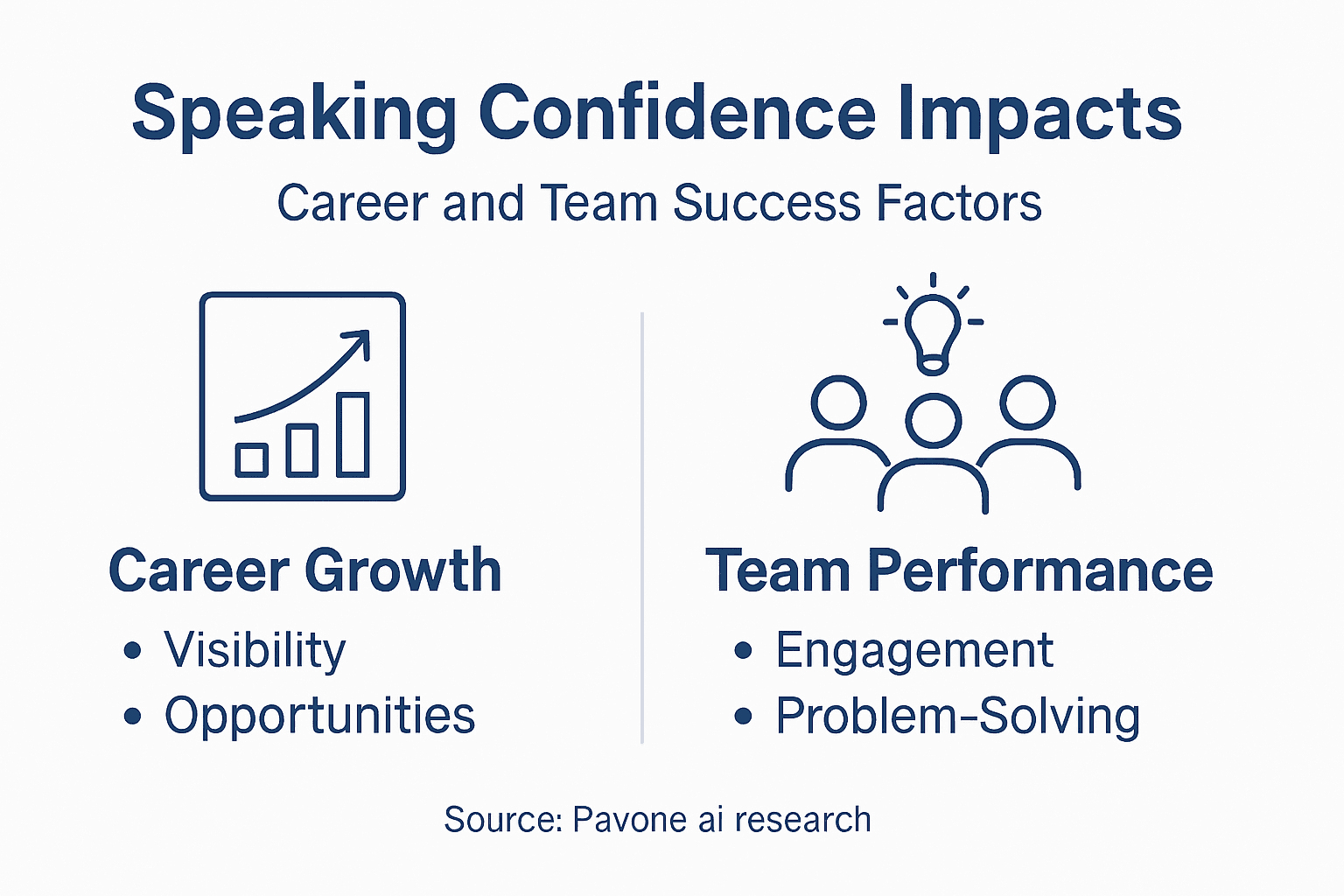
The career implications are substantial. When you speak with confidence in meetings, you gain visibility. People remember what you said. Your ideas get attributed to you rather than absorbed into the collective consciousness. More importantly, confident speakers gain trust and credibility, which opens doors for promotions, leadership roles, and high-stakes projects. You’re not just advancing because you work harder—you’re advancing because decision-makers see you as someone who can represent the company, influence teams, and drive outcomes. Consider also the ripple effect: when you speak confidently, others perceive you as more competent, even when the actual quality of your work hasn’t changed. It’s unfair, perhaps, but it’s how human psychology works.
Then there’s the practical benefit that often gets overlooked. Speaking confidence makes problem-solving faster. When you can articulate what’s actually broken without hedging or seeking permission, teams solve issues quicker. When you can challenge ideas without being defensive, better solutions emerge. When you can ask for what you need in a meeting, projects move forward instead of stalling. These aren’t soft skills that make you feel good. They’re operational advantages that directly impact how quickly your team ships, how effectively you collaborate, and whether your voice gets heard when it matters most.
Here is a summary of how speaking confidence manifests across different workplace scenarios:
| Scenario | Confident Behaviour | Resulting Impact |
|---|---|---|
| One-to-one with manager | Clearly articulates achievements | Gains recognition and advancement |
| Team standup | Shares blockers succinctly | Improves team efficiency |
| Client meeting | Advises authoritatively | Builds client trust and credibility |
| Stakeholder presentation | Tailors message and adapts live | Secures buy-in and fosters alignment |
Pro tip: Next time you’re in a meeting where you usually stay quiet, commit to speaking once in the first five minutes about something you genuinely know, then notice how your anxiety shifts when you realise nothing catastrophic happened.
How Confidence Influences Team Dynamics
Confidence isn’t an individual trait that stays locked inside your head. It spreads. When one person in a meeting speaks with genuine conviction, it shifts the entire room’s energy. People sit up straighter. Others contribute more readily. Ideas build on each other instead of dying in awkward silence. In SaaS teams especially, where collaboration determines whether you ship on time or miss deadlines, the confidence level of individual contributors directly impacts whether the team succeeds or stalls.

Here’s where it gets interesting from a performance perspective. Research on team dynamics shows that confidence increases effort contribution from team members and reduces free-riding behaviour. When one person commits vocally to a goal or outcome, others around them feel accountable too. They can’t hide. The confident person’s commitment becomes the team standard. This isn’t manipulation—it’s a natural psychological response. Someone who speaks clearly about what needs doing, without hedging or apologising for asking, makes it harder for others to slack. They’ve set an expectation through their words and presence. In product teams, this manifests as faster decision-making. In engineering teams, it means blockers get surface and resolved rather than festering silently.
Beyond individual contributions, there’s something more powerful at work: collective efficacy. When multiple team members communicate with confidence, the entire team believes it can accomplish difficult things. Shared team confidence fosters motivation, coordinated action, and positive interpersonal relations, creating a feedback loop where success becomes more likely. Teams with high collective confidence don’t just perform better on metrics—they also experience higher satisfaction and lower burnout. Why? Because people working in an environment where ideas are exchanged confidently, where people speak up without excessive self-doubt, and where contributions are valued feel genuinely valued. The psychological safety that emerges from confident team members actually allows other team members to relax and contribute their best work.
Consider the inverse. In teams where confidence is low, what happens? People self-censor. Necessary information stays hidden. Someone spots a critical flaw in the architecture but stays quiet because they’re not confident enough to challenge the senior engineer. Someone has a better way to approach the sales process but doesn’t mention it because speaking up feels risky. These teams move slower. They miss obvious improvements. They experience higher turnover because people don’t feel heard. The confidence of a few individuals can literally determine whether your entire team operates at 70 percent capacity or 100 percent. This is why investing in individual speaking confidence isn’t a nice-to-have for professional development. It’s infrastructure for team performance.
Pro tip: When you notice a quieter team member has a good idea, explicitly ask them to share it and thank them specifically for speaking up, which reinforces psychological safety and gradually builds their confidence whilst strengthening the team’s collective efficacy.
Reducing Anxiety and Managing Speaking Nerves
Speaking anxiety is real. Your heart races. Your mouth goes dry. Your mind goes blank even though you prepared. This isn’t weakness or lack of competence. Neuroscience shows that the amygdala, your brain’s threat-detection system, can’t distinguish between a predator and a roomful of colleagues waiting for you to speak. Both feel dangerous. The good news is that anxiety management isn’t about eliminating the nerves entirely. It’s about reframing them so they don’t hijack your performance.
The strategies that actually work fall into several categories. Emotional regulation involves recognising what you’re feeling without letting it control your actions. Instead of thinking “I’m terrified, so I can’t do this,” you acknowledge “I feel nervous because I care about this presentation, and that’s normal.” Alongside this, cognitive reappraisal changes how you interpret the physical sensations themselves. That pounding heart isn’t a sign you’ll fail. It’s your body mobilising energy for performance. Inoculation messaging takes this further by helping you reinterpret pre-talk anxiety as something manageable rather than catastrophic, which lowers physical symptoms of anxiety significantly. For SaaS professionals, this shift is practical. You need that adrenaline. You need to be sharp. The anxiety you feel is the same physiological state as excitement. You’re just naming it differently.
Preparation is your second defence mechanism. You cannot think your way out of anxiety, but you can practice your way out of it. When you rehearse your presentation multiple times, record yourself, and get feedback on your pacing and clarity, you’re building procedural memory. Your brain stops requiring conscious effort to retrieve what you want to say. This frees up mental energy that was previously consumed by “What do I say next?” which was fuelling the anxiety spiral. Additionally, seeking social support before and after speaking events reduces isolation. Talking to a colleague about your nervousness or getting feedback after you present normalises the experience. It proves that the catastrophe you imagined didn’t happen.
The practical implementation matters more than understanding the theory. Before your next presentation, try this sequence: spend five minutes on emotional regulation by naming what you feel without judgment, then use cognitive reappraisal by finding one positive interpretation of your nervous energy, then do a final run-through of your opening thirty seconds to activate procedural memory. The combination of these tactics creates a compound effect that measurably reduces anxiety symptoms and improves your actual performance. When you understand how to speak confidently in front of others, these anxiety management techniques become tools rather than panic responses.
The following table compares practical anxiety management techniques and their core benefits for speakers:
| Technique | Core Action | Key Benefit |
|---|---|---|
| Emotional regulation | Labels feelings without judgement | Reduces fear-driven behaviour |
| Cognitive reappraisal | Reframes nerves as positive energy | Transforms anxiety into focus |
| Procedural memory | Rehearses key sections repeatedly | Boosts fluency under pressure |
| Social support | Shares worries and receives feedback | Normalises challenges faced |
Pro tip: Record a one-minute video of yourself presenting tomorrow, then immediately record the same one-minute section again without reviewing the first take, and compare them side by side to see how quickly your anxiety drops once you realise the first attempt didn’t derail you.
Tracking Progress and Sustaining Improvement
Improvement without measurement is just hope. You might feel like you’re getting better at presenting, but feelings deceive. Maybe you’re just more relaxed because the stakes felt lower last time. Maybe you’re comparing yourself to an artificially low baseline from months ago. This is why tracking concrete metrics matters so much for sustained confidence growth. When you measure specific elements of your speaking—filler words, pace, pause length, clarity—you create objective evidence that your effort is working. This evidence is what keeps you practising when motivation dips.
The measurement approach varies depending on your context. For SaaS professionals, the most practical metrics are those that quantify key speaking elements like filler word use and pacing. You might record yourself presenting a feature update and count how many times you say “um” or “like.” Six months later, you do the same presentation and count again. If you’ve dropped from eighteen instances to four, that’s not subjective. You improved. Beyond filler words, track your speaking pace by timing how long you take to deliver the same section—faster or slower pace might indicate different confidence levels depending on your audience. Additionally, record audience engagement cues. How many questions did people ask? Did they maintain eye contact? Did they nod along? These observations provide qualitative data that complements your quantitative metrics.
Building sustained speaking confidence through continuous learning and reflective practice requires establishing routines that keep you progressing. Set specific goals tied to your metrics. Not “become a better presenter” but “reduce filler words to five per minute” or “increase pause length between thoughts by half a second.” These goals connect your daily practice directly to measurable outcomes. Review your recordings monthly, not just after major presentations. This habit prevents regression and catches small deterioration before it compounds. You’ll notice patterns too. Maybe your pace accelerates when discussing certain topics, suggesting underlying anxiety about those areas. Maybe your confidence visibly increases after you’ve done three rehearsals versus one. These patterns become your personal playbook for what actually works.
The psychology of tracking matters as much as the metrics themselves. When you see tangible progress recorded in your system, motivation sustains naturally. You’re not relying on willpower anymore. You’re relying on evidence. This is why professionals who maintain speaking improvement over years tend to be those who document their progress obsessively. They have dashboards. They have spreadsheets. They have recordings indexed by date so they can compare their January delivery to their October delivery side by side. For SaaS professionals especially, this data-driven approach feels natural and credible.
Pro tip: Create a simple spreadsheet with just three columns: date, presentation topic, and three metrics you measured (for example, filler words, average pause length, questions asked), then add one new row after every presentation so you can spot trends over quarters rather than guessing at improvement.
Unlock Your True Speaking Confidence with Pavone.ai
The article highlights how genuine confidence in speaking can transform your professional interactions, reduce anxiety, and boost team dynamics. Yet many struggle to bridge the gap between knowing their content and expressing it with assurance. Common challenges include managing nerves, controlling filler words, adapting to diverse audiences, and tracking real progress over time. If you want to stop relying on guesswork and start building authentic communication skills that resonate in every meeting or presentation, you need actionable insights and measurable feedback.
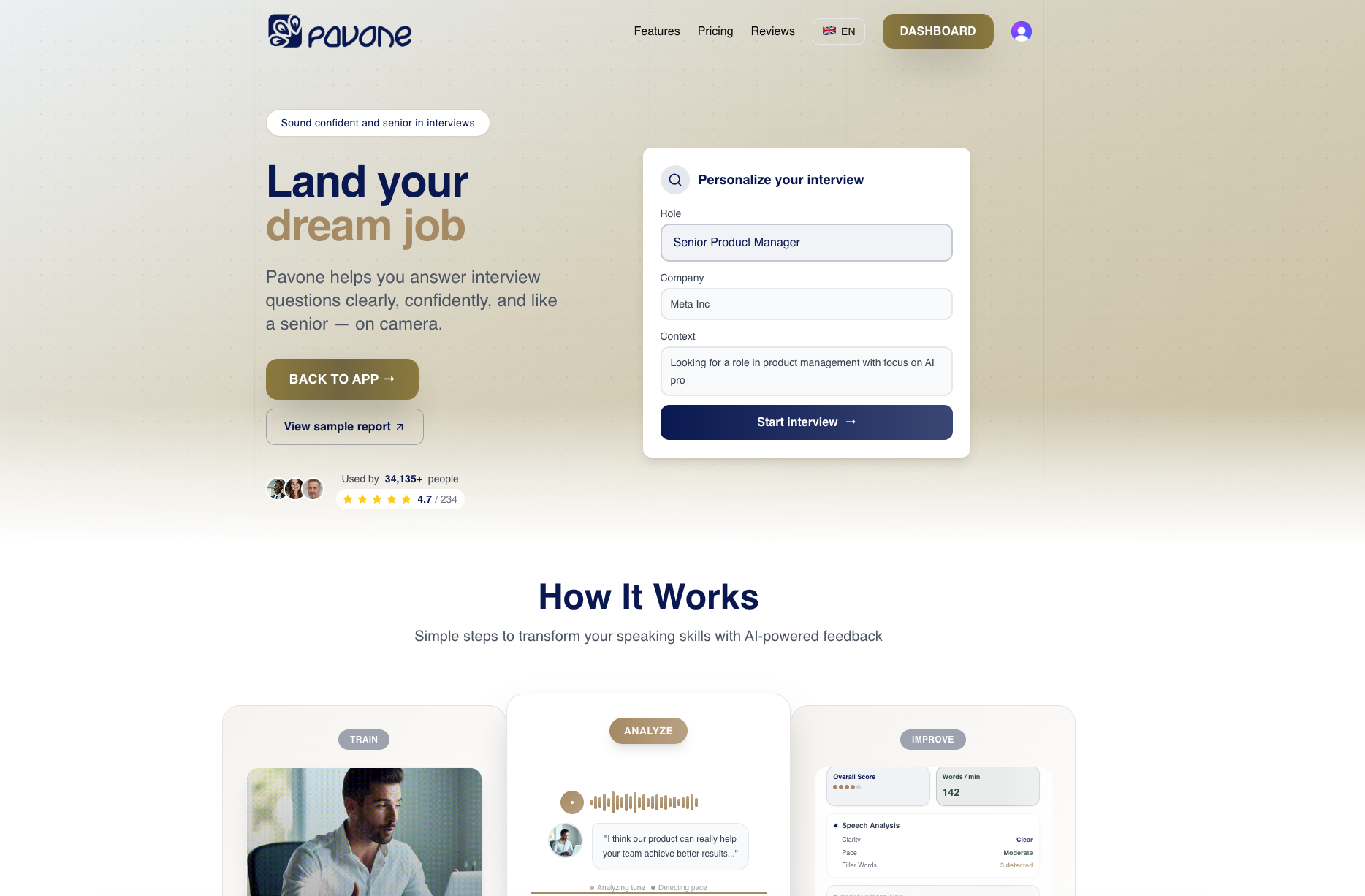
Pavone.ai offers an AI-driven platform designed exactly for professionals who want to enhance their public speaking confidence quickly and effectively. By recording your presentations or conversations, you get immediate, detailed analysis on pace, clarity, tone, and other vital speaking elements mentioned in the article like filler words and pausing. Our dashboard tracks your improvement journey so you can visually see your speaking confidence grow. Experience how tools built for continuous self-improvement align with the practical strategies outlined in the article. Do not wait to elevate your communication skills and influence your team more powerfully. Discover more now at Pavone.ai and start transforming your speaking confidence today.
Frequently Asked Questions
What are the core benefits of having confidence in speaking?
Confidence in speaking enhances communication effectiveness, facilitates better engagement with audiences, increases visibility within teams, and fosters trust and credibility that can lead to career advancement.
How can I measure my progress in developing speaking confidence?
You can track your progress by measuring specific metrics such as the use of filler words, speaking pace, and audience engagement cues. Recording presentations and reviewing them against these metrics over time helps quantify improvement.
What techniques can help reduce anxiety before speaking?
Effective techniques include emotional regulation, cognitive reappraisal to view nerves as positive energy, and thorough preparation through practice and rehearsal to build procedural memory. Social support from colleagues can also mitigate feelings of isolation and anxiety.
How does speaking confidence impact team dynamics?
Speaking confidence positively influences team dynamics by encouraging participation, reducing self-censorship, and contributing to a shared sense of accountability and motivation among team members, which results in better overall performance and satisfaction.
Recommended
Ready to practice?
Start improving your speaking skills with AI-powered feedback and analysis.
Try Pavone Free