
What Is Public Speaking? Core Skills for Professionals

Standing in front of a camera or facing a virtual boardroom no longer means just delivering rehearsed lines. For technology professionals, public speaking has become the gateway to shaping opinions, influencing leadership decisions, and building trust on both technical and personal levels. The impact you make often depends on your ability to inform, engage, and influence in the moment, across a variety of modern communication channels. This guide highlights what really counts in public speaking today, helping you navigate the expectations and build confidence with every audience.
Table of Contents
- What Public Speaking Really Means Today
- Main Types of Public Speaking Explained
- Key Elements of Effective Speaking
- Typical Challenges and How To Overcome Them
- Leveraging AI Feedback for Speaking Success
Key Takeaways
| Point | Details |
|---|---|
| Evolving Public Speaking | Public speaking now includes diverse formats beyond traditional speeches, requiring clarity and engagement across various settings. |
| Types of Speaking | Understand the key types of public speaking—informative, persuasive, entertaining, and demonstrative—to tailor your message appropriately. |
| Effective Speaking Elements | Focus on your word choice, vocal delivery, and body language for creating a cohesive and impactful presentation. |
| Overcoming Challenges | Address common challenges like stage fright by practising thoroughly, varying vocal delivery, and increasing exposure in lower-stakes environments. |
What Public Speaking Really Means Today
Public speaking has fundamentally shifted from what many envision. It’s no longer confined to standing at a podium delivering a formal speech to a seated audience. Today, public speaking encompasses everything from persuading decision-makers in boardrooms to presenting technical findings in virtual meetings, pitching ideas to investors, or building influence through online channels. For technology professionals, this expansion means your speaking skills directly determine how your ideas gain traction, how your team responds to your direction, and ultimately, how far your career advances.
The modern definition embraces multiple dimensions that your career will demand. You might present quarterly performance reviews to senior leadership, explain complex technical architecture to non-technical stakeholders, lead cross-functional project kickoffs, contribute to industry conferences, or represent your organisation in client relationships. Each situation requires you to inform, engage, and influence different audiences through distinct formats. A product demo demands different skills than a board presentation, which demands different skills than a team stand-up. How you speak confidently across these varied scenarios determines whether you appear competent, convincing, and capable of leadership.
What makes today’s public speaking particularly challenging for technology professionals is the expectation of clarity combined with credibility. Your audience increasingly expects you to translate complexity into clarity without oversimplifying. They want proof you understand your subject matter deeply, yet present it accessibly. They judge not just your words, but your delivery patterns, your vocal confidence, your ability to handle interruptions, and your presence on camera. The stakes have risen because remote work, video conferencing, and asynchronous communication have amplified how much your delivery impacts perception. A stuttering phrase, filler words, or hesitant tone registers more noticeably in a Zoom call than it would in a crowded conference room.
Pro tip: Record one presentation, meeting, or pitch this week and review it with focus on three things: your pacing, your use of filler words like “um” or “ah”, and whether you maintained natural eye contact with the camera or audience. Identifying these patterns now gives you concrete areas to improve rather than vague feelings of discomfort.
Main Types of Public Speaking Explained
Not all speaking situations are created equal. Understanding the distinct types of public speaking helps you tailor your approach, content structure, and delivery style to match what your audience actually needs. Technology professionals often move between these types within a single week without fully realising the shift. The main types of public speaking include informative, persuasive, entertaining, and demonstrative, each serving a different purpose and requiring different preparation strategies.
Informative speaking forms the backbone of your work as a technology professional. You use this type when presenting technical findings to your team, explaining how a new system works, or sharing research results with stakeholders. Your goal is straightforward: help your audience understand something complex or unfamiliar. You’re not trying to change their mind or entertain them. Persuasive speaking, by contrast, demands emotional appeal combined with logic. When you pitch a new project to leadership, argue for additional resources, or convince clients to adopt your proposed solution, you’re engaging in persuasive communication. You’re appealing to both rational and emotional motivations to move people toward a specific decision or action.
Entertaining and demonstrative speaking round out your toolkit, though they appear less frequently in technical roles. Entertaining speeches use humour, storytelling, and engaging delivery to keep audiences engaged whilst you make a point. Think conference keynotes or team celebrations where you share lessons from a project failure using self-deprecating humour. Demonstrative speaking shows people how to do something, step by step. When you conduct a software walkthrough, lead a technical workshop, or teach colleagues a new process, you’re demonstrating. These types often overlap in real situations. You might demonstrate a feature (demonstrative) whilst persuading someone it solves their problem (persuasive) using a relatable story (entertaining). Recognising which type dominates your purpose allows you to emphasise the delivery techniques that matter most.
Here is a concise overview of how the main types of public speaking differ in purpose and crucial skills:
| Speaking Type | Core Purpose | Examples | Key Skill Required |
|---|---|---|---|
| Informative | Share knowledge or data | Project updates, technical briefs | Clarity and simplicity |
| Persuasive | Influence beliefs or decisions | Project pitches, resource arguments | Emotional appeal, logic |
| Entertaining | Engage and amuse the audience | Keynote stories, celebration remarks | Storytelling, humour |
| Demonstrative | Teach a process or method | Product walk-throughs, workshops | Step-by-step clarity |
Pro tip: Before your next presentation, identify which type dominates your content, then record yourself delivering just the opening 60 seconds and listen for whether your tone, pace, and language match that speaking type—informative speaking requires clearer, slower pacing whilst persuasive speaking benefits from more vocal variety and strategic pauses.
Key Elements of Effective Speaking
Effective speaking rests on three interconnected pillars that work together to shape how your message lands. Your choice of words, the quality of your voice, and your physical presence all communicate simultaneously to your audience. When one of these elements falters, it undermines the others. You might have brilliant technical insight, but if your pacing is rushed, your audience misses the nuance. You might use clear language, but if your body language appears closed off, people question your conviction. The combination matters more than perfection in any single area.

Word choice and clarity form your foundation. Technology professionals often slip into jargon without realising it creates distance from non-technical audiences. Simple language paired with specific examples works better than complex terminology. When you describe a database query to a product manager, avoid diving into algorithmic complexity. Instead, use analogies they recognise. Your vocal delivery determines whether people stay engaged or mentally drift away. This encompasses pace, which should slow down when presenting complex ideas and quicken when building energy. Vocal variety prevents monotone delivery that lulls audiences to sleep. Tone communicates your attitude toward the content. If you sound uncertain about your own proposal, listeners pick up that signal immediately. Pauses give audiences time to process and create emphasis around key points.
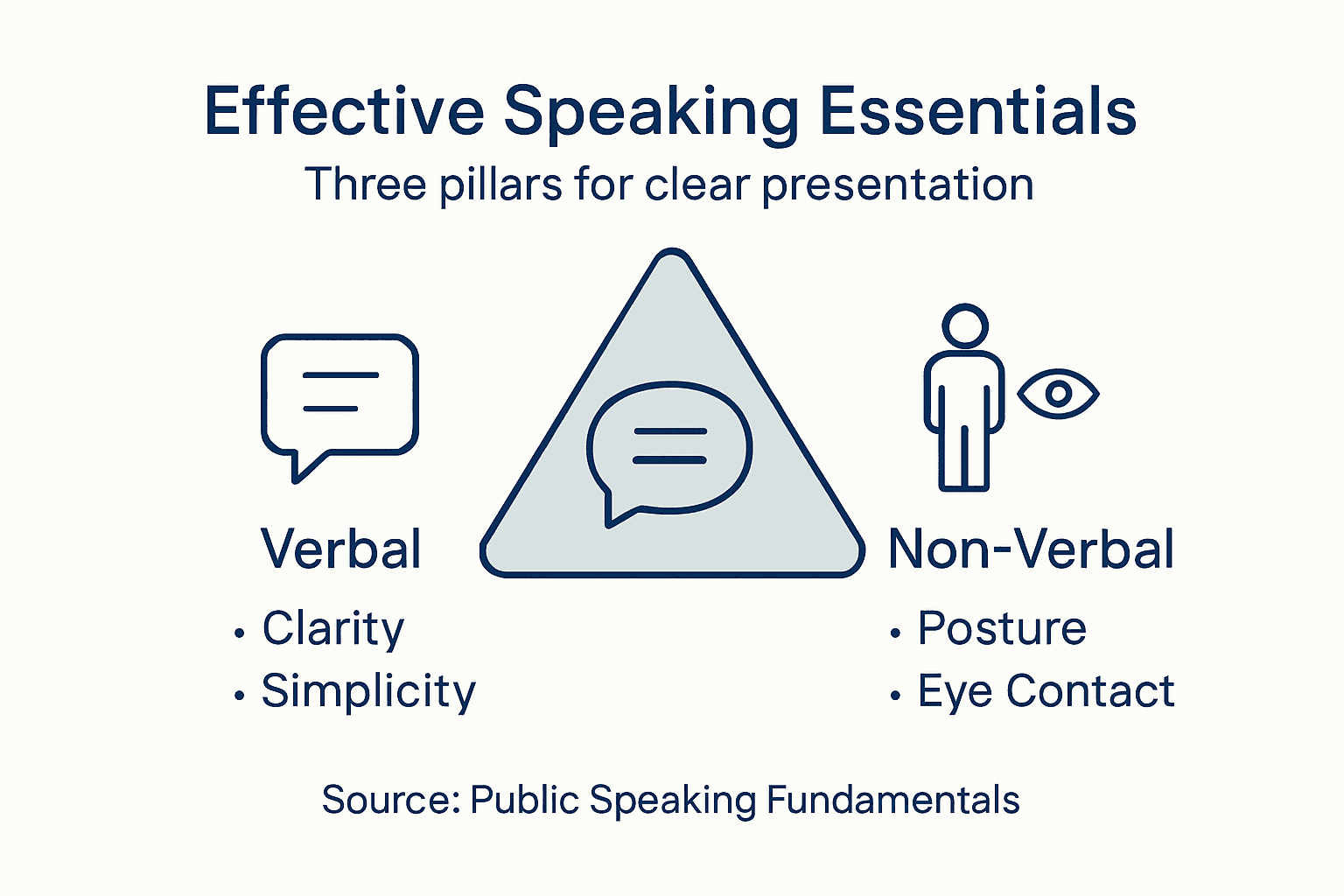
Your body language and eye contact reinforce every word you speak. Posture signals confidence or uncertainty before you open your mouth. Gestures that feel natural help explain complex concepts visually. Eye contact builds trust and keeps attention. In virtual meetings, looking at your camera rather than the screen maintains that connection. Facial expressions convey emotion and sincerity. If you announce good news with a flat expression, your audience experiences cognitive dissonance. For technology professionals presenting to senior leadership or clients, these non-verbal signals often matter more than you realise. People remember how you made them feel far longer than the specific technical details you shared. The goal is alignment: your words, voice, and body language all pointing toward the same message.
Pro tip: Record yourself delivering a 90-second explanation of something you know well, then watch it with the sound off and notice what your body language alone communicates, then watch it again with eyes closed and listen to what your voice conveys independently—misalignment between these two channels reveals where to focus your improvement.
Typical Challenges and How To Overcome Them
Almost every technology professional experiences nervousness before presenting. That physical sensation—elevated heart rate, trembling hands, dry mouth—isn’t a sign you’ll fail. It signals your brain is preparing for something important. The real challenge lies in managing these sensations so they don’t derail your delivery. Common public speaking challenges include stage fright, lack of confidence, poor organisation, and monotonous delivery, yet each has actionable solutions. Stage fright typically stems from insufficient preparation or unfamiliarity with your material. The antidote is thorough rehearsal. Not the kind where you memorise word-for-word, but the kind where you know your content so deeply that your nervous system relaxes. When you can discuss your technical architecture without notes because you built it and understand every component, confidence naturally follows. Record yourself practising. Listen for filler words, rushed pacing, and unclear explanations. Each iteration improves your delivery.
Monotonous delivery kills audience engagement faster than any technical error. Your voice becomes the vehicle for maintaining interest. Practise deliberate pace variation. Slow down when introducing complex concepts to give your audience time to absorb. Speed up slightly when building momentum or excitement. Add pauses after key points, creating space for information to land. These aren’t tricks; they’re how conversation naturally works when we’re engaged with a topic. Many technology professionals struggle with this because technical content feels safer when delivered robotically. But robotic delivery alienates your audience and makes complex ideas harder to follow, not easier. Speak about your work the way you’d explain it to a colleague over coffee: with natural enthusiasm and conversational rhythm.
Psychological barriers like self-doubt and linguistic anxiety require a different approach. If English isn’t your first language, you might catastrophise about accents or grammatical imperfection. Your audience cares far more about understanding your ideas than hearing perfect pronunciation. Accent is not a flaw; it’s part of who you are. Confidence grows through progressive exposure. Start practising in lower-stakes situations: team meetings, small group discussions, lunch presentations to colleagues. Build toward larger audiences as your comfort increases. Knowledge gaps create legitimate anxiety. If you’re presenting something you only partially understand, your nervous system detects that inconsistency. Never present material you haven’t thoroughly studied. If you’re presenting someone else’s research, own it completely by understanding the reasoning, methodology, and implications. This transforms you from a presenter reading slides into an expert explaining a concept.
To help technology professionals overcome common public speaking obstacles, review this summary of effective strategies:
| Challenge | Why It Happens | Practical Solution |
|---|---|---|
| Stage fright | Lack of rehearsal or clarity | Practise deeply, not word-perfect |
| Monotonous delivery | Over-reliance on safe tone | Vary pace, add vocal energy |
| Confidence issues | Self-doubt, limited exposure | Start with low-risk settings |
| Audience disconnect | Excessive jargon, closed body | Use simple language, open posture |
Pro tip: Identify your biggest speaking challenge, then schedule one small, deliberate practice session this week in a lower-stakes environment where you can specifically target that weakness—whether it’s pacing, filler words, or eye contact—and record it to track improvement.
Leveraging AI Feedback for Speaking Success
Traditional public speaking improvement relies on finding time with a coach, scheduling feedback sessions, and waiting for analysis. Modern technology professionals have a faster option. AI-powered speech analysis tools provide immediate, detailed feedback on your delivery without requiring a scheduled appointment or another person’s availability. These tools transcribe your speech, analyse your vocal patterns, assess your pacing and clarity, and identify specific areas for improvement. The advantage is speed and consistency. You can record a presentation at midnight, receive comprehensive feedback in seconds, and practise again before your team meeting tomorrow morning.
AI-powered systems evaluate pronunciation, grammar, fluency, and speaking confidence through advanced speech analysis. Rather than generic advice like “slow down” or “use better eye contact”, AI tools identify precise patterns. You might discover you rush through technical explanations but drag out transitions, or that your filler words cluster at the start of sentences when you’re thinking about what comes next. This specificity matters because you can target exactly where to focus. If your pacing is already strong but your vocal variety needs work, you know to practise tone modulation rather than wasting time on pace exercises. The tools track progress across multiple recordings, showing you whether your improvements actually stick or revert under pressure.
However, AI feedback works best alongside human insight. Machines excel at measuring objective metrics like speech rate, pause frequency, and filler word usage. They struggle with nuance. An AI might flag that you paused frequently, but a human coach recognises those pauses were strategic, giving your audience time to absorb complex technical information. AI can tell you that your facial expressions were minimal, but cannot assess whether that minimalism suited your technical presentation or undermined your credibility. The optimal approach combines both. Use AI for the repetitive technical feedback, allowing you to identify and correct patterns independently. Reserve conversations with mentors or coaches for feedback on the subtle elements: whether your storytelling resonated, whether you adjusted your approach based on audience reactions, whether your overall presence conveyed expertise. This hybrid model lets you improve faster whilst building the deeper speaking skills that distinguish exceptional presenters from adequate ones.
Pro tip: Record a short explanation of your current project using whatever AI tool is available to you, review the feedback focusing on one specific metric like filler words or pacing, then re-record the same explanation with deliberate focus on improving just that element and compare the two recordings side by side.
Master Your Public Speaking Skills with AI-Powered Insights
The challenge of transforming nervousness, jargon-filled explanations, and monotonous presentations into confident, clear, and engaging communication is real for many professionals. This article highlights common obstacles such as managing pacing, eliminating filler words, and maintaining eye contact especially in virtual environments. These issues often slow career progress and reduce the impact of your valuable ideas. If you are determined to overcome these barriers and develop the core public speaking skills that demand clarity, confidence, and connection, we have the perfect solution.
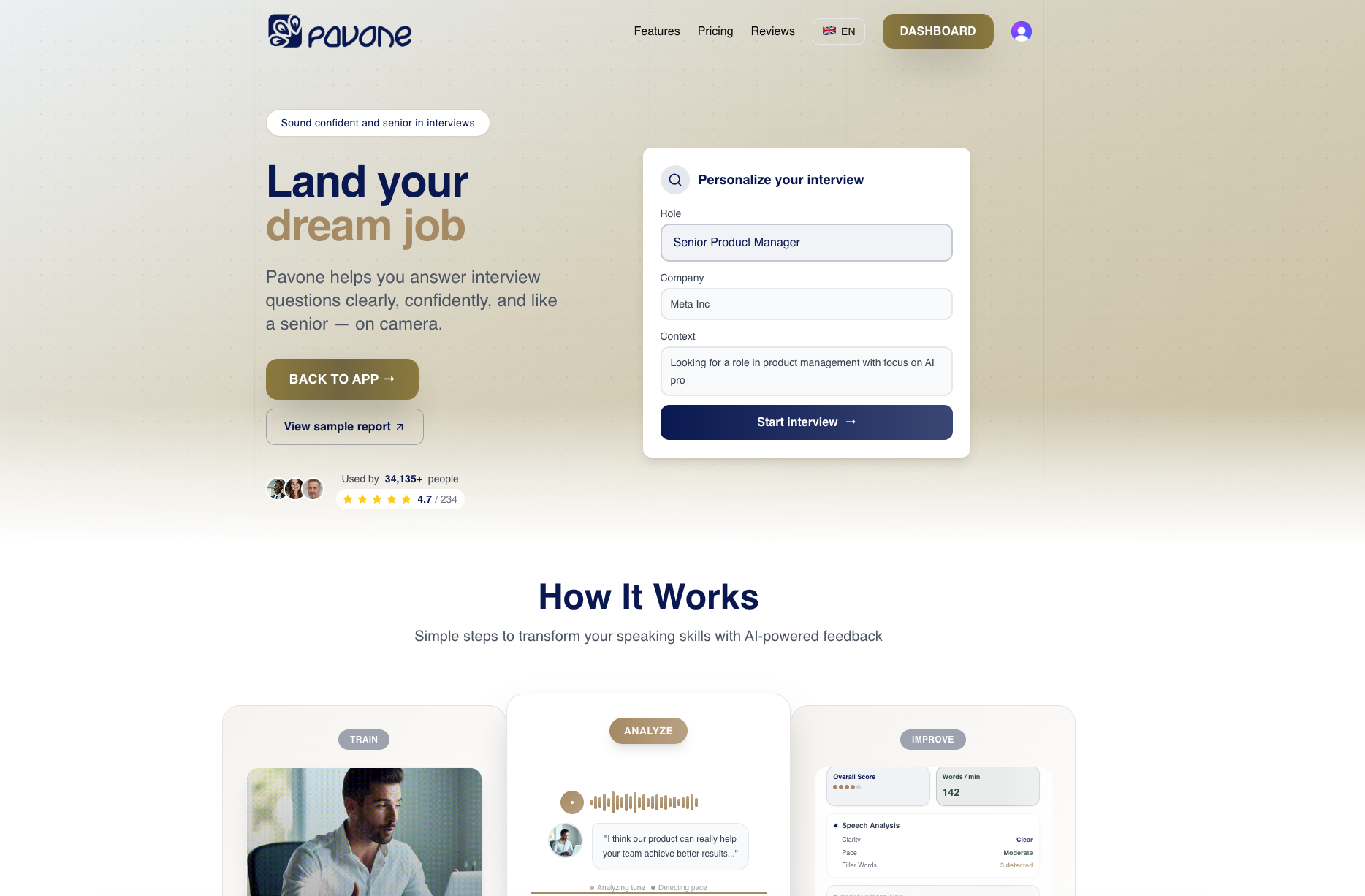
Experience the power of Pavone.ai, a cutting-edge SaaS platform designed to help you improve your public speaking through AI-driven, personalised feedback. Record your presentations or pitches and receive instant, detailed analysis on your vocal delivery, word choice, and non-verbal cues. Track your progress over time and practice efficiently with insights that focus on your unique challenges from pacing to emotional appeal. Start your journey towards compelling, persuasive speaking today by visiting Pavone.ai. Discover how AI technology combined with intuitive design empowers you to become a more articulate and confident communicator with ease.
Frequently Asked Questions
What does public speaking involve today?
Public speaking today involves a broad range of activities, including presenting information in meetings, pitching ideas to clients, and influencing audiences through various formats such as virtual presentations and team updates.
What are the main types of public speaking?
The main types of public speaking include informative, persuasive, entertaining, and demonstrative speaking, each serving distinct purposes and requiring different skills to effectively engage audiences.
How can I improve my public speaking skills?
To improve your public speaking skills, practice recording yourself, focus on your pacing, clarity, and body language, and consider utilising AI feedback tools to pinpoint specific areas for enhancement.
What challenges do technology professionals face in public speaking?
Technology professionals often face challenges such as stage fright, maintaining audience engagement, and overcoming the use of complex jargon that can alienate non-technical audiences.
Recommended
Ready to practice?
Start improving your speaking skills with AI-powered feedback and analysis.
Try Pavone Free