
Why Communication Skills Matter for Marketers

Standing before a group of clients or colleagues, even the most seasoned marketing professional can feel their confidence waver. Strong communication skills mean far more than just speaking clearly—they are the cornerstone of building trust, sharing strategy, and engaging your audience fully. Learning to master both verbal and non-verbal cues, as well as adapting messages for different settings, transforms presentations and pitches into moments of genuine connection. Effective communication gives every message greater clarity and impact.
Table of Contents
Key Takeaways
| Point | Details |
| Importance of Communication Skills | Communication in marketing is a complex process that goes beyond dialogue, involving strategic message design that resonates with audiences. |
| Types of Communication | Marketers must master various channels, including verbal and written communication, to effectively convey their messages to different audiences. |
| Key Traits of Effective Communicators | Successful marketers exhibit empathy, active listening, and adaptability, which enhance audience engagement and understanding. |
| Avoiding Common Pitfalls | Marketers should simplify narratives and adapt to cultural differences to overcome communication barriers and ensure emotional resonance in their messaging. |
Defining Communication Skills in Marketing Context
In marketing, communication skills represent far more than simple dialogue. They encompass a sophisticated process of crafting and delivering messages that resonate with specific audiences. Understanding the communication process reveals the intricate mechanics behind effective marketing interactions.
Marketing communication involves multiple interconnected elements: the sender encoding a message, selecting an appropriate communication medium, transmitting that message, and ultimately ensuring the receiver comprehends the intended meaning. Successful marketers recognise that communication is not merely about speaking, but about strategic message design that considers context, audience psychology, and potential barriers to understanding.
Effective marketing communication requires mastering both verbal and non-verbal techniques. This includes understanding tone, body language, presentation style, written communication clarity, and the ability to adapt messaging across different platforms and audience segments. Effective communication theory suggests that marketers must develop nuanced skills to translate complex ideas into compelling, accessible narratives.
Pro Tip: Practice active listening and message refinement by recording your presentations and analysing them for clarity, pace, and audience engagement.
Types of Communication in Professional Settings
Professional communication encompasses several distinct yet interconnected channels that marketers must master to effectively convey their messages. Professional communication types range from written and verbal to digital and visual methods, each serving unique purposes in workplace interactions.
Verbal communication remains a cornerstone of professional interaction. This includes face-to-face meetings, telephone conversations, presentations, and team briefings. Professional communication channels reveal that verbal communication allows for immediate feedback, nuanced tone interpretation, and complex idea exchange. Marketers must develop strong verbal skills to articulate strategies, pitch ideas, and build relationships with clients and colleagues.
Written communication represents another critical domain. Marketing professionals frequently utilise emails, reports, proposals, social media content, and official documentation to communicate complex information. These written communications demand precision, clarity, and an understanding of audience expectations. Effective written communication requires careful word choice, structured arguments, and the ability to translate technical information into accessible language.
Pro Tip: Develop a communication audit system where you regularly review and analyse your written and verbal communication for clarity, concision, and audience impact.
Core Traits of Effective Communicators
Successful communicators possess a nuanced set of skills that transcend basic dialogue. Communication competence involves more than mere verbal exchange—it requires strategic adaptability, emotional intelligence, and a profound understanding of interpersonal dynamics.
At the heart of effective communication lies empathy—the ability to understand and connect with others’ perspectives. Marketers who can genuinely comprehend their audience’s emotional landscape can craft messages that resonate deeply. Effective communication strategies emphasise that true connection happens when communicators move beyond transmitting information to creating meaningful understanding.

Key traits of exceptional communicators include active listening, clarity of expression, adaptability, and emotional self-regulation. These professionals can read subtle nonverbal cues, adjust their communication style instantaneously, and maintain composure under pressure. They understand that communication is a dynamic, multi-layered process involving verbal and non-verbal elements, requiring continuous refinement and cultural sensitivity.
Here is a summary of key communication traits and their marketing relevance:
| Communicator Trait | Description | Impact in Marketing |
| Active Listening | Fully focusing on speaker’s message | Enhances audience engagement |
| Adaptability | Adjusts style for different audiences | Improves message effectiveness |
| Emotional Intelligence | Recognises and manages emotions | Strengthens client rapport |
| Clarity of Expression | Delivers messages in an understandable way | Reduces miscommunication |
| Reflective Listening | Paraphrases to confirm understanding | Builds team trust |
Pro Tip: Practice reflective listening by paraphrasing what others have said before responding, which demonstrates understanding and builds trust.
Impact on Client Pitches and Team Success
Communication skills are the linchpin of successful client interactions and team dynamics in marketing. Effective teamwork and communication directly correlate with performance, transforming how marketing teams collaborate and deliver results.
In client pitches, communication becomes a critical differentiator. Marketers must strike a delicate balance between showcasing credentials and conveying genuine passion. Startup pitch strategies demonstrate that investors and clients are more attracted to clear, specific, and emotionally compelling narratives than to dry recitations of achievements. The ability to articulate value propositions with precision and enthusiasm can mean the difference between winning and losing a potential opportunity.
Team success hinges on robust communication channels that facilitate seamless information exchange, mutual understanding, and collective problem-solving. High-performing marketing teams cultivate an environment where ideas flow freely, feedback is constructive, and individual strengths are recognised and leveraged. This requires not just technical communication skills, but also emotional intelligence, active listening, and the capacity to adapt communication styles to diverse team members and stakeholders.
Pro Tip: Practice the “two-minute rule” in team meetings: each team member gets two uninterrupted minutes to share insights, challenges, or ideas, ensuring everyone’s perspective is heard and valued.
Common Pitfalls and How to Overcome Them
Marketing communication is fraught with potential obstacles that can derail even the most well-intentioned messaging. Barriers to effective communication reveal complex challenges ranging from psychological filters to environmental distractions that can significantly impede message transmission.
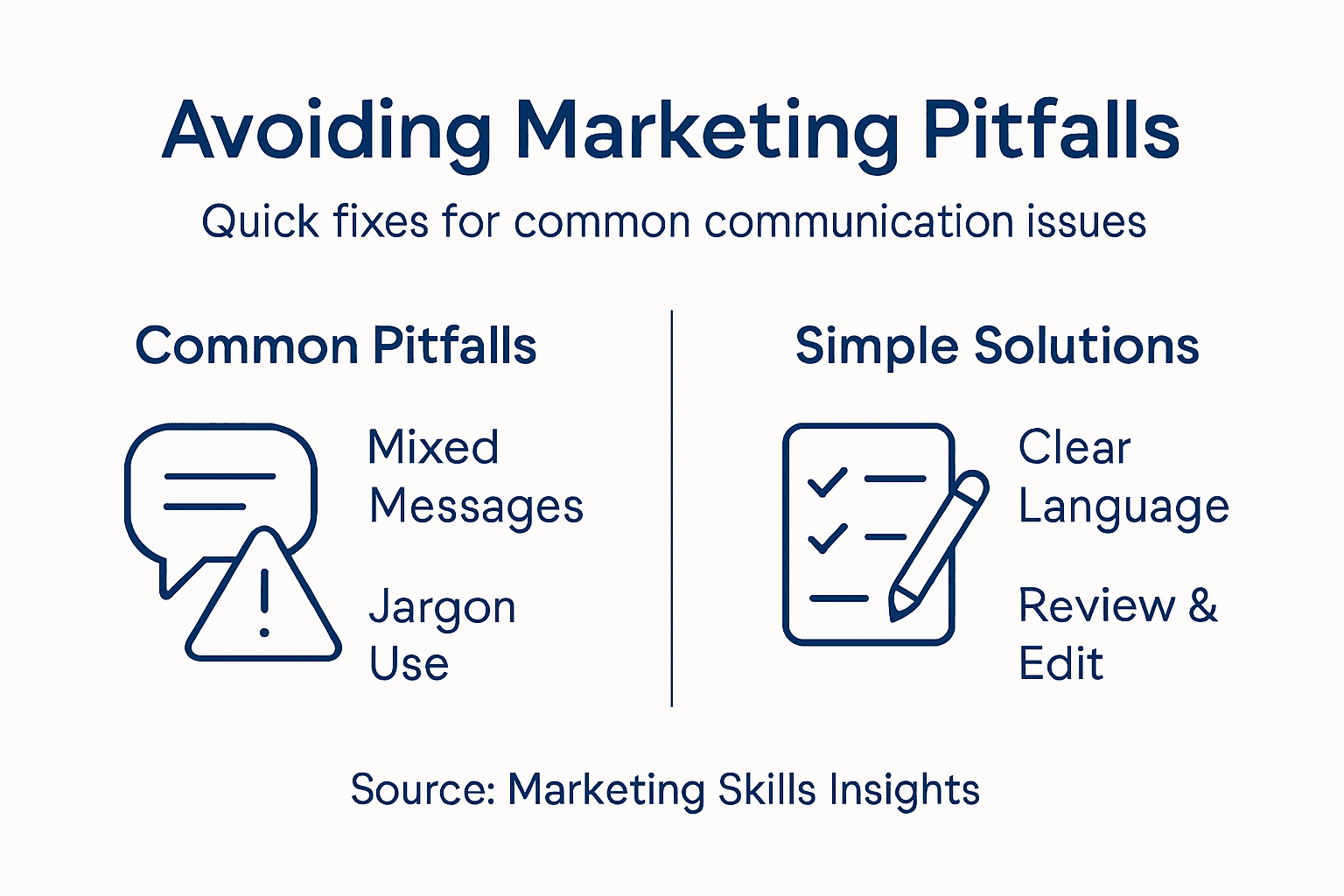
Storytelling represents a particularly nuanced communication arena where marketers frequently stumble. Marketing communication pitfalls often emerge from a lack of authenticity, insufficient emotional resonance, or ineffective narrative structure. Marketers tend to either overcomplicate their narratives or fail to create genuine connections, resulting in messages that feel manufactured rather than compelling.
Communication challenges also manifest through language complexity, cultural misunderstandings, and ineffective channel selection. Successful marketers learn to decode these barriers by developing heightened emotional intelligence, practicing active listening, and cultivating adaptability. This requires continuous self-reflection, willingness to receive feedback, and strategic communication skills that transcend traditional linear messaging models.
The following table compares common marketing communication pitfalls with practical solutions:
| Pitfall | Typical Cause | Solution |
| Overcomplicated Narratives | Excess jargon or detail | Simplify language, focus story |
| Cultural Misunderstandings | Ignoring audience differences | Research and adapt to context |
| Lack of Emotional Resonance | Factual, dry delivery | Use relatable examples |
| Channel Mismatch | Ineffective platform selection | Match message to medium |
Pro Tip: Record and review your professional communications periodically, focusing on identifying unconscious communication habits that might be undermining your message clarity and impact.
Elevate Your Marketing Communication Skills with Pavone.ai
The article highlights how vital clear, adaptable, and emotionally intelligent communication is for effective marketing. If you struggle with crafting compelling narratives, mastering active listening, or delivering client pitches that truly connect, you are not alone. The challenge of refining your verbal and non-verbal skills to enhance audience engagement is where many marketers find themselves seeking support. With Pavone.ai, you gain access to an AI-powered platform designed to analyse and improve exactly those aspects—clarity, tone, pace, and confidence—that make all the difference in professional communication.

Take control of your growth by recording your presentations or conversations on Pavone.ai and receive instant feedback tailored to your unique speaking style. This simple, interactive tool transforms feedback into actionable insights so you can overcome common pitfalls like overcomplicated narratives and lack of emotional resonance. Don’t wait for the next client pitch or team meeting to test your skills. Visit Pavone.ai today to start tracking your progress and become the confident, articulate marketer your audience deserves. Unlock your full communication potential now.
Frequently Asked Questions
What are the key components of effective communication skills in marketing?
Effective communication skills in marketing involve crafting and delivering messages that resonate with specific audiences, utilising verbal and non-verbal techniques, and considering factors like audience psychology and potential barriers to understanding.
How can marketers improve their communication skills?
Marketers can improve their communication skills by practising active listening, refining their message through analysis, using clarity in written communications, and adapting their style to different audiences and platforms.
Why is emotional intelligence important for marketers?
Emotional intelligence allows marketers to connect with their audience on a deeper level, recognise and manage emotions, and build rapport, which is crucial for crafting compelling messages and winning client trust.
What are common pitfalls in marketing communication and how can they be avoided?
Common pitfalls include overcomplicated narratives, cultural misunderstandings, and lack of emotional resonance. To avoid these, marketers should simplify their language, research their audience, and ensure relatable and authentic storytelling.
Recommended
Ready to practice?
Start improving your speaking skills with AI-powered feedback and analysis.
Try Pavone Free