
Interviewing for Mid and Senior Roles: Succeed with Confidence

Facing tough interview panels at tech startups can unsettle even seasoned professionals from Singapore, Germany, or Brazil. Defining your leadership narrative with precision sets you apart and demonstrates your growth as a leader. For non-native English speakers, mastering advanced interview responses and refining delivery is key to unlocking senior roles. This guide brings together proven strategies and research-backed frameworks, helping you communicate your professional story authentically and confidently.
Table of Contents
- Step 1: Define Your Leadership Narrative Clearly
- Step 2: Practise Responding to Advanced Interview Questions
- Step 3: Refine Your Delivery for Clarity and Confidence
- Step 4: Analyse and Act on Targeted Feedback
- Step 5: Verify Progress by Rehearsing Under Real Conditions
Quick Summary
| Key Point | Explanation |
|---|---|
| 1. Define Your Leadership Narrative | Craft a narrative that highlights your core values, challenges overcome, and leadership evolution for impactful communication during interviews. |
| 2. Prepare for Advanced Questions | Use structured methods, like the STAR technique, to articulate your problem-solving and strategic thinking in response to complex interview questions. |
| 3. Refine Your Delivery | Practice emphasising clear communication, steady eye contact, and confident body language to make a strong impression in interviews. |
| 4. Act on Feedback | Use feedback to identify improvement areas, recognising patterns and creating action plans to support personal development and professional growth. |
| 5. Simulate Real Interview Conditions | Conduct mock interviews with varied questions under pressure to enhance your adaptability and refine your communication style. |
Step 1: Define your leadership narrative clearly
Crafting a compelling leadership narrative transforms how senior professionals present themselves during interviews. Your narrative goes beyond a simple career summary—it reveals the essence of who you are as a leader, what drives you, and how you’ve grown through professional challenges.
To develop a powerful leadership story, start by reflecting on your pivotal career moments. Leadership stories often emerge from transformation points that showcase your values, resilience, and personal growth. Consider these key elements when constructing your narrative:
- Identify your core values that consistently guide your leadership approach
- Highlight significant professional challenges you’ve successfully navigated
- Demonstrate the impact your leadership has had on teams and organisations
- Show your evolution as a professional and leader
The most effective narratives are authentic and structured. Meaningful storytelling communicates leadership philosophy through personal experiences that reveal your unique perspective. Your goal is to craft a story that resonates emotionally while providing concrete evidence of your leadership capabilities.
Practice articulating your narrative concisely. During interviews, you’ll want to communicate your leadership journey in 2-3 minutes, highlighting transformative moments that demonstrate your professional growth and potential.
Your leadership narrative is not just a story—it’s a strategic tool for showcasing your professional identity and potential.
Expert advice: Practice your leadership narrative in front of a mirror or record yourself to refine your delivery and ensure you sound confident and authentic.

Step 2: Practise responding to advanced interview questions
Advanced interviews demand sophisticated communication strategies that go beyond standard preparation. Your goal is to demonstrate nuanced problem-solving skills and strategic thinking through carefully crafted responses.
Preparing for complex interview questions requires a systematic approach that helps you articulate your professional experiences with confidence and clarity. Start by identifying the core competencies typically tested in senior-level interviews:
- Leadership decision-making scenarios
- Strategic problem-solving challenges
- Conflict resolution and team management
- Complex organisational change situations
Develop a structured method for answering behavioural and situational questions. Use the STAR method (Situation, Task, Action, Result) to frame your responses, ensuring you provide concrete examples that showcase your professional capabilities. This approach transforms abstract experiences into compelling narratives that demonstrate your leadership potential.
Advanced interview preparation is not about memorising answers, but developing the capability to think critically and communicate strategically in real-time.
Practice your responses by recording yourself or working with a trusted colleague who can provide honest feedback. Pay attention to your communication style, ensuring you balance technical depth with clear, concise storytelling.
Here is a comparison of structured interview response frameworks that senior professionals should consider:
| Framework | Main Focus | Typical Use Case |
|---|---|---|
| STAR | Problem-solving & results | Describing achievements and actions taken |
| CAR | Challenge & impact | Highlighting how you overcame key obstacles |
| SBI (Situation-Behaviour-Impact) | Feedback analysis | Analysing feedback for personal development |
Expert advice: Simulate interview conditions by practising advanced questions under time pressure, which will help you develop the mental agility needed for high-stakes professional conversations.
Step 3: Refine your delivery for clarity and confidence
Delivering a polished and confident interview performance requires more than just knowing your content—it demands strategic communication skills. Your objective is to present your professional narrative with precision, composure, and authenticity.
Strategies for delivering clear interview responses are crucial for making a memorable impression on senior interviewers. Focus on developing communication techniques that demonstrate your professional capabilities:
- Maintain steady eye contact
- Speak with measured pace
- Use concise and impactful language
- Display confident body language
- Manage vocal tone and energy
Practice active listening and respond thoughtfully, avoiding rushed or overly rehearsed answers. Your goal is to sound natural while showcasing your strategic thinking. Be prepared to elaborate on key points without meandering, and learn to pivot smoothly if an answer isn’t landing as intended.
Confident communication is not about being perfect, but about being authentic and adaptable in your professional dialogue.
Pay close attention to your non-verbal cues. Your physical presence communicates as much as your words, so practice maintaining an open, engaged posture that reflects your professional confidence.
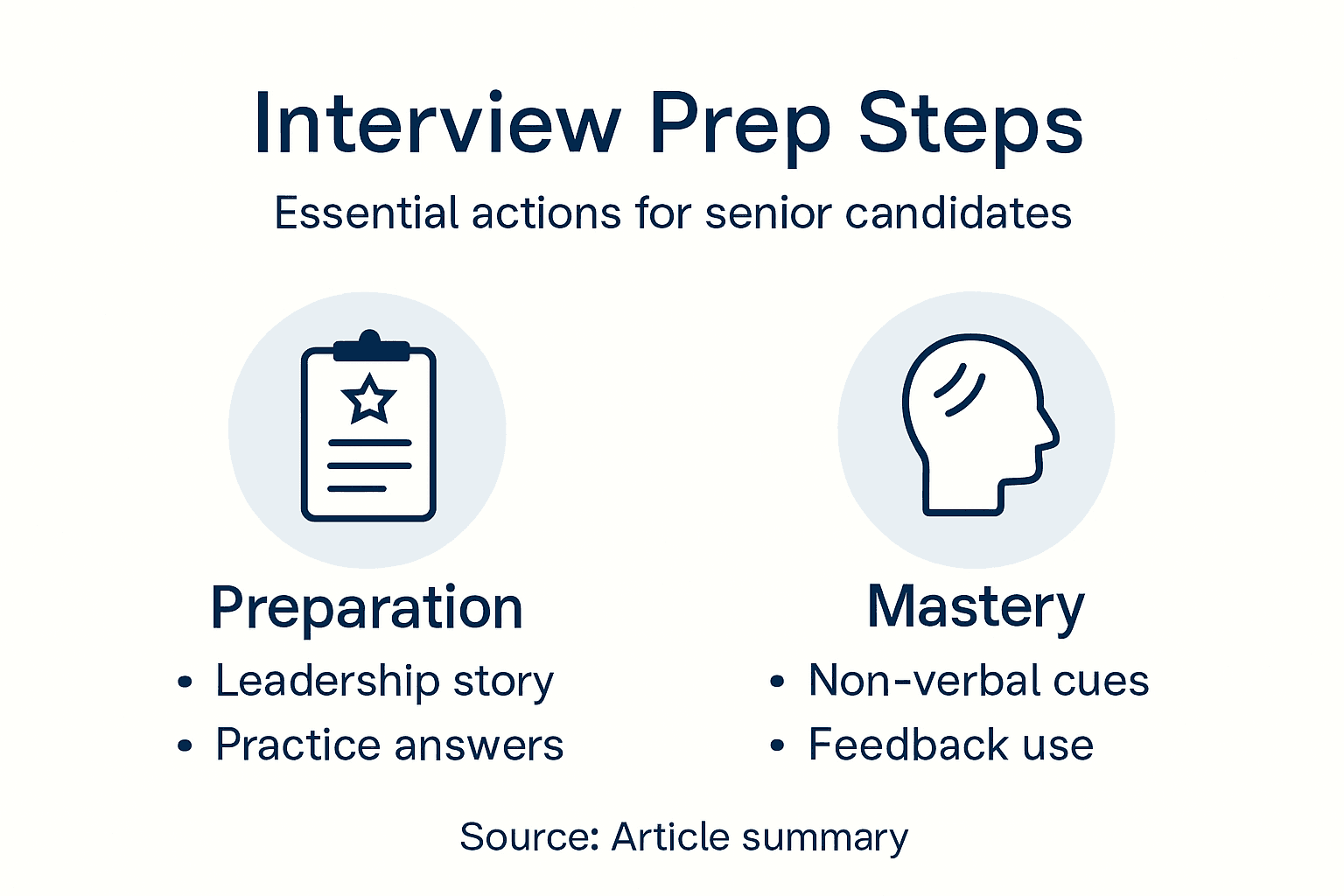
Expert advice: Record yourself during practice interviews to identify subtle communication patterns and areas for improvement, allowing you to refine your delivery with objective self-awareness.
Step 4: Analyse and act on targeted feedback
Navigating professional growth requires a strategic approach to understanding and implementing targeted feedback. This step is about transforming external perspectives into meaningful personal development opportunities that elevate your leadership potential.
Structured feedback frameworks for leadership development provide critical insights into your professional performance. Implement these key strategies to analyse feedback effectively:
- Approach feedback with an open mindset
- Seek specific, actionable insights
- Identify patterns across multiple perspectives
- Distinguish between constructive critique and personal opinion
- Create a systematic action plan for improvement
The Situation-Behavior-Impact model offers a powerful lens for understanding feedback. Break down each piece of input by examining the specific context, observed behaviors, and potential consequences of your actions. This analytical approach transforms abstract comments into concrete opportunities for growth.
Effective leaders view feedback not as criticism, but as a strategic tool for continuous professional development.
Communicate with the individuals who provided feedback, seeking clarification and demonstrating your commitment to personal improvement. This collaborative approach not only deepens your understanding but also shows your professional maturity and willingness to learn.
Expert advice: Create a dedicated feedback journal where you document insights, track progress, and reflect on your growth journey, turning feedback into a structured path of professional development.
Step 5: Verify progress by rehearsing under real conditions
Transitioning from preparation to performance requires simulating authentic interview environments that challenge and refine your communication skills. Your goal is to transform theoretical knowledge into confident, dynamic professional interactions.
Practicing interviews under realistic conditions helps validate your readiness and expose potential improvement areas. Create a comprehensive rehearsal strategy that mimics genuine interview experiences:
- Set up a structured mock interview environment
- Use unfamiliar recording equipment
- Invite a professional peer as an interviewer
- Time your responses precisely
- Record and review your performance
Ensure your practice sessions incorporate unexpected challenges. Ask your mock interviewer to introduce curveball questions or sudden topic shifts to test your adaptability. Simulate high-pressure scenarios that require quick thinking and composed responses.
Real interview mastery emerges from rigorous, intentional practice that pushes you beyond your comfort zone.
Analyse your recorded sessions objectively. Look for patterns in communication style, body language, and response structure. Pay particular attention to moments of hesitation, filler words, and areas where your narrative could be more concise and impactful.
This summary table outlines strategies for practising under real interview conditions:
| Strategy | Benefit | Implementation Tip |
|---|---|---|
| Mock interviews | Realistic pressure simulation | Use a peer from a different sector |
| Recording sessions | Objective performance review | Analyse both content and delivery |
| Introducing uncertainty | Tests adaptability and composure | Add unexpected or curveball questions |
Expert advice: Schedule multiple practice sessions with different interviewers to expose yourself to varied questioning styles and perspectives, ensuring a comprehensive preparation approach.
Prepare with Confidence for Senior Interviews Using Pavone.ai
The article highlights the challenge of mastering your leadership narrative and delivering clear, confident responses to advanced interview questions for mid and senior roles. Key difficulties include articulating complex experiences with structure, maintaining authentic delivery under pressure, and effectively acting on feedback to improve. If you aim to refine your communication style, eliminate filler words, and boost your confidence for high-stakes interviews, Pavone.ai offers a tailored solution that directly addresses these goals.
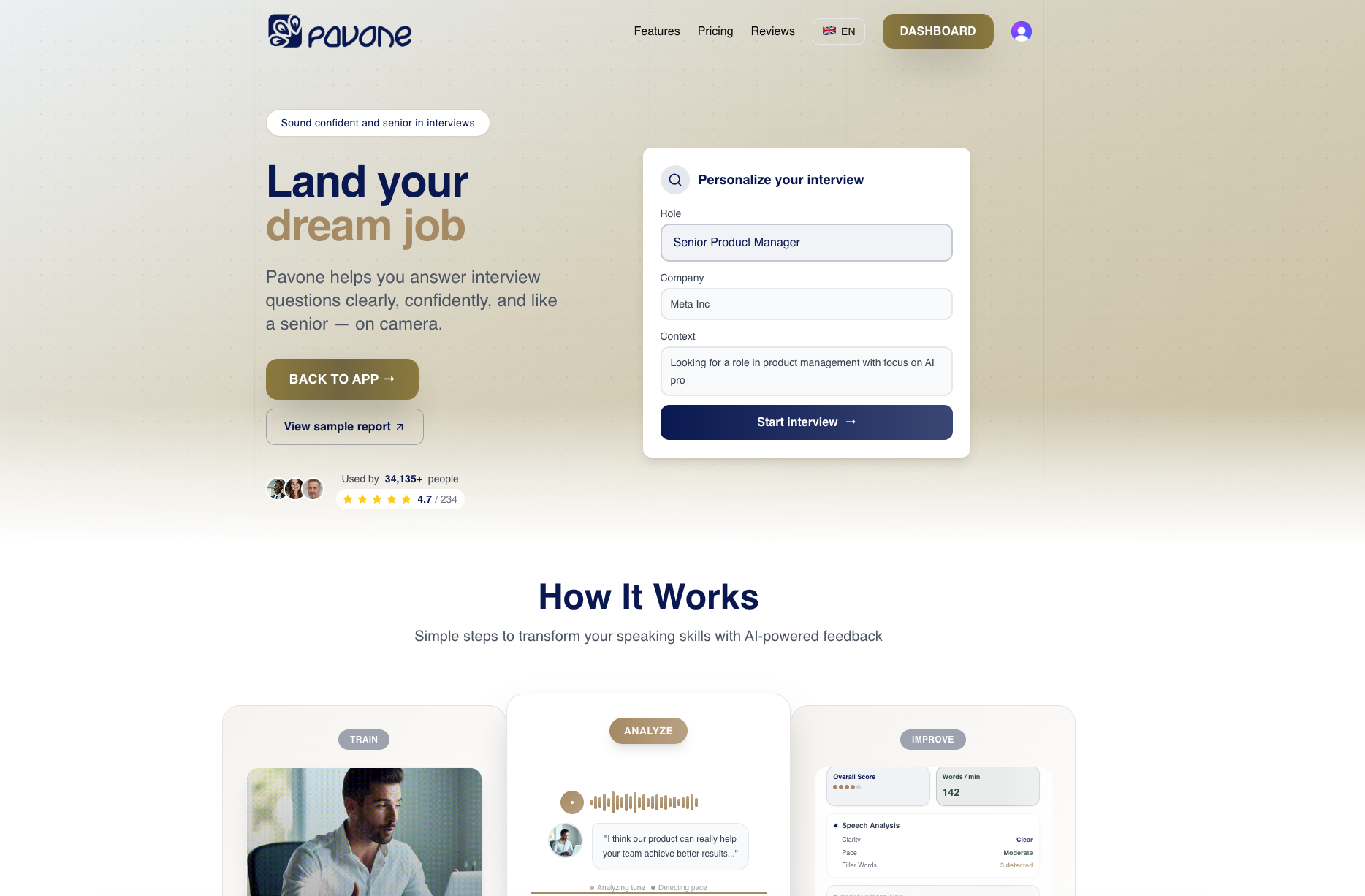
Take control of your interview preparation with Pavone.ai, the personal interview coach available 24/7. Practise sophisticated answers on camera, receive immediate, actionable feedback on clarity and delivery, and track your progress over time. Instead of generic tips, Pavone focuses on how you say things, helping you present your leadership story with precision and authority. Start practising today at Pavone.ai and transform your interview performance into a powerful professional advantage.
Frequently Asked Questions
How can I define my leadership narrative for mid and senior roles?
Craft your leadership narrative by reflecting on key career moments, your core values, and significant challenges you’ve overcome. To do this, identify at least three pivotal experiences and describe the impact of your leadership on your teams.
What is the STAR method, and how can I use it in interviews?
The STAR method stands for Situation, Task, Action, Result. Use this framework to structure your answers to behavioural questions by detailing a specific situation, the task you were assigned, the action you took, and the outcome achieved.
How should I practice delivering my interview responses?
To refine your delivery, practice your responses in front of a mirror or record yourself speaking. Aim for clarity and confidence, focusing on maintaining eye contact and a steady pace during your practice sessions.
What should I do after receiving feedback on my interview performance?
Analyse the feedback you receive by identifying specific, actionable insights. Create a structured action plan to address the areas for improvement mentioned in the feedback, focusing on one or two aspects that you can enhance within the next month.
How can I simulate a realistic interview environment for practice?
Set up mock interviews that mimic real interview conditions by including unexpected questions and time limits. Conduct these sessions with peers who can provide honest feedback, allowing you to refine your performance under pressure.
What are some effective strategies for managing interview anxiety?
To manage anxiety, practice deep breathing techniques and positive visualisation before your interview. Additionally, rehearsing your answers in a structured manner will build your confidence, helping you stay calm and composed during the actual interview.
Recommended
- How to Speak Confidently in Job Interviews - Pavone
- Corporate Interview Questions: Succeeding with Clarity | Pavone Academy
- Body Language in Interviews: Boosting Tech Careers | Pavone Academy
- 7 Types of Public Speaking Every Job Seeker Should Know | Pavone Academy
- Create Your Success: Ultimate Goal Setting Checklist
- professional advisors Archives | DegreeSight
- TEFL Blog: Teaching Tips, Stories & Career Advice | EBC
Ready to practice?
Start improving your speaking skills with AI-powered feedback and analysis.
Try Pavone Free