
How to Enhance Persuasive Speaking for Interviews

Standing out in a competitive interview demands more than technical expertise, especially when persuasive communication feels challenging in a second language. Mid-to-senior professionals often struggle to deliver structured responses that highlight their unique strengths clearly and confidently. By focusing on structured communication techniques and practising targeted delivery strategies, you can transform anxious interviews into opportunities that showcase your true potential and build lasting confidence.
Table of Contents
- Step 1: Prepare Effective Interview Responses
- Step 2: Structure Answers for Maximum Clarity
- Step 3: Refine Delivery with Confident Techniques
- Step 4: Practise and Analyse Real Interview Scenarios
- Step 5: Review Feedback to Improve Persuasiveness
Quick Summary
| Key Point | Explanation |
|---|---|
| 1. Research the role thoroughly | Understand the job description, company culture, and skills necessary for the position to tailor your responses effectively. |
| 2. Use structured frameworks for responses | Employ methods like STAR or CAR to create clear narratives that effectively communicate your experiences and achievements. |
| 3. Master confident delivery techniques | Focus on body language, eye contact, and voice modulation to present yourself professionally and reduce anxiety during interviews. |
| 4. Regularly practice with mock interviews | Simulate real interview environments and seek feedback to refine both verbal and non-verbal communication skills. |
| 5. Continuously seek and review feedback | Collect diverse perspectives to identify strengths and weaknesses, ensuring ongoing improvement in your interview skills. |
Step 1: Prepare Effective Interview Responses
Preparing effective interview responses requires strategic planning and thoughtful communication. Your goal is to articulate clear, compelling answers that demonstrate your professional capabilities while showcasing your unique strengths.
To craft powerful interview responses, begin by developing structured communication techniques. This involves several critical steps:
- Research the role thoroughly: Understand the job description, company culture, and required skills
- Analyse potential questions: Anticipate likely interview queries based on your industry and position
- Develop clear narrative frameworks: Create response structures that highlight your experiences
When constructing your responses, focus on providing concrete examples that illustrate your professional achievements. Use the STAR method (Situation, Task, Action, Result) to organise your narratives coherently:
- Describe the specific professional context
- Explain your specific responsibilities
- Detail the precise actions you took
- Share quantifiable results or meaningful outcomes
Effective interview preparation transforms uncertain conversations into confident, strategic opportunities for showcasing your professional capabilities.
Practice is paramount. Record yourself answering potential questions, paying close attention to your articulation, pace, and clarity. This allows you to refine your delivery and identify areas for improvement.
Top recommendation: Rehearse your responses aloud to build muscle memory and reduce interview anxiety, ensuring you sound natural and composed.
Step 2: Structure Answers for Maximum Clarity
Structuring your interview responses with precision transforms meandering conversations into powerful, memorable demonstrations of your professional capabilities. The key is to communicate your experiences systematically, ensuring every word contributes meaningful insight about your skills and potential.
Master structured interview response frameworks that enable you to present complex professional experiences concisely. These strategic approaches help you navigate different question types while maintaining clarity:
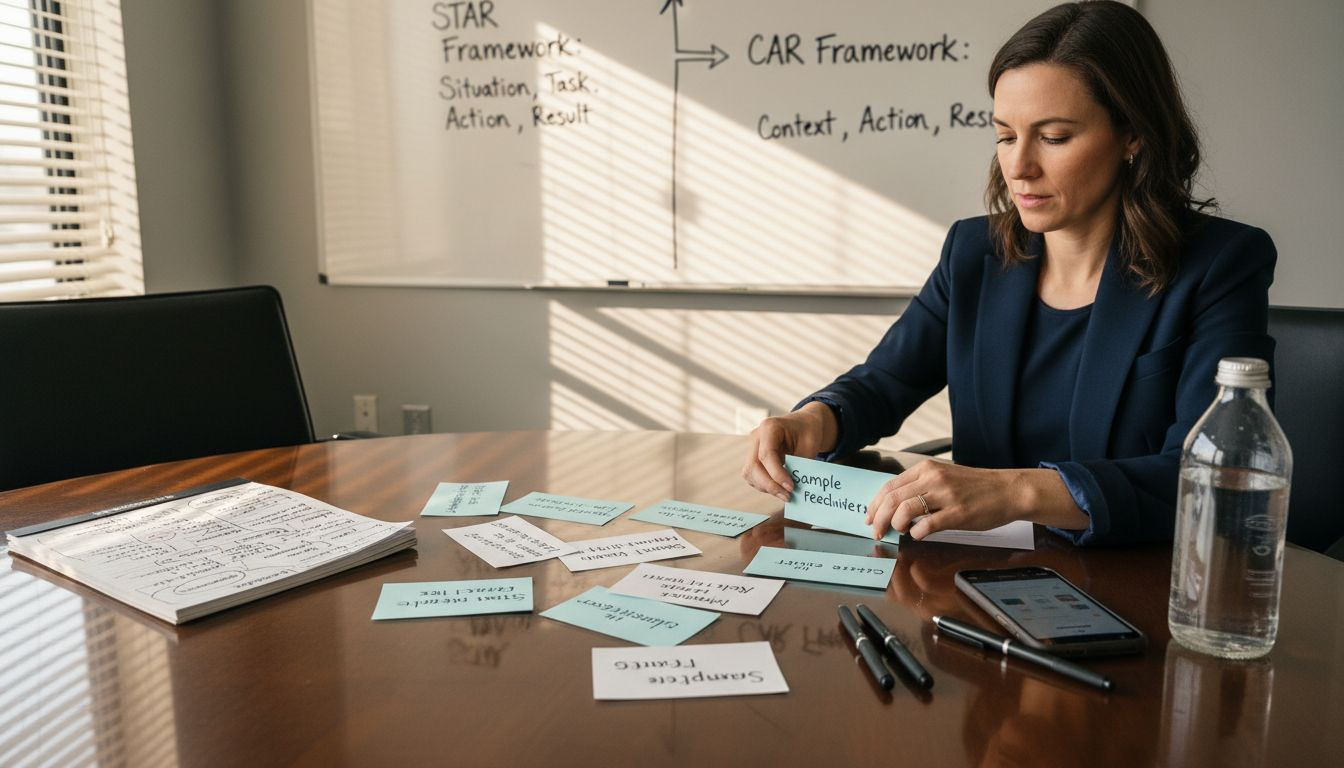
The following table compares popular interview answer frameworks to help you choose the most appropriate for different scenarios:
| Framework | Focus Area | Best Used For |
|---|---|---|
| STAR | Structured problem-solving | Behavioural and competency questions |
| CAR | Quick outcome demonstration | Achievement and results-oriented questions |
| PAR | Concise issue resolution | Problem-based and challenge questions |
- STAR Method: Situation, Task, Action, Result
- CAR Framework: Context, Action, Result
- PAR Technique: Problem, Action, Resolution
When constructing your narrative, follow these essential steps:
- Set the context briefly and precisely
- Highlight your specific role and responsibilities
- Describe deliberate actions you undertook
- Quantify the outcomes with concrete metrics
Professional communication is an art of distilling complex experiences into clear, compelling narratives that resonate with your interviewer.
Practice transforming your past experiences into structured, concise stories. Each response should feel like a mini-case study that demonstrates your problem-solving abilities, leadership potential, and professional growth.
Expert recommendation: Rehearse your structured responses with a trusted colleague who can provide honest feedback about your clarity, pace, and narrative flow.
Step 3: Refine Delivery with Confident Techniques
Mastering confident interview delivery transforms your communication from hesitant to compelling. Your goal is to project professional assurance while maintaining authentic, engaging interactions that showcase your genuine capabilities.
Develop confident public speaking strategies that help you manage nervousness and communicate with clarity. These techniques will help you control your physical and vocal presentation:
- Body language: Stand tall, maintain open posture
- Voice modulation: Control pitch and speaking pace
- Eye contact: Connect with your interviewer meaningfully
- Breathing techniques: Manage anxiety through controlled breathing
Implement these refined delivery approaches:
- Practice power posing before interviews to boost confidence
- Visualise successful interaction scenarios
- Record yourself speaking to identify improvement areas
- Use deliberate pausing to emphasise key points
Confident communication is not about perfection, but about genuine, purposeful engagement.
Remember that confidence stems from thorough preparation and self-awareness. Your delivery should feel natural, not rehearsed, allowing your authentic professional personality to shine through.
Expert recommendation: Develop a pre-interview ritual that helps you centre your energy and approach the conversation with calm, professional confidence.
Step 4: Practise and Analyse Real Interview Scenarios
Transforming theoretical knowledge into practical interview skills requires immersive, realistic practice. Your objective is to create meaningful learning experiences that simulate authentic professional interactions, helping you develop genuine confidence and communication prowess.
Mock interview techniques provide crucial opportunities to refine your communication approach and identify areas for improvement. These practice scenarios enable comprehensive evaluation of your verbal and non-verbal communication:
- Record video responses: Capture your actual interview performance
- Analyse body language: Review your physical communication patterns
- Time your responses: Check pacing and concision
- Seek external feedback: Get objective perspectives on your delivery
Implement a structured practice approach:
- Select realistic scenarios matching your career level
- Simulate interview environments as closely as possible
- Review recordings objectively
- Iterate and improve based on insights
Professional growth emerges from honest self-reflection and deliberate practice.
Remember that effective practice is not about achieving perfection, but developing adaptability and authentic communication skills that showcase your unique professional capabilities.
Expert recommendation: Create a personal feedback loop where you consistently record, review, and refine your interview performance to build genuine confidence.
Step 5: Review Feedback to Improve Persuasiveness
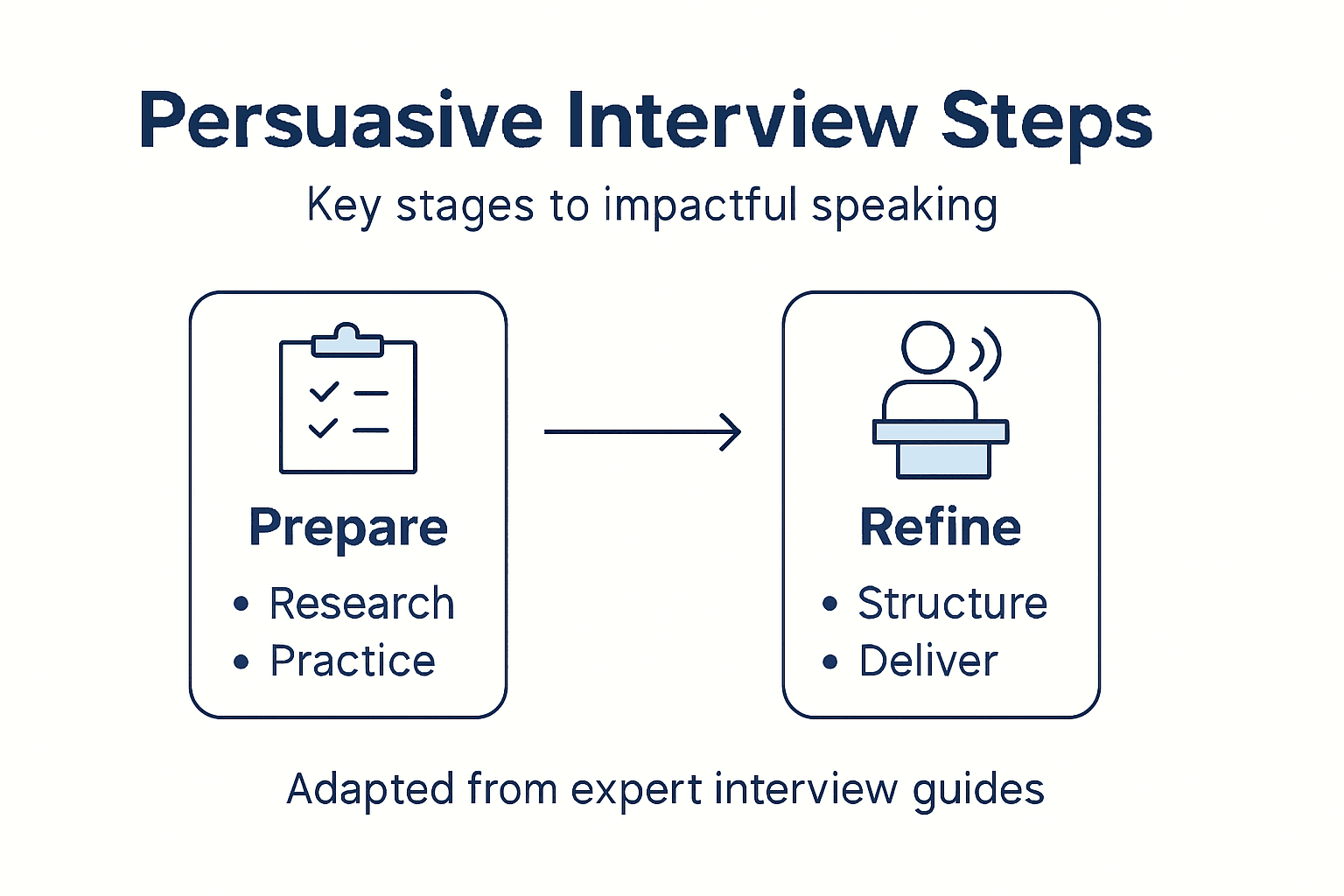
Developing persuasive communication requires continuous learning and strategic self-improvement. Your mission is to transform external insights into actionable strategies that enhance your interview performance and professional communication skills.
Structured feedback mechanisms provide critical opportunities to refine your speaking abilities and boost confidence. These analytical approaches help you understand your communication strengths and potential areas of development:
- Collect multiple perspectives: Gather feedback from diverse sources
- Analyse video recordings: Review your non-verbal communication
- Identify specific patterns: Note recurring communication challenges
- Track measurable improvements: Set clear communication goals
Implement a comprehensive feedback review process:
- Request specific, constructive feedback
- Compare multiple evaluation sources
- Categorise improvement areas
- Develop targeted practice strategies
Continuous improvement is not about perfection, but consistent, intentional growth.
Remember that feedback is a gift. Approach each critique with curiosity and openness, viewing it as an opportunity to enhance your professional communication skills.
Here is a summary of interview feedback sources and the insights they provide:
| Feedback Source | Type of Insight | Value for Improvement |
|---|---|---|
| Trusted colleague | Honest, external perspective | Highlights blind spots |
| Video recording | Visual and vocal review | Reveals non-verbal issues |
| Professional coach | Expert guidance | Provides targeted strategies |
Expert recommendation: Create a personal feedback journal where you document insights, track progress, and design strategic improvement plans.
Enhance Your Persuasive Speaking with Personalised Interview Coaching
Mastering persuasive speaking for interviews requires not only well-structured answers but also confident delivery and timely feedback. The article highlights common challenges such as managing nervousness, structuring responses with frameworks like STAR or CAR, and refining clarity and pacing to make a memorable impression. If you want to move beyond generic advice and improve exactly how you communicate—your clarity, confidence, and overall presence—Pavone.ai offers a tailored solution that fits perfectly with these goals.
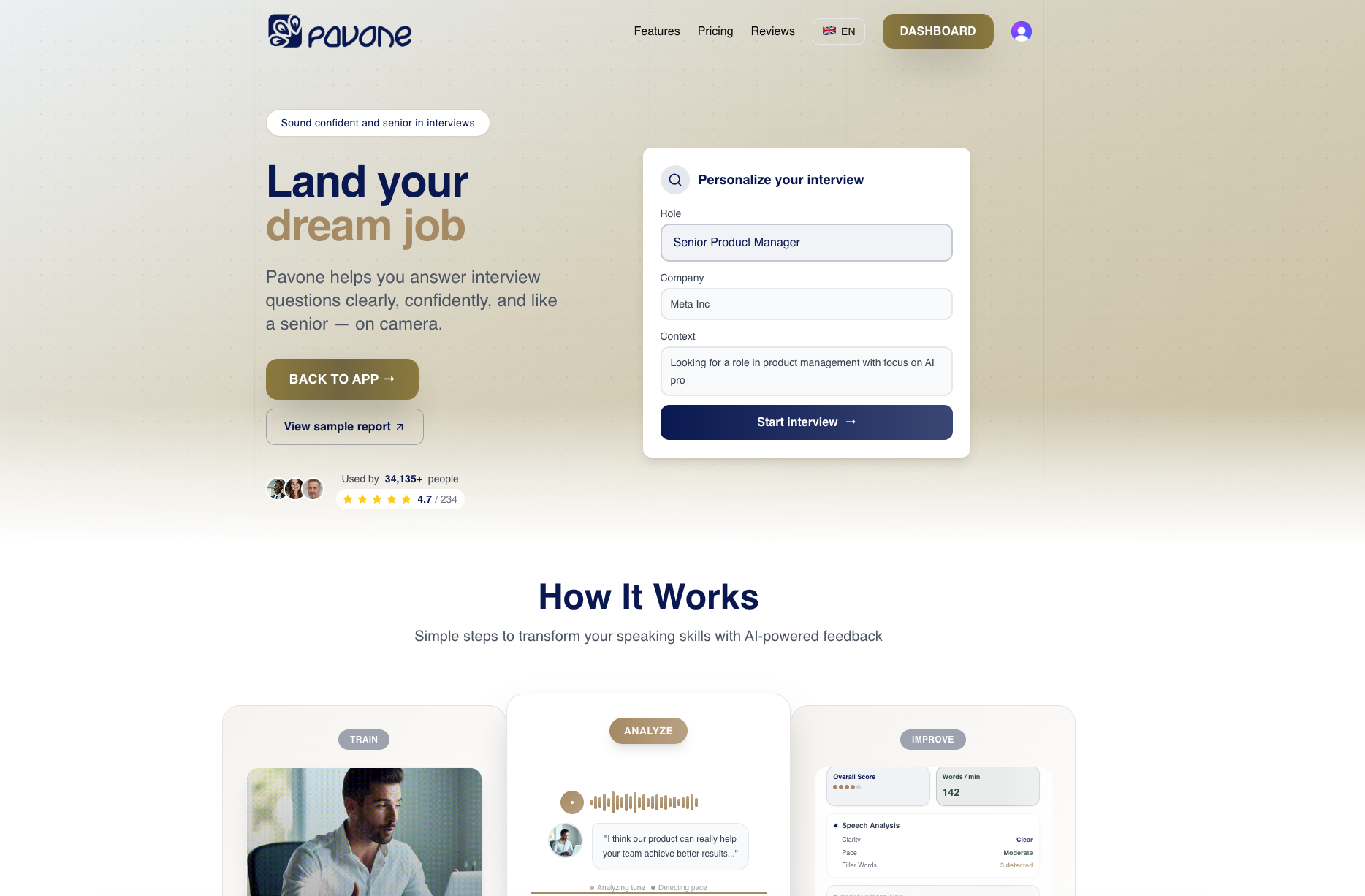
Experience Pavone.ai, an interview preparation platform designed to help you practise common interview questions while receiving immediate, actionable feedback on key interview factors such as structure, pacing, filler words, and confidence. With Pavone.ai, you can record answers anytime in a private environment and track your progress towards sounding more senior and concise. Don’t let anxiety or unclear delivery hold you back. Start practising with Pavone today and take confident steps toward excelling in your next interview. Discover how to transform your interview responses by learning more at Pavone and deepen your preparation with insights on structured interview response frameworks. Take control of your interview success now.
Frequently Asked Questions
How can I prepare effective interview responses to enhance my persuasive speaking?
To prepare effective interview responses, research the role thoroughly and anticipate potential questions. Develop structured narratives using the STAR method to communicate your achievements clearly, which can help you articulate your points powerfully.
What techniques can I use to structure my answers for maximum clarity during an interview?
Utilise structured frameworks like STAR, CAR, or PAR to organise your responses systematically. Start by setting the context briefly, then highlight your specific role, describe your deliberate actions, and quantify the outcomes to enhance clarity.
How can I refine my delivery to sound more confident during interviews?
Mastering confident delivery involves practising body language, voice modulation, and controlled breathing. Implement power posing before interviews to boost your confidence and record yourself speaking for self-evaluation to identify areas for improvement.
What should I focus on when practising real interview scenarios?
When practising real interview scenarios, choose realistic situations that closely match the job you are applying for. Record your performance to analyse your verbal and non-verbal communication, and seek feedback to continuously refine your approach.
How can I effectively review feedback to improve my persuasive speaking?
Develop a structured feedback review process by collecting insights from diverse sources and analysing your performance recordings. Identify specific patterns or challenges and create targeted practice strategies to address them for continuous improvement.
How often should I rehearse my interview responses to ensure I am well-prepared?
Aim to rehearse your interview responses regularly, ideally several times a week leading up to the interview. Practising aloud can help solidify muscle memory and reduce anxiety, making you feel more prepared and composed on the day of the interview.
Recommended
- Effective Speaking: Transforming Interview Success | Pavone Academy
- Why Practice Speaking Matters for Interview Success | Pavone Academy
- Why Practice Speaking Matters for Interview Success | Pavone Academy
- Why Practice Speaking Matters for Interview Success | Pavone Academy
Ready to practice?
Start improving your speaking skills with AI-powered feedback and analysis.
Try Pavone Free