
Interview Question What: Mastering Clarity and Impact

Nerves can spike the moment the interview starts, especially if you believe every question is designed to catch you out. For many mid-career professionals in technical roles across North America, understanding the true aim of an interview question is crucial for building confidence and reducing anxiety. By demystifying the nature of these questions and focusing on genuine professional insights, you can approach on-camera interviews with clarity and strategic poise.
Table of Contents
- Interview Question What: Definition And Misconceptions
- Main Types Of Interview Questions Explained
- How Interview Questions Assess Candidates
- Common Pitfalls And Mistakes To Avoid
- Practical Strategies For Impactful Answers
- Using Pavone.ai To Refine Responses
Key Takeaways
| Point | Details |
|---|---|
| Interview Questions are Purposeful | They are crafted to gain insights into candidates’ professional capabilities and organisational fit, not to trick them. |
| Types of Interview Questions Matter | Understanding structured, semi-structured, and unstructured questions helps candidates prepare and adapt their responses effectively. |
| Preparation is Key | Candidates should research the organisation, anticipate questions, and practice articulating their experiences using frameworks like the STAR method. |
| Embrace Technology for Improvement | Platforms like Pavone.ai offer innovative tools for feedback on communication skills, helping to enhance interview performance. |
Interview question what: definition and misconceptions
An interview question represents a strategic communication tool designed to extract meaningful insights about a candidate’s professional capabilities, potential, and fit within an organisational context. Unlike casual conversation, these questions are meticulously crafted to uncover deeper understanding beyond surface-level responses.
Professional interview questions typically fall into several distinct categories:
- Behavioural questions: Exploring past performance and problem-solving approaches
- Situational questions: Assessing hypothetical decision-making skills
- Technical questions: Evaluating specific professional knowledge and competencies
- Cultural fit questions: Understanding alignment with organisational values
Many professionals misunderstand the fundamental purpose of interview questions. Common academic interview strategies reveal that interviewers are not attempting to trick candidates, but rather seeking genuine insights into their professional capabilities. The misconception that questions are unpredictable or deliberately challenging can create unnecessary anxiety.
Interviewers typically design questions to evaluate multiple dimensions simultaneously. Behavioural interview techniques demonstrate that past experiences - even those outside direct professional contexts - can effectively predict future performance. This approach allows candidates to draw from diverse life experiences when constructing compelling responses.
Key Misconceptions about Interview Questions:
- They are designed to catch candidates off-guard
- Only professional experiences are relevant
- There is a single “correct” answer
- Technical skills matter more than communication abilities
Interview questions are collaborative exploration tools, not interrogation techniques.
Pro tip: Practice answering questions by recording yourself and analysing your communication style, focusing on clarity, confidence, and structured responses.
Main types of interview questions explained
Interview questions represent sophisticated communication tools with diverse formats designed to extract comprehensive insights about a candidate’s professional capabilities. Understanding these variations allows candidates to prepare more effectively and showcase their unique strengths.
Research interview methodologies reveal three primary interview question types:
- Structured interviews: Predetermined, standardised questions
- Semi-structured interviews: Flexible framework with core questions
- Unstructured interviews: Conversational, open-ended dialogue
Each interview question type serves distinct purposes in professional assessment. Interview format analysis demonstrates that the approach depends on the interviewer’s objectives and the specific information they wish to uncover.

Structured interviews follow a rigid questionnaire, ensuring consistent evaluation across candidates. Semi-structured interviews blend systematic questioning with adaptive exploration, allowing deeper insights while maintaining core assessment parameters. Unstructured interviews offer maximum conversational flexibility, permitting spontaneous discussion and unexpected revelations about a candidate’s capabilities.
For clarity, here is a comparison of structured, semi-structured, and unstructured interview questions:
| Interview Type | Question Format | Candidate Experience | Best Use Case |
|---|---|---|---|
| Structured | Fixed and standardised | Predictable, uniform for all | Large-scale hiring, data analysis |
| Semi-Structured | Flexible core questions | Guided yet open to elaboration | Deep role fit exploration |
| Unstructured | Conversational, adaptive | Unpredictable, rapport-building | Senior or creative roles |
Key Characteristics of Interview Question Types:
- Structured: Identical questions, limited candidate variation
- Semi-structured: Core questions with room for elaboration
- Unstructured: Minimal pre-planning, maximum conversational flow
Professional interviews are strategic conversations, not interrogations.
Pro tip: Prepare flexible response templates that can be adapted across different interview question styles, demonstrating both structure and spontaneity.
How interview questions assess candidates
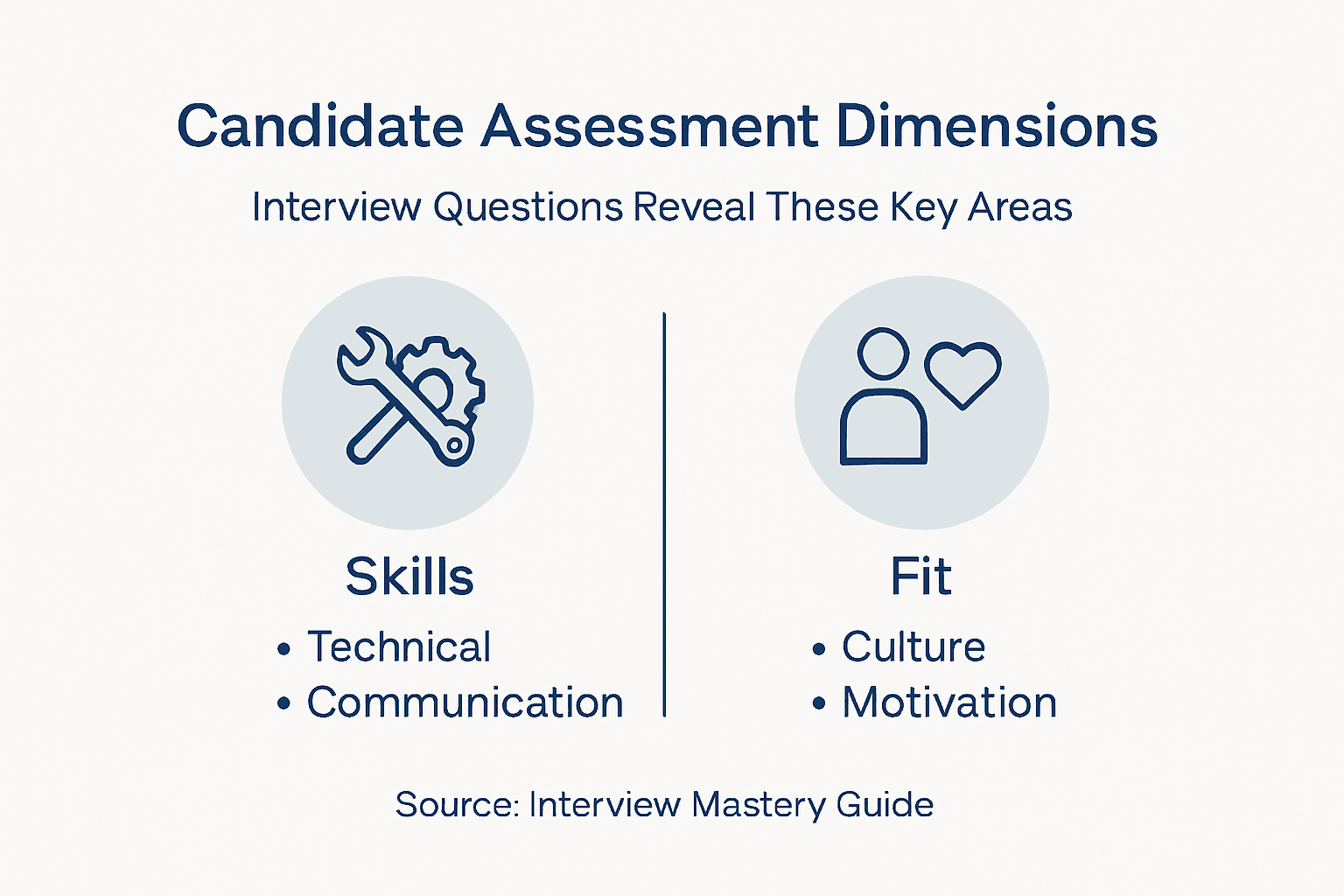
Interview assessments represent sophisticated evaluation strategies designed to uncover a candidate’s true professional potential beyond surface-level qualifications. Professional interviewers deploy strategic questioning techniques to gain multidimensional insights into a candidate’s capabilities, character, and compatibility.
Academic interview methodologies reveal multiple dimensions of candidate evaluation:
- Research capabilities: Depth of knowledge and intellectual curiosity
- Problem-solving skills: Analytical thinking and creative approach
- Communication proficiency: Clarity, structure, and coherence
- Cultural alignment: Organisational fit and values compatibility
Interviewers utilise different question types to probe these critical dimensions. Candidate assessment strategies typically incorporate several complementary approaches:
Behavioural questions examine past performance as a predictor of future actions, revealing how candidates have navigated complex professional scenarios. Situational questions present hypothetical challenges, testing real-time problem-solving and decision-making abilities. Technical questions assess specific job-related competencies, while competency-based inquiries explore broader professional capabilities.
Key Assessment Dimensions:
- Past performance indicators
- Problem-solving potential
- Technical knowledge
- Interpersonal adaptability
- Strategic thinking capacity
Interview questions are precision instruments for understanding professional potential.
Pro tip: Anticipate assessment dimensions by preparing versatile responses that showcase your capabilities across multiple professional competencies.
Common pitfalls and mistakes to avoid
Navigating professional interviews demands strategic awareness of potential missteps that can undermine even the most qualified candidate’s performance. Understanding and preempting common interview mistakes represents a critical component of successful job preparation.
Interview performance pitfalls encompass several key areas of potential weakness:
- Arriving late or unprepared
- Displaying poor non-verbal communication
- Speaking negatively about previous employers
- Providing generic or unfocused responses
- Demonstrating insufficient research about the role
Candidates frequently underestimate the significance of comprehensive preparation. Academic interview strategies reveal that institutional knowledge and authentic engagement matter significantly more than rehearsed scripts. Over-preparing formulaic answers can make candidates appear rigid and disconnected from the organisation’s unique culture and requirements.
Professional communication requires a delicate balance between confidence and humility. Candidates should avoid these critical communication errors:
The following table summarises common interview pitfalls and strategies for improvement:
| Pitfall | Why It Hurts Performance | Quick Improvement Tip |
|---|---|---|
| Generic responses | Fails to differentiate candidate | Use concrete role-specific examples |
| Speaking negatively | Raises professionalism concerns | Reframe with positive insights |
| Poor non-verbal communication | Undermines spoken competence | Practise confident posture and tone |
| Overusing jargon | Obscures real expertise | Explain technical points simply |
| Arriving unprepared | Signals lack of interest | Research employer and role in depth |
- Interrupting the interviewer
- Appearing overly defensive
- Using excessive technical jargon
- Failing to provide concrete examples
- Neglecting to ask insightful questions
Interview success depends on authenticity, not perfection.
Pro tip: Record your practice interviews to identify unconscious communication patterns and refine your professional presentation strategy.
Practical strategies for impactful answers
Crafting compelling interview responses requires a strategic approach that transforms raw professional experience into clear, memorable narratives. Successful candidates understand that communication is an art form, blending authenticity with structured articulation.
Interview skill techniques emphasise several critical preparation strategies:
- Thoroughly research the organisation
- Anticipate potential questions
- Develop concise, relevant examples
- Practice articulating complex experiences
- Align responses with employer expectations
One particularly powerful framework for structuring responses is the STAR method. Structured response techniques provide a systematic approach to answering behavioural interview questions by breaking down complex experiences into digestible components:
- Situation: Context and background
- Task: Specific challenge or objective
- Action: Steps taken to address the challenge
- Result: Concrete outcomes and learnings
Professional communication demands more than merely reciting facts. Candidates must demonstrate emotional intelligence, strategic thinking, and the ability to translate past experiences into future potential. This requires crafting responses that are:
- Specific and concrete
- Relevant to the role
- Professionally articulated
- Backed by measurable outcomes
- Reflective of personal growth
Impactful answers reveal not just what you did, but how you think.
Pro tip: Develop a personal “story bank” of professional experiences that can be flexibly adapted to different interview questions, ensuring you’re always prepared with relevant, engaging examples.
Using Pavone.ai to refine responses
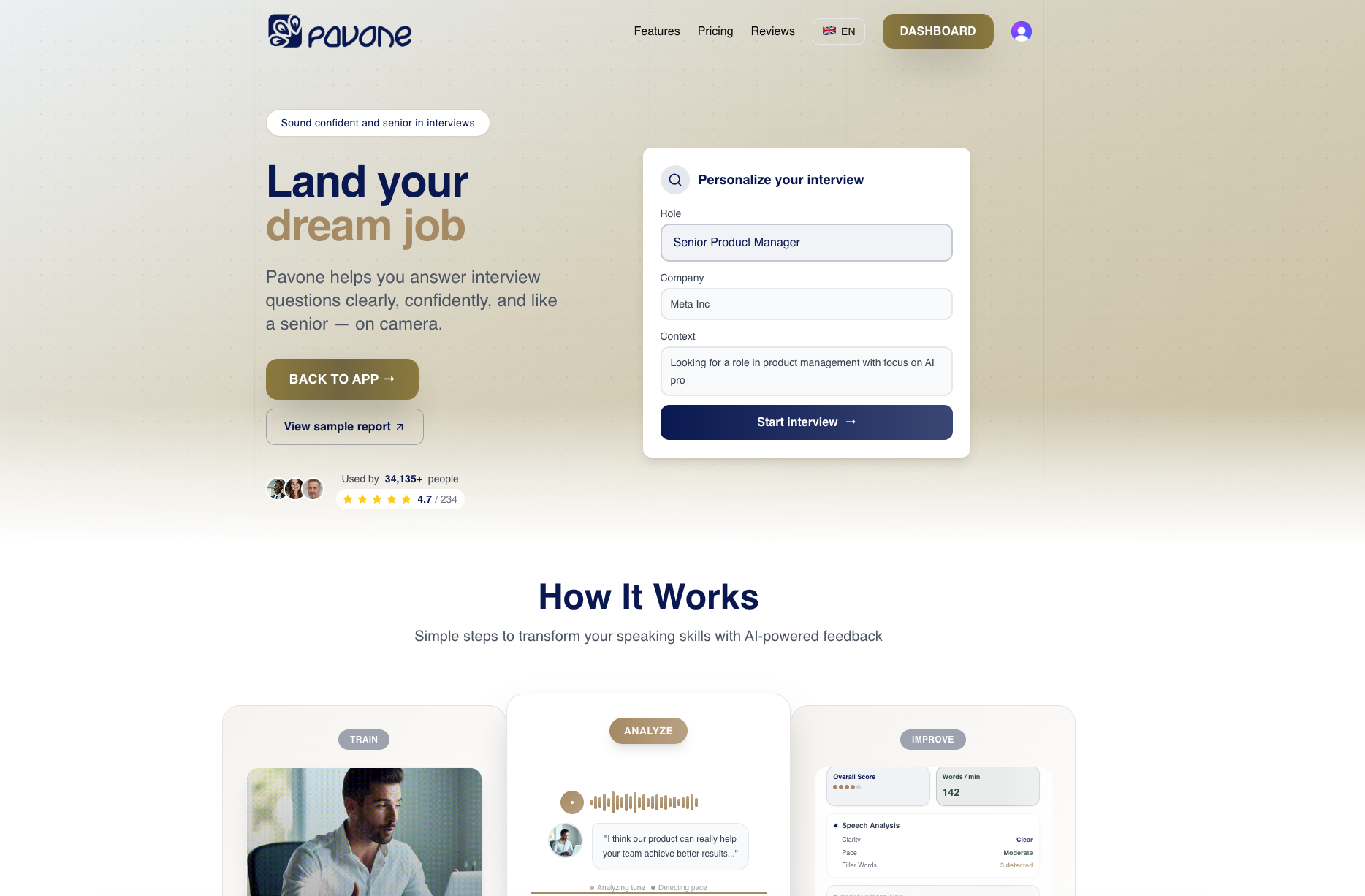
Modern interview preparation demands sophisticated technological solutions that go beyond traditional practice methods. Pavone.ai represents a cutting-edge platform designed to transform how professionals approach interview readiness through intelligent, data-driven feedback mechanisms.
Scientific interview optimization highlights the importance of technology in interview skill development. The platform offers several unique refinement features:
- Real-time speech analysis
- Confidence level measurement
- Filler word detection
- Structural response evaluation
- Non-verbal communication insights
Pavone.ai’s innovative approach breaks down interview response quality into measurable components. Users can record practice answers and receive immediate, objective feedback on crucial communication dimensions such as clarity, pacing, articulation, and professional tone. This granular analysis helps candidates identify and address subtle communication barriers that traditional coaching methods often miss.
Key Refinement Capabilities:
- Transcription of spoken responses
- Algorithmic clarity scoring
- Comparative performance tracking
- Personalised improvement recommendations
- Confidential practice environment
Technology transforms interview preparation from guesswork to precise skill development.
Pro tip: Use Pavone.ai’s recording feature to capture multiple answer variations, allowing you to systematically compare and optimise your communication approach.
Master Your Interview Responses with Pavone.ai
Interview questions are not just about what you say but how you communicate your answers. This article emphasises the importance of clarity, structure and confidence when responding to behavioural, situational and technical questions. If you find yourself struggling with organising your thoughts, avoiding filler words or projecting confidence on camera, these challenges can create unnecessary anxiety and weaken your impact.
Pavone.ai is designed to tackle these precise pain points by providing a personal interview coach available 24/7. With its real-time speech analysis and detailed feedback on clarity, pacing and delivery, you can practise common interview questions in a private, pressure-free environment. This platform helps transform your raw experiences into polished narratives that interviewers remember.
Take control of your interview preparation today and reduce anxiety while increasing your professionalism. Start practising with Pavone.ai now at https://pavone.ai to build clear, confident and compelling answers that stand out in every interview.
Frequently Asked Questions
What are the main types of interview questions?
The main types of interview questions include behavioural, situational, technical, and cultural fit questions, each designed to assess different aspects of a candidate’s capabilities and fit for the organisation.
How should I prepare for different types of interview questions?
To prepare for different types of interview questions, develop flexible response templates using the STAR method, anticipate potential questions based on the job role, and ensure your examples are specific and relevant.
What are common pitfalls to avoid during an interview?
Common pitfalls include arriving late, using generic responses, speaking negatively about previous employers, and failing to ask insightful questions. Thorough preparation and understanding of the role can help mitigate these issues.
How can technology, like Pavone.ai, enhance my interview preparation?
Technology like Pavone.ai can enhance interview preparation by providing real-time feedback on your speech, detecting filler words, analysing your structure, and offering insights into non-verbal communication, allowing for data-driven improvement in your responses.
Recommended
- 7 Best Interview Questions and Answers Examples for Clarity | Pavone Academy
- How Do I Prepare for Interview: Achieve Clear Confident Delivery | Pavone Academy
- Master Business Interview Questions and Answers for Senior Roles | Pavone Academy
- Interviewing for Mid and Senior Roles: Succeed with Confidence | Pavone Academy
- CIC Presidents Institute 2026: Key Higher Ed Trends
Ready to practice?
Start improving your speaking skills with AI-powered feedback and analysis.
Try Pavone Free