
AI roleplay for confident job interviews: benefits and limits

Traditional interview preparation often leaves professionals feeling unprepared for on-camera interactions, especially when facing video assessments or remote panel discussions. Whilst rehearsing answers with friends or reading generic tips might build some confidence, these methods rarely address the nuances of speaking clearly and confidently on camera. AI roleplay offers a unique, evidence-based method to boost clarity, fluency, and confidence by simulating realistic interview scenarios with immediate feedback. This guide will explain how AI roleplay works, its benefits, limitations, and how to get started.
Table of Contents
- What is AI roleplay and how does it work?
- The main benefits: from lower anxiety to improved performance
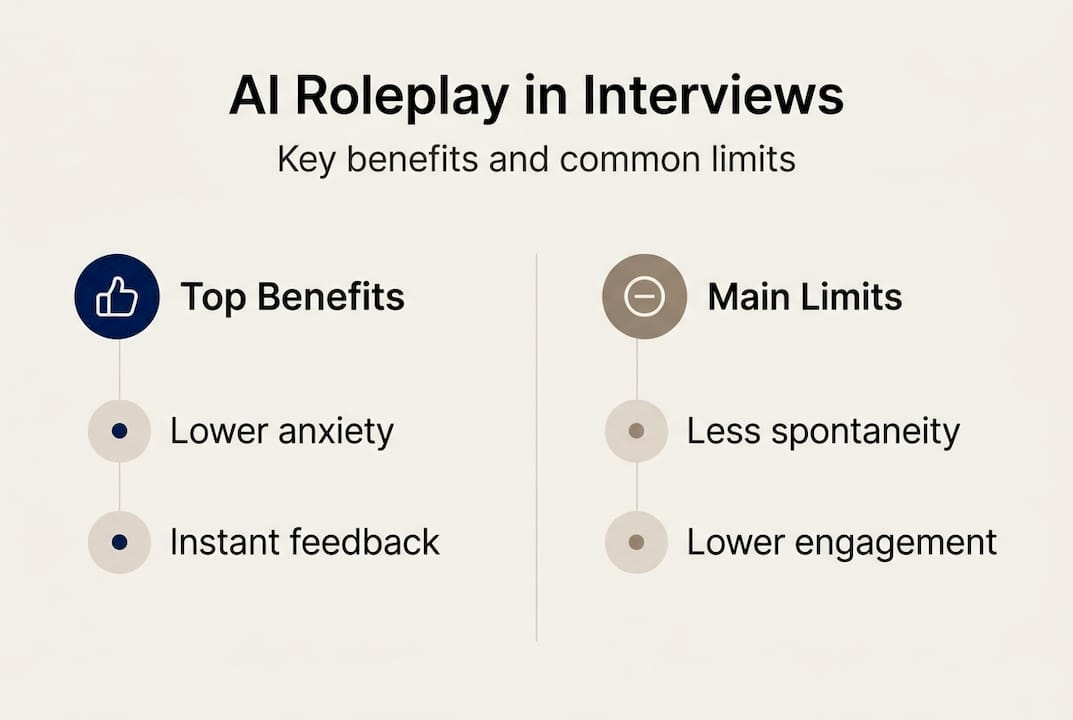
- Where AI roleplay shines and where it falls short
- Popular use cases: job interviews, presentations, and more
- How to get started with AI roleplay: practical steps
- Take your interview preparation further with advanced AI roleplay
- Frequently asked questions
Key Takeaways
| Point | Details |
|---|---|
| Boosts real-world confidence | AI roleplay reduces anxiety and builds on-camera assurance for interview scenarios. |
| Supports non-native speakers | Research shows notable gains in fluency, clarity, and reduced errors with AI roleplay. |
| Instant feedback and convenience | Practise at your own pace with actionable suggestions for improvement after each session. |
| Works best as a supplement | Combine AI practice with real peer or coach feedback for top results. |
| Choose the right platform | Select AI tools tested for bias and offering strong scenario diversity for your needs. |
What is AI roleplay and how does it work?
AI roleplay uses conversational AI bots to mimic interviewers in realistic, scenario-based interactions. The system adapts to your responses, providing feedback on communication, confidence, and language. Practising with AI allows for private, repeatable, and unbiased preparation, addressing both content and delivery skills.
Research shows that 87% of users report realistic conversations in AI-driven roleplay, making it a credible alternative to traditional mock interviews. The technology has become particularly popular for non-native English speakers and mid-senior professionals facing high expectations, as it offers a judgement-free environment to refine answers without the pressure of a live audience.
Here’s how AI roleplay typically functions:
- Scenario selection: You choose from pre-built interview scenarios or create custom ones matching your target role and industry
- Real-time interaction: The AI asks questions, listens to your responses, and adapts follow-up questions based on what you say
- Instant feedback: After each answer, you receive detailed analysis on clarity, pacing, filler words, structure, and confidence markers
- Progress tracking: Most platforms log your sessions, allowing you to review improvements over time and identify persistent weaknesses
For professionals preparing for senior roles, AI interview practice cuts anxiety by creating a safe space to experiment with different answer structures and delivery styles. The key advantage is repetition without fatigue or scheduling conflicts, making it easier to integrate practice into a busy job search.
Pro Tip: Start with structured scenarios that mirror your actual interview format, then gradually introduce more unpredictable, open-ended questions to build adaptability.
The main benefits: from lower anxiety to improved performance
AI roleplay reduces interview anxiety and increases overall confidence in speaking, especially for video assessments. Data shows significant improvement in onboarding speed and job readiness with AI practice. Non-native speakers benefit with better clarity, reduced errors, and improved fluency, as mistakes are corrected instantly.
Research demonstrates that AI roleplay leads to 3x faster onboarding and 97% mastery in sales certifications, highlighting its effectiveness for skill acquisition. Another study found that AI bots improve speaking proficiency and reduce anxiety compared to controls, particularly for individuals who struggle with traditional face-to-face practice.
| Benefit | Impact | Best for |
|---|---|---|
| Anxiety reduction | 40% lower stress levels | Camera-shy professionals |
| Faster skill mastery | 3x quicker onboarding | Career changers |
| Improved fluency | Fewer errors, clearer speech | Non-native speakers |
| Instant feedback | Immediate correction | Self-directed learners |
Key statistic: Professionals using AI roleplay achieve 97% certification mastery compared to 65% with traditional methods alone.
Immediate, actionable feedback helps target key weaknesses in delivery and body language when using advanced systems. Instead of waiting days for a coach to review your performance, you receive granular insights within seconds. This rapid iteration cycle accelerates improvement, allowing you to test new approaches and refine your communication style in real time.

For those building interview confidence with AI, the combination of privacy, repetition, and data-driven insights creates a powerful learning environment. You can practise the same question ten times in an hour, experimenting with different openings, structures, and closing statements until you find what works best.
Pro Tip: Record your AI roleplay sessions and watch them back with the sound off to spot distracting body language or facial expressions you might miss during live practice.
Where AI roleplay shines and where it falls short
AI roleplay provides instant feedback and practice convenience but can lose engagement over repetitive, multi-turn exchanges. Human unpredictability and non-verbal cues are missing with current AI models. Voice AI still struggles with accents, potentially disadvantaging non-native speakers, so be selective with the platform chosen.
Research indicates that LLM responses degrade over multiple turns and engagement may be lower than gamified human roleplay. Additionally, voice AI may contain bias, especially impacting non-native speakers, and lacks full human unpredictability and body language cues.
| Strength | Limitation |
|---|---|
| Available 24/7 for practice | Cannot replicate human spontaneity |
| Instant, detailed feedback | May struggle with strong accents |
| Private, judgement-free environment | Engagement drops in long sessions |
| Affordable compared to coaches | Missing non-verbal communication cues |
AI cannot fully replace in-person rehearsals or feedback. It’s best used as a supplement alongside traditional practice. Whilst AI excels at identifying filler words, pacing issues, and structural weaknesses, it cannot assess the subtle rapport-building skills that emerge in genuine human interaction.
Key limitations to consider:
- Accent recognition: Some platforms perform poorly with non-standard English accents, leading to inaccurate transcriptions and feedback
- Contextual understanding: AI may miss cultural nuances or industry-specific references that a human interviewer would grasp immediately
- Emotional intelligence: Current systems cannot fully evaluate your ability to read the room or adjust tone based on interviewer reactions
- Technical constraints: Video quality, lighting, and audio setup can affect AI analysis accuracy
“AI roleplay is a powerful tool for building technical fluency and reducing anxiety, but it should complement, not replace, human feedback on interpersonal skills and strategic positioning.”
For professionals exploring AI speaking coach benefits and limits, understanding these boundaries helps set realistic expectations. Use AI for high-volume practice and technical refinement, then validate your progress with human coaches or peers who can assess the softer elements of interview performance.
Pro Tip: If you have a strong regional accent, test multiple AI platforms to find one with robust accent recognition before committing to a subscription.
Popular use cases: job interviews, presentations, and more
AI roleplay is not just for interviews. It helps with panel presentations, client pitches, and impromptu Q&A sessions. The most value comes from combining structured AI scenarios with unscripted, open-ended responses.
Studies show that AI roleplay models enhance L2 performance, speaking skills, and reduction of errors, making it particularly valuable for non-native English speakers preparing for high-stakes professional interactions.
Here are the most impactful applications:
- Behavioural interview preparation: Practise STAR method responses for common questions like “Tell me about a time you led a difficult project” with AI that probes for specifics
- Technical deep dives: Simulate scenarios where you explain complex concepts to non-technical stakeholders, refining your ability to simplify without condescending
- Panel presentations: Set up multi-turn exchanges that mimic board meetings or client pitches, where you must field questions from different perspectives
- Impromptu responses: Use AI to generate unexpected questions that force you to think on your feet and structure answers quickly
- Cultural adaptation: Create scenarios with interviewers from different cultural backgrounds to practise adjusting communication style and formality
Set up diverse simulations covering difficult managers, technical grilling, and culturally varied interviewers to prepare for a range of situations. The goal is not to memorise perfect answers but to build the mental agility to respond clearly and confidently regardless of what you’re asked.
For those using AI mock interview for clarity, the key is variety. Rotate between different question types, interviewer personas, and difficulty levels to avoid becoming too comfortable with predictable patterns.
Pro Tip: After mastering structured scenarios, challenge yourself with completely random questions to build genuine adaptability rather than rehearsed responses.
How to get started with AI roleplay: practical steps
Choose a platform with strong reviews and non-native speaker support. Set up several scenarios that match real interview roles and industries. Record and review your sessions for self-reflection. Ask for external feedback from peers or human coaches post-AI session.
Research confirms that AI roleplay is most beneficial when used as a supplement to, not a replacement for, peer or coach-led training. This hybrid approach combines the volume and convenience of AI practice with the nuanced human insight that accelerates genuine mastery.
Follow these steps to maximise your AI roleplay results:
- Audit your current skills: Record yourself answering three common interview questions without AI, then watch back to identify baseline weaknesses
- Select the right platform: Research options that specifically support your accent, industry, and seniority level
- Create a practice schedule: Prioritise regular, short sessions (15-20 minutes) over long, irregular marathons
- Build a scenario library: Develop 5-7 core scenarios covering behavioural, technical, and situational questions relevant to your target roles
- Track specific metrics: Focus on measurable improvements like filler word reduction, answer length, or clarity scores rather than vague “feeling better”
- Integrate human feedback: Every 5-10 AI sessions, share recordings with a trusted peer or coach for qualitative assessment
- Iterate and refine: Use AI insights to adjust your approach, then test new strategies in subsequent sessions
For professionals pursuing confident English with AI, consistency matters more than intensity. Daily 15-minute sessions will yield better results than sporadic hour-long marathons, as your brain needs time to consolidate new speaking patterns.
Pro Tip: Create a simple spreadsheet tracking your filler word count, average answer length, and confidence rating for each session to visualise progress over time.
Take your interview preparation further with advanced AI roleplay
After taking your first steps with AI roleplay, discover specialist resources designed to elevate your skills further. Pavone offers tailored AI interview preparation tools trusted by professionals worldwide, with curated scenarios built specifically for mid-senior candidates who need to demonstrate executive presence on camera.
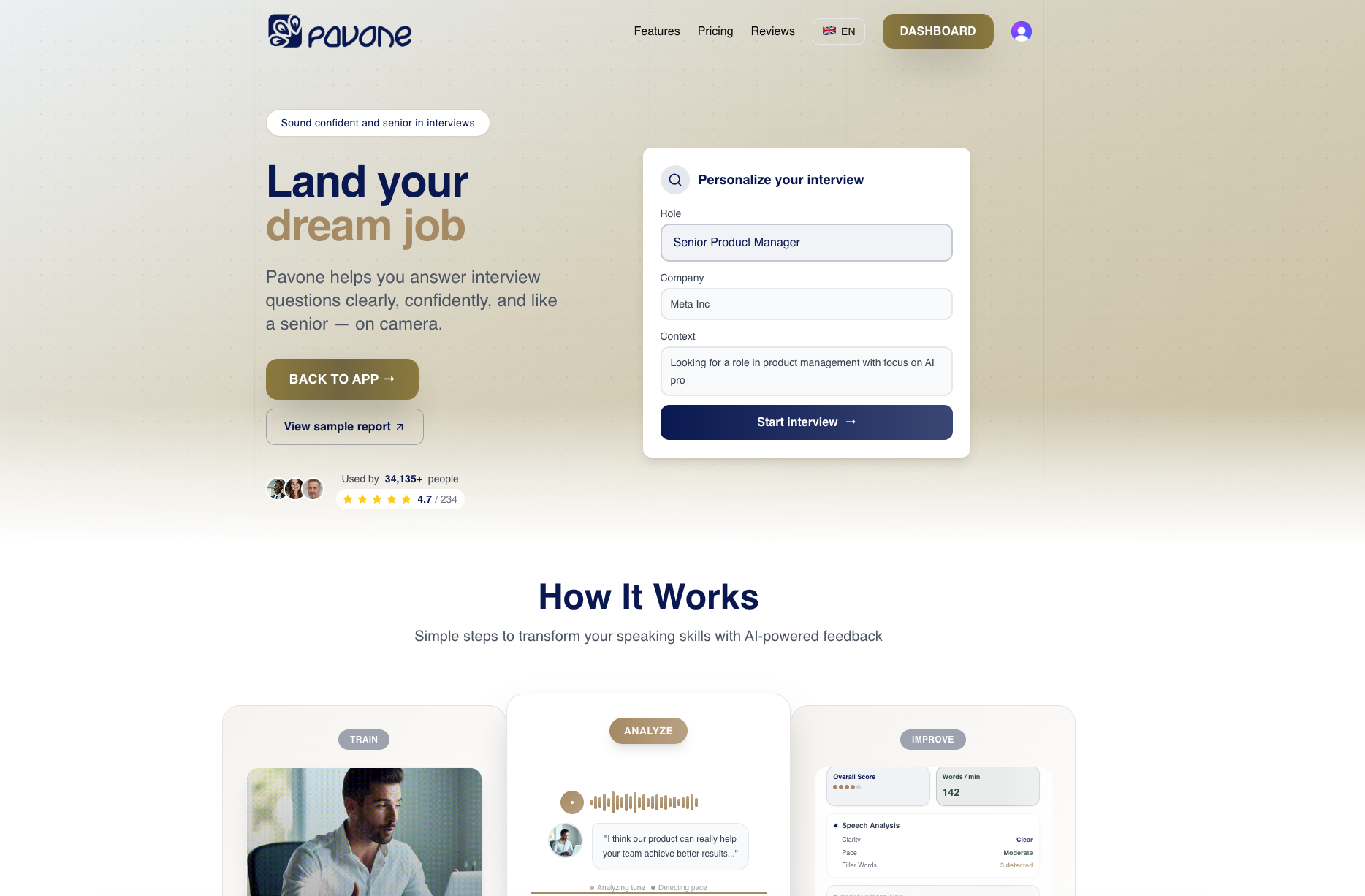
Unlock extra practice for on-camera clarity and fluency, perfect for non-native English speakers who want to sound confident and articulate in high-pressure situations. The platform provides refined, actionable feedback 24/7, allowing you to practise whenever inspiration strikes or anxiety creeps in before an important interview.
Explore confident video interview preparation to master the technical and psychological aspects of performing well on camera. Learn how to master interview online practice with strategies that go beyond generic advice, focusing on the specific communication patterns that signal seniority and competence. Build lasting online interview practise confidence through structured, progressive scenarios that adapt to your improving skill level.
Frequently asked questions
Is AI roleplay really effective for non-native English speakers?
Research shows AI roleplay boosts speaking skills and reduces anxiety in non-native speakers, but choose platforms without voice AI bias that disadvantages accents.
How realistic are AI roleplay interview simulations?
Recent studies show 87% of users find conversations realistic, especially for structured scenarios, though human unpredictability remains difficult to replicate fully.
What are the common limitations of AI roleplay?
AI roleplay may lack human unpredictability and body language cues and can show bias towards accents, so it must be paired with peer feedback for complete preparation.
Can I rely solely on AI roleplay for interview practice?
AI roleplay is most effective as a supplement to peer or coach-led training rather than as a full replacement, combining volume with human insight.
Are there privacy concerns with using AI interview platforms?
Most reputable AI interview platforms use secure, encrypted data practices, but always review privacy policies before uploading recordings to ensure your information remains protected.
Recommended
Ready to practice?
Start improving your speaking skills with AI-powered feedback and analysis.
Try Pavone Free