
Oracle interview questions: Excel in mid-senior roles in 2026

TL;DR:
- Success in mid-senior Oracle interviews depends on clear structure, troubleshooting process, and composure.
- Core topics include backup strategies, high availability, performance tools, and managing complex scenarios.
- Effective communication and scenario-based answers showcase diagnostic thinking and professional maturity.
Landing a mid-senior Oracle role is genuinely challenging. Interviewers at this level are not testing whether you can recall a definition. They want to see how you think under pressure, how you diagnose a crisis, and whether you can explain a complex system clearly on camera without losing your train of thought. The gap between candidates who get offers and those who do not often comes down to one thing: the ability to structure a technically sound answer and deliver it with composure. This guide gives you both. You will find the core topics, model frameworks, real scenario examples, and on-camera techniques that help you perform at your best when it matters most.
Table of Contents
- Core Oracle interview topics and what interviewers really want
- Must-know technical questions and frameworks for clear answers
- Scenario-based Oracle interview questions: Real examples for technical depth
- Oracle architecture essentials: High availability, backups, and ACID clarity
- What mid-senior candidates often miss about Oracle interview success
- Accelerate your Oracle interview prep: Practise, analyse, and perfect your answers
- Frequently asked questions
Key Takeaways
| Point | Details |
|---|---|
| Scenario answers matter | Mid-senior Oracle interviews favour practical explanations over memorised facts. |
| Master core topics | Backup types, performance, and architecture come up in nearly all Oracle interviews. |
| Structure boosts confidence | Using frameworks like STAR helps you respond clearly, especially on camera. |
| Prepare for high-stress | Practise complex recovery and troubleshooting questions to demonstrate poise under pressure. |
| Use tools for practice | Make use of interview generators and video tools to refine your answers and self-assessment. |
Core Oracle interview topics and what interviewers really want
With the interview landscape set, let us break down what is actually tested and why scenario depth trumps memorisation.
Most mid-senior Oracle interviews circle around five core technical pillars. Understanding what lies beneath each one helps you prepare answers that land with authority rather than sound rehearsed.
- Backup and recovery: RMAN strategies, ARCHIVELOG mode, point-in-time recovery
- High availability: RAC, Data Guard, failover and switchover procedures
- Indexing and query performance: B-tree vs bitmap indexes, execution plans, stale statistics
- Performance monitoring: AWR, Statspack, wait events, V$ views
- PL/SQL: Procedures, packages, triggers, exception handling
The reason interviewers return to these areas is not because they are easy to memorise. It is because they reveal diagnostic thinking. When you describe how you approached a failed recovery or a degraded query, you show a mental roadmap of your experience. That is far more persuasive than stating facts.
Interviewers at this level are specifically listening for process. They want to hear you say things like, “The first thing I check is the alert log because it tells me the exact sequence of events.” That kind of narration signals seniority. As practical scenarios over rote answers carry far more weight at mid-senior level, practising step-by-step troubleshooting on camera builds both your confidence and your credibility.
Structuring your answers also boosts how competent you appear. When you use clear signposting like “First… then… finally,” the interviewer can follow your reasoning without effort. You can find strong answer examples for clarity to sharpen this further.
Pro Tip: Before diving into your answer, pause and clarify the scenario. Ask yourself: what is the constraint here? Production downtime? Data loss risk? That single habit separates senior candidates from everyone else.
Must-know technical questions and frameworks for clear answers
Now that you know the main themes, let us drill into specific question types and the frameworks that ensure you stand out.
The STAR method (Situation, Task, Action, Result) is not just for behavioural questions. It works brilliantly for technical scenarios too. “We had a production database degrading at peak load. My task was to identify the root cause within two hours. I pulled AWR reports and found a rogue full-table scan on a 50-million-row table. After adding a composite index and gathering fresh statistics, query time dropped from 40 seconds to under 2.” That is STAR applied technically, and it is crystal clear.
Here are five technical areas you absolutely must be ready for:
- Hot vs cold backups: Know when each is appropriate, what ARCHIVELOG mode enables, and why RMAN is preferred for both.
- ORA errors: Especially ORA-01555 (snapshot too old). For ORA-01555 resolution, increase UNDO_RETENTION, resize the undo tablespace, and tune long-running queries.
- Performance tools: AWR, Statspack, EXPLAIN PLAN, and V$SESSION. Know what each one tells you and when to reach for it.
- ACID properties: Atomicity, Consistency, Isolation, Durability. Be ready to explain each with a real-world example, not just a definition.
- PL/SQL exceptions: Predefined exceptions include NO_DATA_FOUND, TOO_MANY_ROWS, and ZERO_DIVIDE. User-defined exceptions use EXCEPTION and RAISE, handled with WHEN OTHERS or specific WHEN clauses.
“The strongest candidates do not just name the tool they used. They describe the sequence: what they checked first, what they ruled out, and what the fix confirmed.” This narration is what mid-senior interviewers are listening for.
Timing matters on camera. Aim for answers between 90 seconds and 3 minutes. Shorter risks sounding thin. Longer risks losing the interviewer. You can review guidance on mastering interview answers to practise pacing and delivery. You might also find useful context in Oracle DBA questions advice from industry sources.
Pro Tip: Record yourself answering one question per day. Play it back and count your filler words. Most people are surprised. Reducing “um” and “so” immediately makes you sound more senior.
Scenario-based Oracle interview questions: Real examples for technical depth
With frameworks in hand, let us see how to tackle complex scenarios and show off advanced troubleshooting skills.
Two scenarios appear in almost every mid-senior Oracle interview: a database crash recovery situation and a query performance slowdown. Here is how to frame both.

| Scenario | Diagnostic tools | Action steps |
|---|---|---|
| Database crash | Alert log, RMAN, OEM | Restore from RMAN backup, apply archivelogs, validate with CVU |
| Query performance degradation | AWR, EXPLAIN PLAN, V$SESSION | Check CPU and I/O, tune SQL, review index usage, refresh statistics |
As confirmed by scenario-based preparation, checking alert logs first during a crash recovery, followed by RMAN restore and archivelog application, reflects exactly what senior DBAs do in practice. Similarly, performance troubleshooting grounded in AWR and EXPLAIN PLAN analysis shows the interviewer you have done this for real.
Strong answers in scenario questions share these characteristics:
- You narrate what you check, why you check it, and in which order
- You acknowledge trade-offs openly (“I chose a hot backup here because downtime was not acceptable”)
- You mention what you would do if the first approach did not resolve the issue
- You summarise the outcome and what you learnt
Talking through trade-offs is especially powerful. It signals that you understand the broader business context, not just the technical fix. For instance, if asked about resolving a performance issue, explain why you prioritised SQL tuning over adding hardware, because it is a sustainable fix that does not incur infrastructure cost.
Composure matters too. If you do not immediately know the answer, say, “My first instinct would be to check X because Y, and from there I would assess whether Z is a factor.” This approach shows structured thinking even under pressure. Practising responses with tools that focus on building interview confidence can make a real difference when nerves kick in on the day.
Oracle architecture essentials: High availability, backups, and ACID clarity
To round out technical mastery, let us focus on system architecture and ensure your answers convey clarity as well as knowledge.
Architecture questions tend to trip up even experienced professionals because the answers can become very dense, very quickly. The trick is to anchor each answer to a business outcome before going technical.
| Topic | Key distinction | Business relevance |
|---|---|---|
| RAC vs Data Guard | RAC uses multiple nodes for concurrent access; Data Guard provides standby for disaster recovery | RAC for uptime; Data Guard for resilience |
| Hot vs cold backup | Hot backup needs ARCHIVELOG; cold backup requires shutdown | Hot for 24/7 ops; cold for simplicity |
| RMAN | Preferred tool for both backup types | Consistent, recoverable, automatable |
| ACID | Atomicity, Consistency, Isolation, Durability | Underpins data integrity in every transaction |
Key talking points to weave into your architecture answers:
- RAC: Mention shared storage, cache fusion, and the role of interconnects. A useful analogy: RAC is like a multi-lane motorway. Traffic keeps flowing even if one lane is blocked.
- Data Guard: Clarify the difference between physical and logical standbys. Emphasise that it is your disaster recovery safety net, not a load-balancing tool.
- Hot backup: Stress that ARCHIVELOG mode must be enabled. Without it, a hot backup is not recoverable to a consistent state.
- ACID: Use the classic banking example: a transfer deducts from one account and credits another as a single atomic operation. That resonates immediately in any interview room.
On camera, plain analogies like these are worth their weight in gold. They show you can communicate complex ideas to a non-technical stakeholder, which is exactly what mid-senior roles demand. If you want to practise these types of responses, a question generator for Oracle interviews lets you rehearse across all architecture topics systematically.
What mid-senior candidates often miss about Oracle interview success
Now that all the technical elements are in place, it is worth reflecting on what truly sets apart those who land the role.
Here is something most Oracle candidates do not want to hear: the person who gets the job is rarely the one who knows the most. They are the one who communicates their knowledge most clearly. We see this pattern consistently. Seasoned DBAs with fifteen years of experience lose ground in interviews because they dive straight into technical depth without first outlining their plan. The interviewer is left piecing together a narrative that the candidate never provided.
The most effective candidates do something different. They state their assumptions upfront. They use a brief structure like STAR to signpost where their answer is going. They actively listen to the full question before responding, which is harder than it sounds under pressure. And when they finish, they summarise in one sentence and invite follow-up.
The failure mode to avoid is trying to demonstrate everything you know in one answer. It reads as nervousness, not expertise. Matching the depth of your answer to the actual scope of the question is a senior communication skill in itself. If you want to answer confidently in interviews, the focus should be on structure and delivery, not volume of information.
Accelerate your Oracle interview prep: Practise, analyse, and perfect your answers
To put all these strategies into practice, use the right tools and resources to accelerate your preparation.
Pavone.ai is built for exactly this kind of preparation. You can generate Oracle interview questions on demand and practise answering them on camera in a private, low-pressure environment. Each session gives you immediate feedback on clarity, structure, pacing, and filler words, so you can see exactly where to improve.
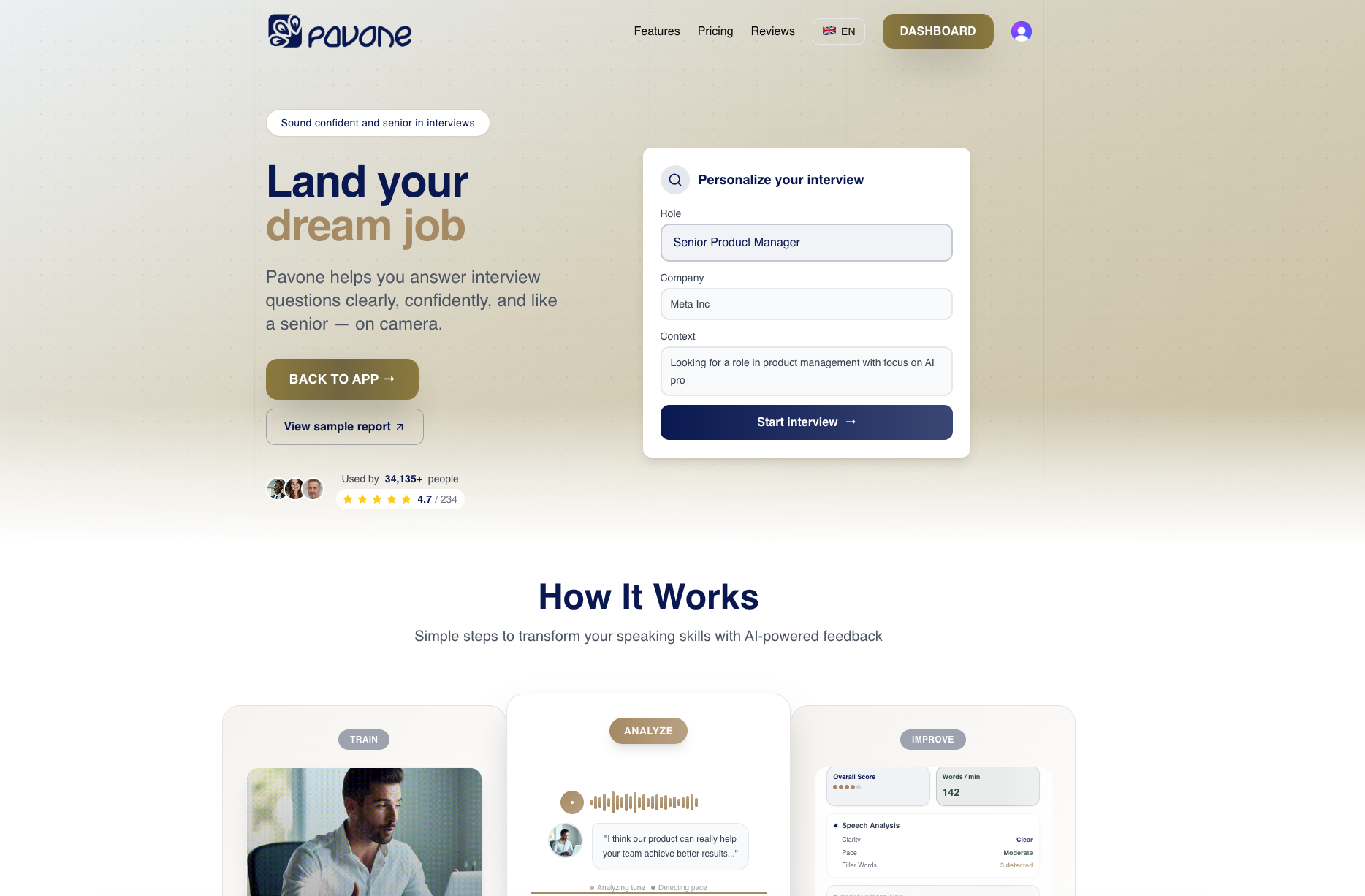
For professionals who want to sharpen their on-camera confidence specifically, the interview practice on camera resource walks you through how to project composure and structure responses under real interview conditions. You can also explore the video interview confidence course to build the delivery skills that make technical expertise truly visible in a hiring context.
Frequently asked questions
What is the best way to prepare for Oracle interview scenario questions?
Focus on practising real-world troubleshooting aloud, using the STAR method to structure clear, confident responses. Articulating step-by-step troubleshooting on camera builds the fluency and confidence that mid-senior interviewers expect.
How do I explain hot vs cold backup in interviews?
Hot backups occur while the database is running and require ARCHIVELOG mode, whereas cold backups need the database shut down and are simpler but cause downtime. Always mention RMAN as the preferred tool for both approaches.
What tools should I mention for Oracle performance troubleshooting?
Always mention AWR, Statspack, EXPLAIN PLAN, and V$ views like V$SESSION when discussing performance tuning. These tools together give a complete picture of wait events, execution plans, and missing indexes.
What is a model answer to the ORA-01555 ‘snapshot too old’ error?
Increase UNDO_RETENTION, adjust the undo tablespace size, and tune long-running queries to prevent the error recurring. Resolving ORA-01555 also involves reviewing whether queries overlap with active undo segments during peak load.
How important is on-camera communication for Oracle interviews?
Clear, structured on-camera answers make a strong impression and boost your perceived seniority and expertise. Using the STAR method and pausing to structure your response before speaking are two habits that immediately elevate how you come across.
Recommended
Ready to practice?
Start improving your speaking skills with AI-powered feedback and analysis.
Try Pavone Free