
Top JP Morgan interview questions and expert strategies

TL;DR:
- JP Morgan’s interview process includes online assessments, technical and behavioral interviews, and a final cultural fit stage.
- Success requires demonstrating core qualities like analytical thinking, risk awareness, and leadership judgment through structured responses.
- Practicing clear communication, handling edge cases, and mastering video interview skills give candidates a competitive edge.
JP Morgan is one of the most selective employers in global finance. Each year, thousands of candidates compete for a limited number of roles, and the interview process is deliberately rigorous. Whether you’re pursuing a position in technology, investment banking, or risk management, you’ll face a combination of technical assessments, behavioural questions, and case scenarios designed to reveal how you think under pressure. This guide breaks down what to expect, which questions appear most often, and exactly how to prepare your answers so you walk into that interview ready to perform at your best.
Table of Contents
- Understanding JP Morgan’s interview process
- Essential JP Morgan interview questions for mid-to-senior roles
- How to craft stand-out answers using the STAR technique
- Comparison of JP Morgan interview question types and ideal approaches
- Why mastering the softer edge cases gives you an advantage
- Take your JP Morgan interview prep to the next level
- Frequently asked questions
Key Takeaways
| Point | Details |
|---|---|
| Understand question motives | Knowing why each question is asked helps you tailor answers to what JP Morgan wants to see. |
| Master technical details | Be prepared for edge cases, audit trail scenarios, and low-latency requirements, especially in technical rounds. |
| Structure behavioural answers | Use the STAR framework to clearly demonstrate decision-making and leadership in your experiences. |
| Practise for virtual delivery | Success in video interviews depends on body language and clear, confident communication. |
| Use targeted preparation tools | Leverage online generators and practice platforms to build confidence and answer clarity. |
Understanding JP Morgan’s interview process
Before you can prepare effectively, you need a clear picture of how JP Morgan structures its interviews. The process typically unfolds across three main stages, each with a distinct purpose.
- Online assessment — This usually comes first and includes numerical reasoning, coding challenges, or situational judgement tests. It filters for raw analytical ability before you speak to a single person.
- Technical and behavioural interviews — These rounds probe both your subject matter expertise and how you handle real-world challenges. Expect deep-dive questions on your specific function, whether that’s software engineering, finance, or operations.
- Final round — Often involving senior stakeholders, this stage focuses on cultural fit, leadership potential, and decision-making under ambiguity.
For mid and senior role interview guidance, the bar is significantly higher. JP Morgan looks for three core qualities across every stage: analytical thinking, risk awareness, and leadership judgement. These aren’t just buzzwords. Every question is designed to reveal whether you genuinely possess them.
One thing that surprises many candidates is how technically specific the assessments become. Edge cases are emphasised in coding and finance-specific assessments, meaning you’ll need to demonstrate that you’ve thought beyond the obvious scenario. Can you handle an empty input? What happens when data is duplicated? How do you ensure an audit trail if something goes wrong?
“JP Morgan doesn’t just want to know that you can do the job — they want evidence that you’ve thought through what could go wrong and how you’d respond.”
Soft skills matter here too. Communication, stakeholder management, and the ability to explain complex ideas clearly are all evaluated, often implicitly, throughout every stage.
Pro Tip: Before your interview, map out two or three examples from your career that demonstrate each of the three core qualities JP Morgan values. Having these stories ready saves you from scrambling mid-interview.
Essential JP Morgan interview questions for mid-to-senior roles
Understanding the process highlights what JP Morgan values. Now let’s look at the questions you’ll likely face.
JP Morgan interviews in 2025 and 2026 cycles have consistently featured a mix of technical and behavioural questions. Here’s a breakdown of what to expect.
Technical questions you should prepare for:
- How would you handle duplicate transactions in a payment processing system?
- What approach would you take when a function receives an empty or null input?
- Walk me through how you’d build an audit trail for a financial transaction.
- How do you handle negative values in a risk calculation model?
- Explain idempotency and why it matters in financial systems.
Behavioural and situational questions:
- Describe a time you had to make a high-stakes decision with incomplete information.
- Tell me about a situation where you identified a risk that others had overlooked.
- How have you managed conflict within a cross-functional team?
- Give an example of a time you influenced a senior stakeholder without direct authority.
For broader preparation, reviewing business interview questions for seniors and common senior role questions will give you a strong foundation across categories.
What’s revealing about these questions is what they’re actually measuring. Finance-specific technical questions assess audit trails and error handling, which signals that JP Morgan isn’t just testing knowledge. They want to see a mindset that anticipates failure and designs for resilience. For senior candidates especially, the ability to speak about risk with precision and confidence is what separates good answers from outstanding ones.
Behavioural questions, meanwhile, are designed to uncover your real decision-making patterns. JP Morgan knows that polished answers can be rehearsed. They’re listening for the specifics: the actual context, the genuine conflict, the measurable result.

How to craft stand-out answers using the STAR technique
Equipped with sample questions, here’s how to craft answers that work in practice.
The STAR technique gives your answers a clear, logical structure that makes them easy to follow and evaluate. It stands for:
- Situation — Set the scene. Keep it brief and factual. What was happening, and why did it matter?
- Task — What was your specific responsibility? Be precise about your role, not the team’s role.
- Action — This is the heart of your answer. Describe exactly what you did, the decisions you made, and why you made them.
- Result — Quantify wherever possible. What changed? What was the measurable impact?
Here’s how this looks in practice for a JP Morgan-style question:
Question: Tell me about a time you identified a financial risk that others missed.
Situation: During a quarterly reconciliation at my previous firm, I noticed a recurring discrepancy in overnight funding positions. Task: I was responsible for sign-off on the daily report, which meant the error would carry my name. Action: I traced the discrepancy back to a manual data entry step that lacked validation controls. I flagged it to the risk team and proposed an automated check with a full audit trail. Result: The fix was implemented within two weeks and prevented an estimated £200,000 in misreported exposure over the following quarter.
Clarity in answers and focus on audit trails enhance evaluation scores, which is why the result stage of your STAR answer deserves particular care. Vague results like “the team improved” won’t land. Numbers, timeframes, and concrete changes do.
To build answering interview questions confidently, practise delivering your STAR answers out loud. Saying something aloud is very different from thinking it through in your head.
Pro Tip: Limit each STAR answer to around 90 seconds when spoken. Any longer and you risk losing the interviewer’s attention before you reach the result.
Comparison of JP Morgan interview question types and ideal approaches
To help you decide where to focus, here’s how common question types compare and the ideal way to tackle each.
| Question type | What it tests | Ideal approach | Common pitfall |
|---|---|---|---|
| Technical | Problem-solving, edge case awareness | Step-by-step reasoning, mention error handling | Skipping edge cases or giving incomplete logic |
| Behavioural | Judgement, leadership, communication | STAR structure with specific, measurable results | Being vague or describing team actions instead of your own |
| Case or scenario | Business awareness, structured thinking | Framework-led response (e.g. issue tree, cost-benefit) | Jumping to solutions before diagnosing the problem |
Technical and low-latency assessments require unique preparation approaches, which is why treating each question type as a separate discipline pays off.
Key strategies by question type:
- Technical: Always walk your interviewer through your reasoning process, not just your answer. State your assumptions, identify edge cases, and explain trade-offs.
- Behavioural: Practise three to five career stories that can flex to fit multiple questions. Specificity is your strongest asset.
- Case or scenario: Resist the urge to answer immediately. Take 30 seconds to structure your thinking visibly. Interviewers reward organised minds.
Building clarity in corporate interviews takes deliberate effort, particularly for senior candidates who are used to communicating in shorthand with expert colleagues. In an interview, you need to slow down and make your logic visible.
Why mastering the softer edge cases gives you an advantage
Here’s something that most interview guides won’t tell you. At the senior level, most candidates who reach the final round are technically competent. The person who gets the offer is rarely the one with the strongest technical knowledge. It’s the one who communicates their thinking most clearly and confidently.
JP Morgan panels notice subtle signals. How you handle a question you don’t know the answer to. Whether you pause to think or fill silence with filler words. How you signal confidence without arrogance. These are the softer edge cases of interviewing, and they’re just as worth preparing for as any coding problem.
Candidates who practise for video interview outcomes consistently outperform those who only rehearse content. Delivery matters. Eye contact, pacing, and how you frame uncertainty all factor into the impression you leave. The candidates who master these details don’t just answer questions well. They feel like leaders from the moment they open their mouths.
Take your JP Morgan interview prep to the next level
Knowing the right strategies is only half the work. The other half is practising them until they feel natural.
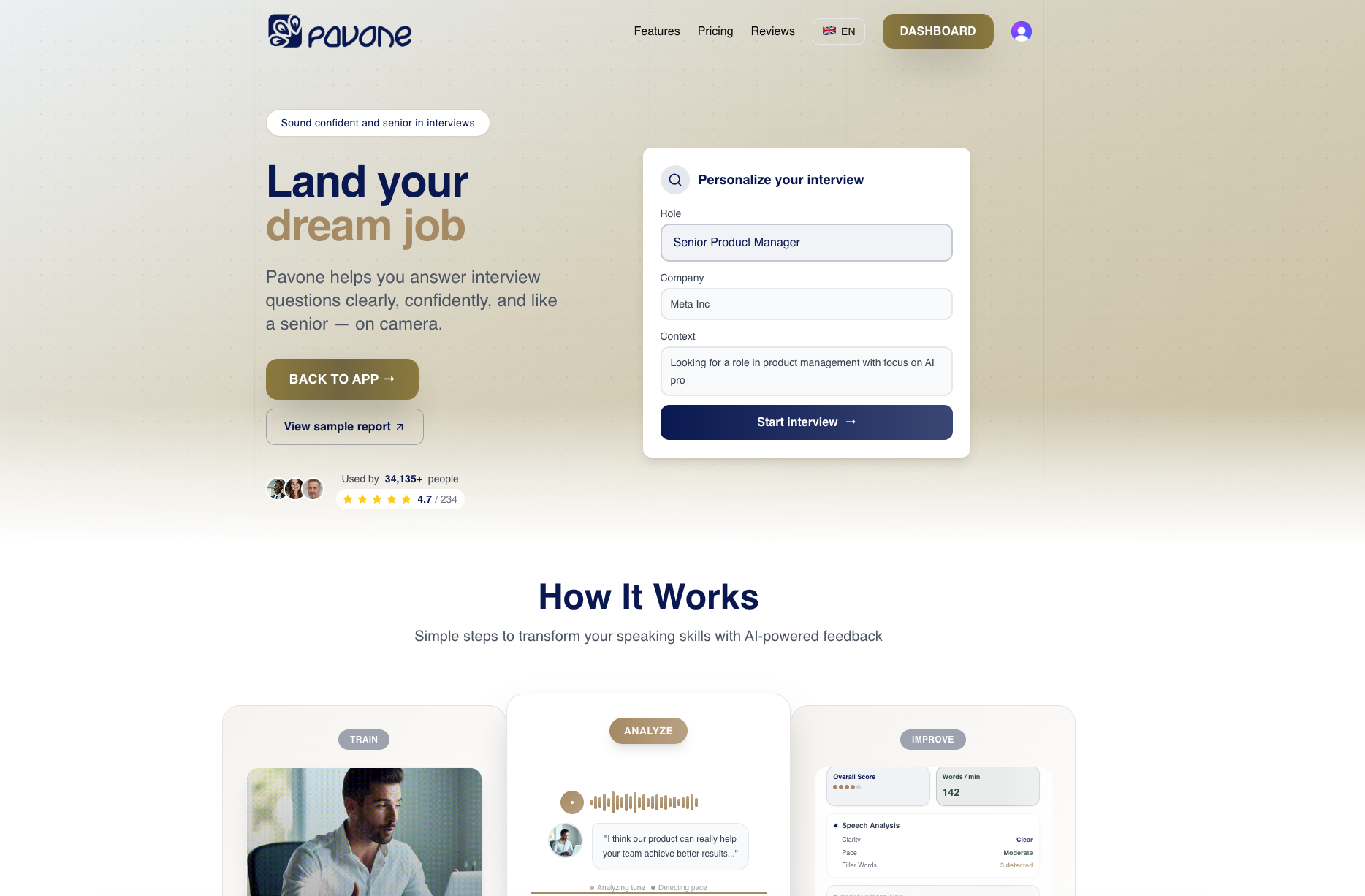
Pavone.ai gives you a private, pressure-free space to record your answers to JP Morgan-style questions and receive immediate feedback on your delivery, structure, and confidence. You can generate personalised interview questions tailored to your target role and use video interview confidence tools to sharpen how you come across on screen. Whether you want to reduce filler words, improve your pacing, or master online interview practice, Pavone helps you make measurable progress before the real thing.
Frequently asked questions
Which coding topics are most important for JP Morgan interviews?
Edge cases are emphasised in coding questions, so prioritise handling empty inputs, duplicates, and error conditions alongside core data structures and algorithms.
What behavioural qualities does JP Morgan value?
JP Morgan places high value on integrity, sound decision-making, and the ability to manage pressure while communicating clearly with stakeholders at every level.
How can I stand out in a senior JP Morgan interview?
Demonstrate business awareness, frame your answers around risk and oversight, and use structured responses that show audit trails and oversight thinking at every step.
Should I practise video interviews for JP Morgan?
Yes. Many JP Morgan interview rounds are now held virtually, and practising on camera sharpens both your clarity and your confidence before the real conversation.
Recommended
Ready to practice?
Start improving your speaking skills with AI-powered feedback and analysis.
Try Pavone Free