
Navigate the Airbnb interview process with confidence

TL;DR:
- Airbnb’s interview process typically involves four stages: recruiter screen, technical or case interview, onsite loop, and final leadership round.
- Clear, structured communication and confidence on camera are crucial, especially for non-native English speakers.
- Effective preparation includes research, building responses, timed mock interviews, recording practice, and seeking feedback.
Airbnb does not publish a detailed, step-by-step guide to its interview process. If you have spent time searching the Airbnb Careers page hoping for a clear roadmap, you already know this. Most candidates piece together what to expect from Glassdoor reviews, TeamBlind threads, and third-party prep sites. For non-native English speakers aiming at mid-to-senior roles, that uncertainty carries an extra weight. This article cuts through the noise. We will map out the typical interview journey, explain what each stage demands, and give you practical tools to communicate with genuine clarity and confidence on camera.
Table of Contents
- Understanding the Airbnb interview journey
- What to expect: interview stages, questions and values
- Secrets to clear and confident on-camera performance
- Preparation hacks: practice, feedback, and ongoing improvement
- Why mastering clarity beats knowing every answer
- Supercharge your Airbnb interview preparation
- Frequently asked questions
Key Takeaways
| Point | Details |
|---|---|
| No official roadmap | Airbnb’s interview process isn’t clearly defined on their careers page and requires independent research. |
| Value alignment matters | Interview questions heavily emphasise Airbnb’s values as much as technical competence. |
| Video clarity is key | Clear, confident communication on camera can be a bigger differentiator than perfect answers, especially for non-native speakers. |
| Structured practice pays off | Mock interviews, feedback, and dedicated preparation tools lead to measurable improvement and confidence. |
Understanding the Airbnb interview journey
Once you have recognised the uncertainty, it is time to map out what you can actually expect. Because reliable insight depends on forums and prep sites rather than official documentation, the stages below reflect the patterns most consistently reported by candidates.
Typically, the process for a mid-to-senior role moves through four phases:
- Recruiter screen: A 30-minute call covering your background, motivations, and salary expectations. The recruiter is assessing cultural fit as much as qualifications.
- Technical or case interview: Depending on the role, this may involve a coding challenge, a product design exercise, or a strategic case study.
- Onsite or virtual loop: Usually three to five back-to-back sessions covering technical depth, cross-functional collaboration, and behavioural scenarios.
- Executive or final round: A conversation with a senior leader focused on leadership presence, values alignment, and long-term thinking.
| Stage | Airbnb | Typical large tech firm |
|---|---|---|
| Recruiter screen | Values-forward, culture emphasis | Largely CV-focused |
| Technical round | Blends competence and values | Primarily technical |
| Onsite loop | Often video-based, structured | Mix of in-person and video |
| Final round | Executive values conversation | Hiring manager sign-off |
For non-native English speakers, the virtual loop is where the pressure is most acute. You are being assessed on what you say and, critically, on how clearly you say it. Fatigue from back-to-back video calls can cause pacing to speed up and structure to collapse.
Pro Tip: Pay close attention to video-based rounds. Interviewers are assessing your clarity of thought as much as the content of your answers. Slowing down and signposting your ideas matters more than you might expect.
Building confidence on camera before the loop begins is one of the most impactful investments you can make. If nerves are a significant factor for you, there are also practical strategies for anxious candidates that address the psychological side of preparation alongside the technical.
What to expect: interview stages, questions and values
Having mapped the journey, let us go deeper into each stage and what you should prepare for.
| Stage | Format | Core focus |
|---|---|---|
| Recruiter screen | Phone or video | Motivation, values, fit |
| Technical round | Video with shared screen | Role-specific skills |
| Behavioural interview | Video | Values, past experience |
| Cross-functional session | Video | Collaboration, communication |
| Executive round | Video | Leadership, vision, culture |
Airbnb places its core values at the centre of the interview process. Questions are rarely purely technical. Interviewers want to understand how you think, how you treat colleagues, and whether you embody principles like Be a Host, which reflects genuine care for those around you. Most questions blend technical competence and value fit, a pattern consistently reported across preparation forums.
For behavioural questions, structure your answers clearly. The STAR method (Situation, Task, Action, Result) works well, but only if you use it with discipline.
- Set the scene briefly. One or two sentences to establish context, nothing more.
- State your specific role. Avoid saying “we did” when you mean “I did.” Interviewers want to understand your individual contribution.
- Describe your actions with precision. Focus on decisions and reasoning, not just activity.
- Quantify your result where possible. Numbers make outcomes credible and memorable.
- Connect back to values. End with a short reflection on what the experience taught you or how it shaped how you work.
Pro Tip: In video formats, rambling is penalised more heavily than in face-to-face settings. Interviewers lose the benefit of body language cues that signal engagement. Aim to complete each answer within 90 to 120 seconds and practise on-camera interview techniques that help you stay concise under pressure.
Secrets to clear and confident on-camera performance
With an understanding of questions and values, improving your performance on camera is the next crucial step.
Many non-native English speakers are highly articulate in their first language and technically strong in their field. The challenge is not knowledge. It is the gap between what you know and how it lands when you are speaking live on a screen, under pressure, in a second language. Clarity suffers when pace accelerates and nerves take over.
Here are specific techniques that make a measurable difference:
- Slow your pace intentionally. Speaking more slowly than feels natural to you will usually sound natural to the interviewer. Record yourself to check.
- Pause before answering. A two-second pause after a question signals confidence and gives you time to organise your thoughts. It is not a weakness.
- Use signposting language. Phrases like “There are two things I would highlight here” or “To summarise” give the interviewer a mental roadmap and make your answer easier to follow.
- Limit filler words. “Um,” “like,” and “you know” erode perceived seniority. Replacing them with a brief pause sounds far more polished.
- Make eye contact with the camera, not the screen. It feels unnatural at first, but it creates a sense of directness and confidence for the person watching.
Pro Tip: Record yourself answering a typical behavioural question and watch it back without sound first. Focus entirely on your facial expressions and body language. Then watch it again with sound. This two-pass review reveals things you simply cannot notice in the moment. Consistent camera interview practice is what separates candidates who improve quickly from those who plateau.
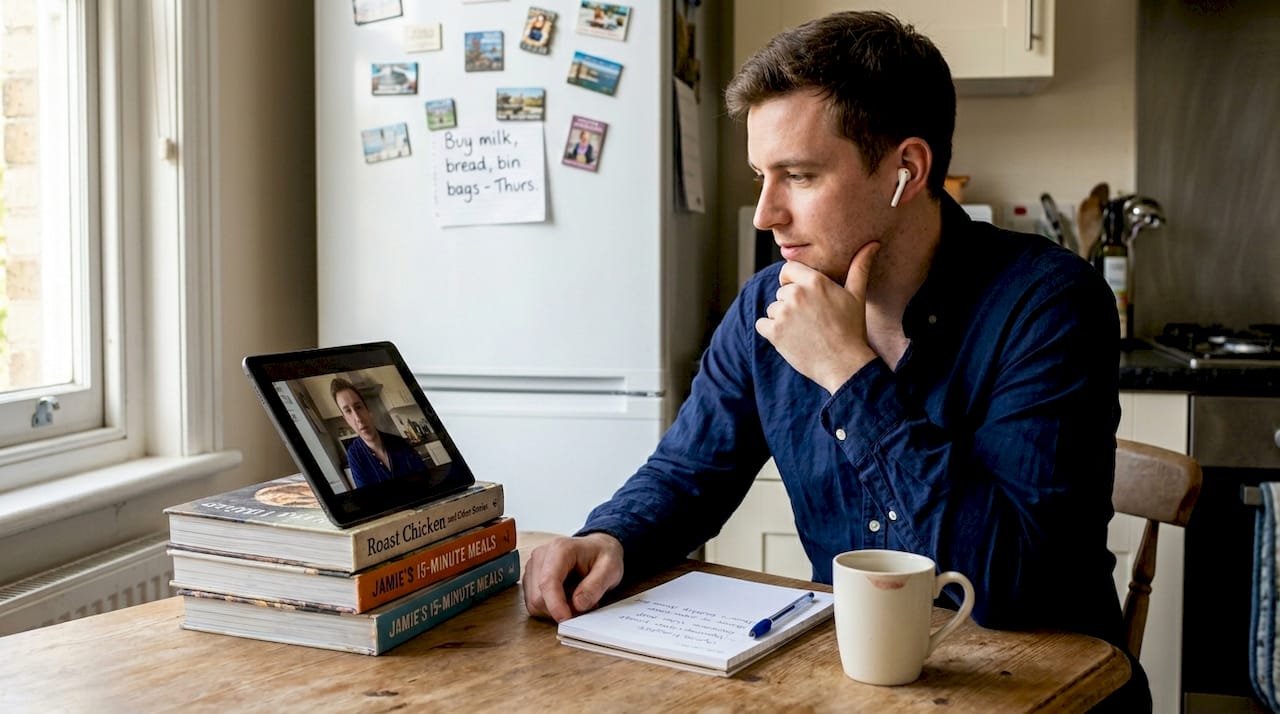
Clear, concise video communication is increasingly decisive in tech interview success, and those who practise in realistic conditions outperform those who only prepare mentally.
Preparation hacks: practice, feedback, and ongoing improvement
Once you know what to improve on, effective practice seals your preparation.
Effective interview preparation is not about cramming more answers. It is about building the habit of communicating clearly under conditions that replicate the real thing. Here is a practical process you can follow:
- Research the role and Airbnb’s values deeply. Read every job description word for word. Note which values appear most frequently and prepare specific examples that connect your experience to each one.
- Build your answer library. Write out STAR answers for 10 to 15 likely questions. Then convert them into spoken responses. The shift from written to spoken language matters enormously.
- Run timed mock interviews. Set a timer. Practise answering questions in 90 to 120 seconds. Stop when the time is up, even mid-sentence. This builds the discipline of concise delivery.
- Record every practice session. Do not rely on how the session felt. Watch it back and note specific moments where your pacing, structure, or confidence could improve.
- Seek feedback and iterate. Share recordings with a trusted colleague or use an AI-powered feedback tool. Identify patterns, not just one-off mistakes, and work on them systematically.
Useful resources to build into your preparation:
- Glassdoor and TeamBlind for real candidate experiences and sample questions specific to Airbnb roles
- Interview question generators that simulate role-specific scenarios so your answers connect to Airbnb’s context
- AI speaking coaches that transcribe your answers and flag filler words, pacing issues, and structural gaps
- Video replay tools that let you watch and score your own performance objectively
Review platforms and coaching sites are where candidates consistently find the most reliable insight into what Airbnb actually looks for, making them essential rather than optional in your preparation toolkit.
Why mastering clarity beats knowing every answer
Here is something that surprises many candidates: the person who gives a slightly imperfect answer with crystal-clear structure and calm delivery will almost always be rated more highly than the person who knows everything but communicates it messily. Airbnb interviews are designed to test how you think, not just what you know. At mid-to-senior levels, your ability to organise ideas quickly, communicate them crisply, and adapt in real time is the actual signal interviewers are reading.
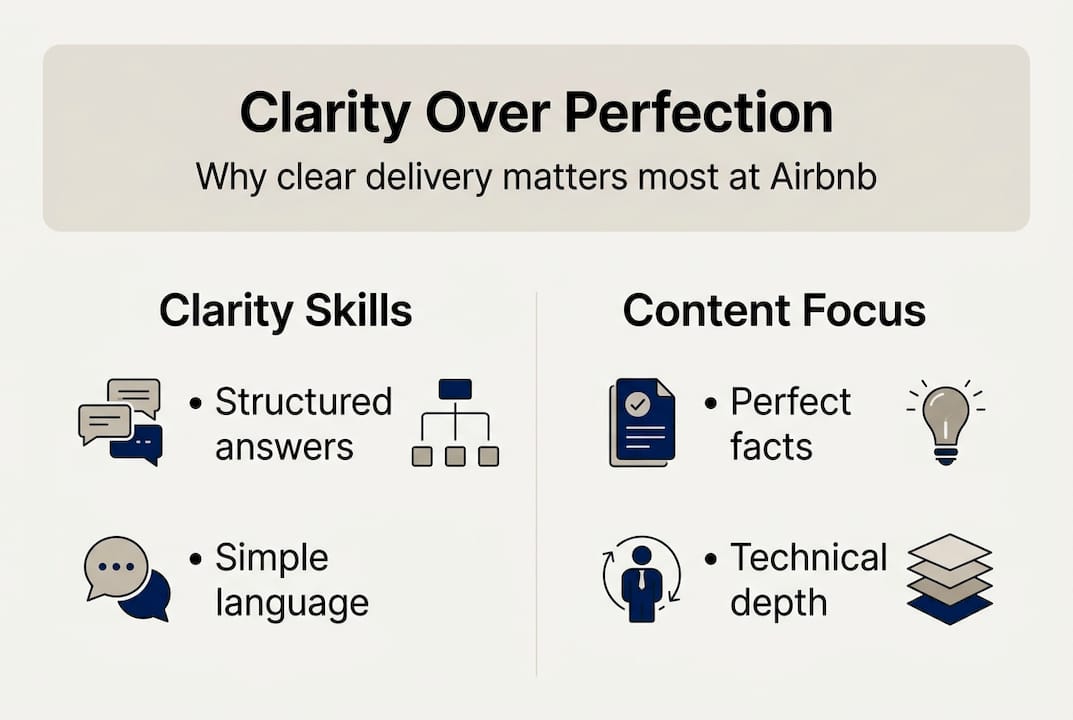
For non-native English speakers, this is genuinely good news. You do not need a perfect accent or native fluency. You need to be understood. You need your thinking to feel ordered and your presence to feel composed. Many successful candidates in senior Airbnb roles are non-native speakers who won those positions by demonstrating clear thought process and authentic engagement, not by reciting flawless answers.
Stop chasing the perfect answer. Start practising clear delivery. That shift in focus, from content to communication, is what will set you apart.
Supercharge your Airbnb interview preparation
Knowing what to prepare for is the first step. Actually practising it on camera, getting real feedback, and refining your delivery is where the real progress happens. Pavone.ai is built precisely for this moment in your journey.
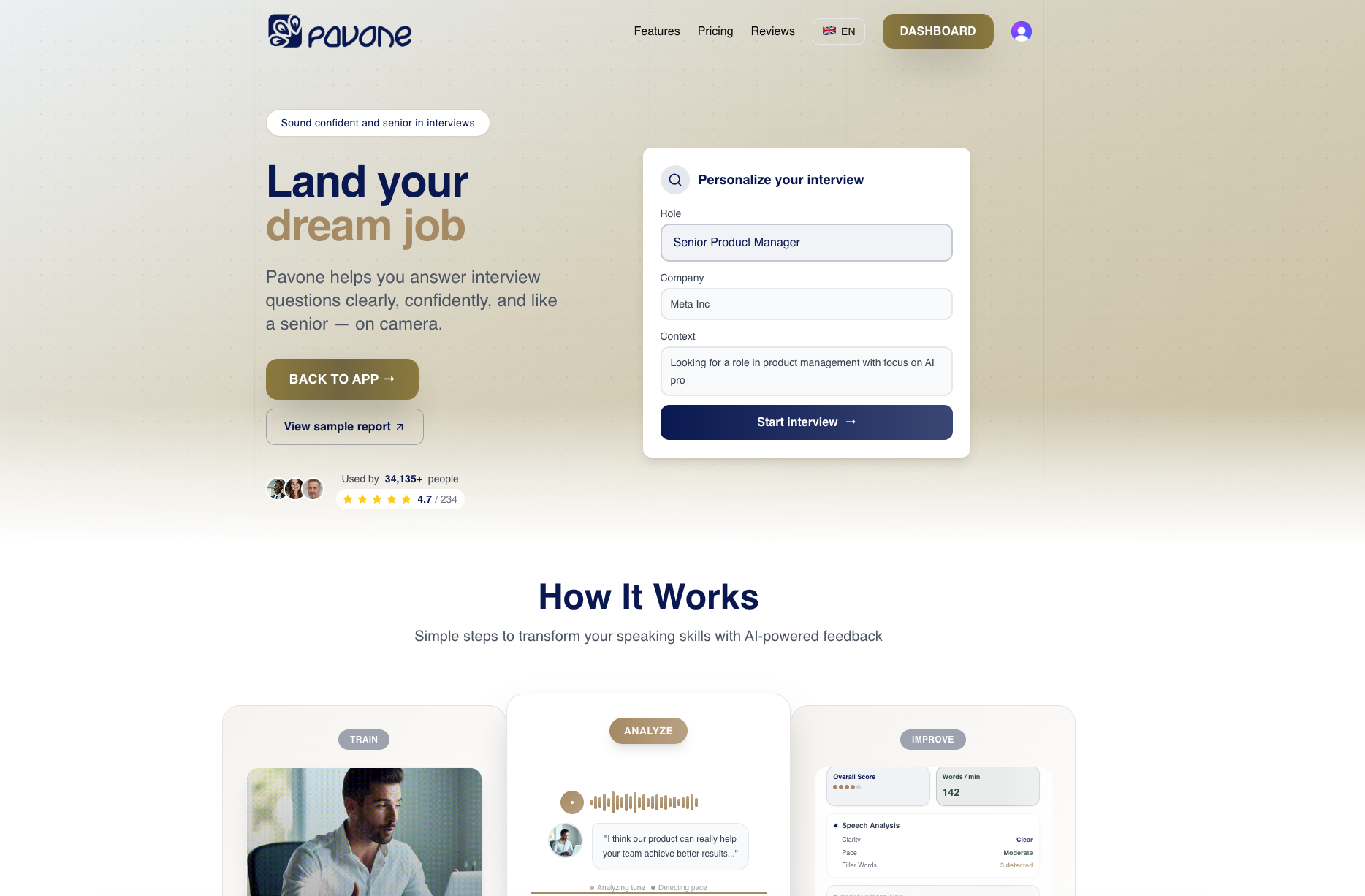
With Pavone, you can use the interview question generator to practise Airbnb-relevant scenarios, then record your answers and receive immediate, actionable feedback on clarity, structure, and pacing. Whether you need support with video interview preparation or want focused on-camera interview practice, Pavone gives you a private, pressure-free space to improve every single day. Your next Airbnb interview deserves more than hope. Give it genuine preparation.
Frequently asked questions
Is there an official step-by-step guide to the Airbnb interview process?
No. Airbnb does not publish a detailed process guide, so most candidates rely on third-party forums and preparation sites to understand what to expect at each stage.
What types of questions are common in Airbnb interviews?
Expect a mix of technical challenges and behavioural questions. Most questions blend competence with values alignment, particularly around how you work with and support others.
How important is clear communication for non-native English speakers?
Clear, concise communication is critical, especially across video-based rounds where your delivery and structure are evaluated as closely as your answers.
What is the best way to practise for Airbnb’s interview formats?
Combine timed mock interviews with recorded self-review and structured feedback. Review platforms and coaching sites are particularly useful for finding role-specific questions and realistic preparation scenarios.
Recommended
Ready to practice?
Start improving your speaking skills with AI-powered feedback and analysis.
Try Pavone Free