Choose the best AI interview tools for confident answers

Choosing the right AI interview tool can feel overwhelming when dozens of platforms promise to improve your on-camera communication. For mid-to-senior level job seekers, the stakes are high: you need feedback that genuinely sharpens your delivery, not generic advice that wastes your time. The best AI interview tools analyse your verbal clarity, pacing, body language, and confidence, helping you present yourself as polished and senior. This guide breaks down the key criteria for evaluating AI interview platforms, reviews the top options available in 2026, and shows you how to match the right tool to your career goals and budget.
Table of Contents
- How To Evaluate AI Interview Tools: Key Criteria For Selection
- Top AI Interview Tools To Improve Your On-Camera Confidence
- Comparison Of AI Interview Tools: Pricing, Accuracy, And Features
- Choosing The Right AI Interview Tool For Your Career Goals
- Boost Your Interview Confidence With Pavone AI Practice
- Frequently Asked Questions
Key takeaways
| Point | Details |
|---|---|
| AI tools boost communication | AI interview platforms improve clarity and confidence by 20-30% on average through personalised feedback. |
| Evaluate key features | Assess feedback accuracy, non-verbal analysis, cost-effectiveness, and language accent support before choosing. |
| Modular AI saves costs | Modular voice AI architectures offer better scalability and lower costs compared to integrated APIs. |
| Top tools vary widely | Leading AI platforms differ significantly in pricing, accuracy rates, and feature depth. |
| Match tool to goals | Select based on your interview preparation needs, budget constraints, and desired feedback focus. |
How to evaluate AI interview tools: key criteria for selection
When you’re comparing AI interview platforms, understanding the underlying technology helps you spot truly effective tools. AI-powered interview tools utilise Natural Language Processing and Machine Learning to analyse video and audio data, providing feedback on communication skills. These systems transcribe your answers, evaluate speech patterns, and assess non-verbal cues like eye contact and facial expressions. The sophistication of these algorithms directly impacts how useful the feedback will be for your preparation.
Accuracy matters most when you’re investing time in practice. Look for platforms that specify their speech recognition accuracy rates, especially if you have a regional accent or speak English as a second language. The best tools should catch filler words, identify pacing issues, and flag unclear explanations without generating false positives that undermine your confidence. Platforms that combine multiple AI models typically deliver more reliable insights than single-model systems.
Cost and scalability considerations become crucial if you’re preparing for multiple interviews over weeks or months. Some platforms charge per session, whilst others offer monthly subscriptions with unlimited practice. Modular AI architectures often provide better value because they allow providers to optimise costs at scale, potentially passing savings to users. Compare pricing structures carefully, factoring in how many practice sessions you realistically need.
User interface quality affects whether you’ll actually use the tool consistently. A clunky platform with confusing navigation wastes precious preparation time. Prioritise tools that let you quickly record answers, review feedback, and track improvement without wrestling with complicated menus. Personalised feedback should be specific and actionable, pointing to exact moments in your answer where you lost clarity or confidence rather than offering vague suggestions.

Data privacy deserves serious attention when you’re sharing recorded interview answers. Verify that platforms encrypt your data, specify retention policies, and don’t share your practice sessions with third parties. Mid-to-senior professionals especially need assurance that their interview preparation remains confidential and won’t surface in unexpected contexts.
Pro Tip: Test any AI interview tool with one or two practice sessions before committing to a subscription. This reveals whether the feedback style matches your learning preferences and whether the platform’s accuracy meets your standards.
When evaluating platforms, create a simple checklist covering these criteria:
- Speech recognition accuracy for your accent and speaking style
- Quality and specificity of verbal feedback (filler words, pacing, structure)
- Non-verbal analysis capabilities (eye contact, body language, facial expressions)
- Pricing model and total cost for your preparation timeline
- User interface simplicity and mobile accessibility
- Data privacy policies and security measures
- Integration options with other interview success strategies
Top AI interview tools to improve your on-camera confidence
Several leading platforms have emerged in 2026 that specifically target on-camera interview preparation with AI-driven feedback. Understanding each tool’s strengths helps you select the best fit for your preparation style and career level.
Pavone stands out for its focus on how you communicate rather than just what you say. The platform analyses verbal delivery elements like clarity, structure, pacing, and confidence whilst tracking improvement over time. Users record answers to common interview questions and receive immediate, specific feedback on filler words, rambling, and unclear explanations. The interface prioritises simplicity, making it easy to fit short practice sessions into a busy interview preparation schedule. Pavone particularly suits mid-to-senior professionals who need to sound more concise and confident without generic coaching advice.
InterviewStream offers comprehensive video practice with AI analysis of both verbal and non-verbal communication. The platform provides question banks organised by industry and role level, helping you prepare for specific interview scenarios. Feedback covers speech patterns, body language, and emotional presentation. The tool works well for candidates who want structured practice across multiple interview types, though the interface can feel complex for users seeking quick, focused sessions.
MyInterview combines AI analysis with optional human review, creating a hybrid approach to feedback. The platform’s AI evaluates your answers for clarity, confidence, and relevance whilst flagging areas where human coaching might add value. This modular approach offers flexibility, though costs increase significantly when adding human review sessions. The tool suits candidates who want AI efficiency with the option to escalate to expert feedback on challenging answers.
Deepgram technology powers several interview platforms with exceptional pricing, low latency, and accuracy for diverse English accents. Platforms using Deepgram’s voice AI typically deliver faster transcription and more reliable speech analysis than competitors, particularly for candidates with Indian, Australian, or other non-American accents. This technical advantage translates to more accurate feedback on verbal delivery.
Pro Tip: Prioritise platforms that show you specific timestamps where issues occur in your answers. Vague feedback like “improve your confidence” helps far less than “you used filler words at 0:34 and 1:12, breaking your answer’s flow.”
Key features to compare across these tools:
- Real-time vs post-recording feedback delivery
- Depth of non-verbal analysis (eye contact, posture, gestures)
- Question bank size and customisation options
- Progress tracking and improvement metrics
- Mobile app availability for flexible practice
- Integration with AI mock interview approaches
Comparison of AI interview tools: pricing, accuracy, and features
Understanding how leading AI interview platforms stack up across critical dimensions helps you make an informed choice. The table below compares key factors that impact your preparation effectiveness and budget.
| Platform | Pricing model | Speech accuracy | Non-verbal analysis | Best for |
|---|---|---|---|---|
| Pavone | Monthly subscription | 85-90% across accents | Eye contact, pacing | Busy professionals needing quick, focused practice |
| InterviewStream | Per-session or annual | 80-85% | Comprehensive body language | Structured preparation across multiple interview types |
| MyInterview | Tiered with human review | 82-87% | Facial expressions, posture | Candidates wanting AI plus optional expert feedback |
| Deepgram-powered tools | Variable by provider | 88-92% | Depends on implementation | Non-American accents requiring high accuracy |
Modular voice AI pipelines offer cost efficiency at scale compared to integrated speech-to-speech APIs, which explains why some platforms can offer lower subscription costs whilst maintaining high accuracy. Providers that build custom AI architectures using components like Deepgram for transcription and separate models for analysis can optimise performance and pricing more effectively than platforms relying on single-vendor solutions.
Accuracy rates matter significantly when you’re using feedback to refine your interview delivery. An 85% accuracy rate means the platform correctly identifies speech patterns, filler words, and pacing issues in roughly 17 out of 20 instances. Lower accuracy creates frustration when tools flag non-existent problems or miss genuine issues. For non-verbal analysis, current AI capabilities remain less precise than verbal assessment, typically achieving 60-70% accuracy in interpreting complex emotional states.
Pricing structures vary considerably, with monthly subscriptions ranging from £25 to £80 depending on features and session limits. Per-session pricing typically costs £8 to £15 per practice interview, which can exceed subscription costs if you need extensive preparation. Annual plans often provide 20-30% savings compared to monthly billing, making them worthwhile if you’re preparing over several months or anticipate ongoing interview activity.
Feature depth differs substantially across platforms. Some tools focus exclusively on verbal delivery, whilst others attempt comprehensive analysis including micro-expressions and vocal tone variations. More features don’t always mean better preparation, especially if complex feedback overwhelms you or highlights issues beyond your control. Mid-to-senior professionals often benefit most from platforms that excel at verbal clarity and confidence rather than trying to perfect every non-verbal nuance.
Consider your interview practice goals when weighing these factors. If you primarily need to eliminate filler words and improve answer structure, prioritise speech accuracy over extensive non-verbal analysis. If you struggle with on-camera presence, seek platforms with strong body language feedback even if they cost slightly more.
Choosing the right AI interview tool for your career goals
Matching an AI interview platform to your specific preparation needs requires honest assessment of your current skills and target improvement areas. Start by identifying your primary challenge: do you ramble and lose focus, use excessive filler words, appear nervous on camera, or struggle with answer structure? Different tools excel at different feedback types, so clarity about your weakness helps you select effectively.
Mid-to-senior level candidates often need different support than junior professionals. You likely have solid domain knowledge but may need help sounding more concise and confident when explaining complex topics. Tools that emphasise verbal clarity, pacing, and executive presence typically serve senior candidates better than platforms focused on basic interview etiquette. Your preparation should refine how you communicate expertise, not teach you what to say.
Budget constraints shape your options significantly. If you’re actively interviewing with multiple companies, investing £50-80 monthly in a comprehensive platform makes sense. For occasional interview preparation, per-session pricing or a basic subscription around £25-30 monthly provides adequate support without overspending. Remember that AI interview practice can reduce anxiety by 40% for senior professionals, making even modest investment worthwhile if it improves your performance.
Pro Tip: Schedule AI practice sessions at the same time of day as your actual interviews. If you’re interviewing at 10am, practise at 10am so you’re rehearsing your communication when your energy and focus match real conditions.
Follow these steps to maximise your chosen platform’s benefits:
- Record your first practice answer without reviewing the question extensively, capturing your natural response style.
- Review AI feedback carefully, noting the top three issues flagged most frequently across multiple answers.
- Focus improvement efforts on those top three issues rather than trying to perfect everything simultaneously.
- Re-record the same answer after addressing feedback, comparing the AI analysis to confirm improvement.
- Track your progress weekly, looking for measurable reductions in filler words, improved pacing scores, or better clarity ratings.
- Combine AI practice with mock interviews involving real people to validate that improvements translate beyond algorithmic assessment.
Interpreting AI feedback requires understanding current technological limitations. Current AI models achieve 60-70% accuracy in interpreting complex emotional states during interviews, meaning non-verbal feedback should inform rather than dictate your preparation. If AI flags your facial expressions as uncertain but you feel confident, trust your judgement whilst staying open to patterns across multiple sessions.
Integrating AI practice with human coaching creates the strongest preparation approach when budget allows. Use AI tools for frequent practice and immediate feedback, then schedule occasional sessions with interview coaches to address nuanced issues AI might miss. This hybrid model balances cost-effectiveness with the irreplaceable value of human insight into senior-level interview dynamics.
Boost your interview confidence with Pavone AI practice
If you’re ready to transform how you come across in interviews, Pavone offers the AI-powered practice platform designed specifically for professionals like you. The system analyses exactly what mid-to-senior candidates need most: clear, confident delivery that positions you as the senior hire you are. You’ll record real interview answers, receive immediate feedback on clarity, pacing, and filler words, then track improvement as your communication sharpens.
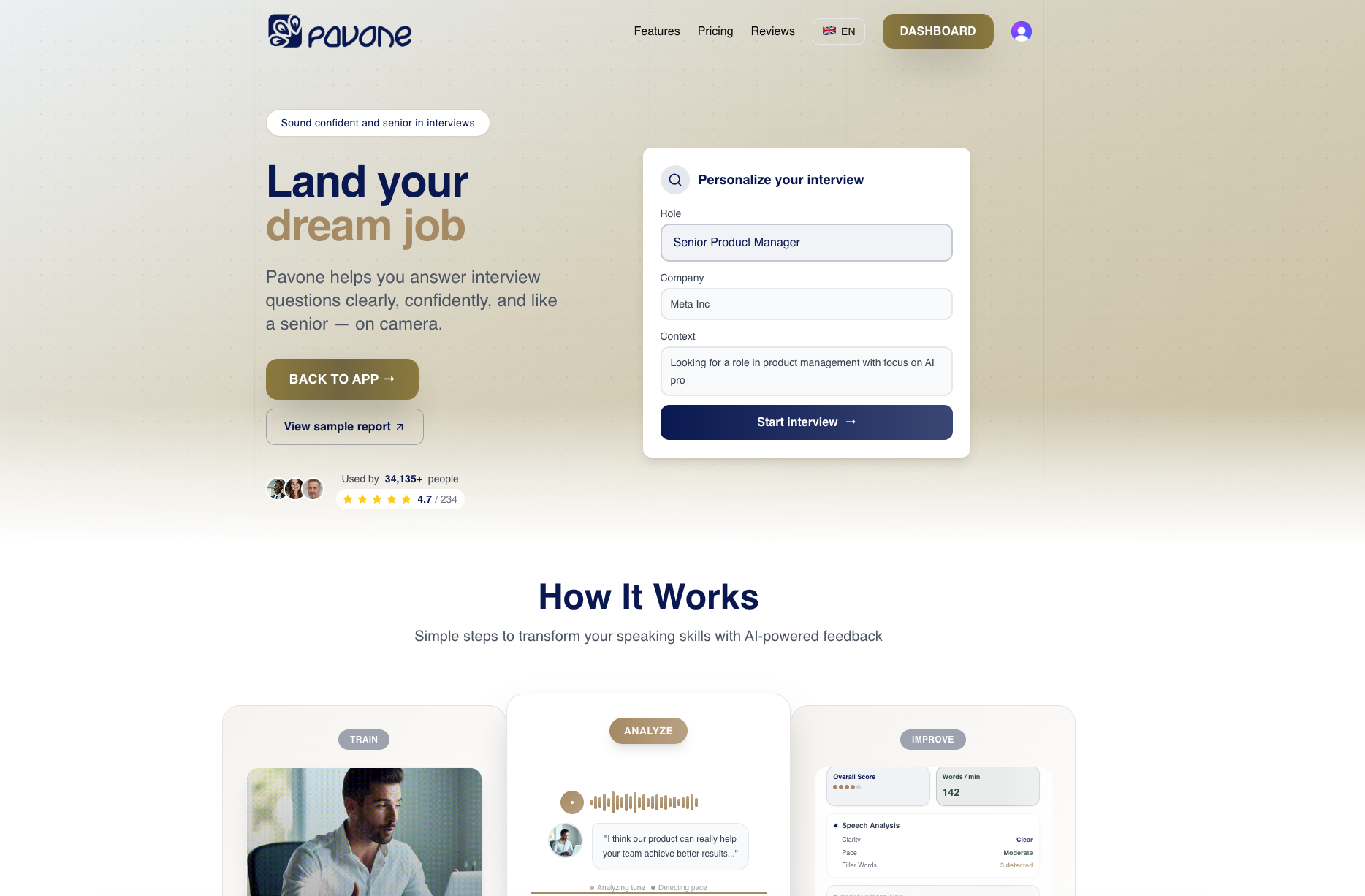
Pavone fits naturally into your interview preparation without complicated setup or time-consuming sessions. The platform focuses on how you communicate, not generic interview advice, helping you sound more concise and confident in actual conversations. Whether you’re preparing for one critical interview or managing an active job search, Pavone gives you the private, flexible practice space you need to perform your best.
Explore our interview preparation guide to understand how AI practice integrates with your overall strategy. Discover how professionals improve their answers fast using focused AI feedback. Ready to see the difference? Try Pavone’s AI mock interview platform and experience personalised feedback that actually changes how you interview.
Frequently asked questions
What are AI interview tools and how do they work?
AI interview tools use speech and video analysis powered by Natural Language Processing and Machine Learning to evaluate your interview answers. They transcribe what you say, analyse verbal patterns like filler words and pacing, and assess non-verbal cues including eye contact and facial expressions. The systems then generate personalised feedback highlighting specific areas for improvement in your communication delivery.
Can AI interview tools accurately assess body language and emotions?
AI achieves moderate accuracy of 60-70% when interpreting emotions and body language during interviews, making it useful for identifying obvious patterns but less reliable for subtle emotional nuances. The technology works best when combined with human feedback for complex situations requiring contextual understanding. Use AI body language insights as helpful indicators rather than definitive assessments of your non-verbal communication.
How much do AI interview practice platforms typically cost?
Pricing varies significantly across platforms, with monthly subscriptions ranging from £25 to £80 depending on features and session limits. Per-session pricing typically costs £8 to £15 per practice interview, which can exceed subscription costs for extensive preparation. Annual plans often provide 20-30% savings compared to monthly billing, making them cost-effective for longer preparation periods.
How can I maximise benefits from AI interview practice?
Practise regularly and review AI feedback carefully, focusing on the top three issues flagged most frequently rather than trying to perfect everything at once. Pay attention to both verbal clarity and non-verbal cues, re-recording answers after addressing feedback to confirm improvement. Combine AI practice with real interview simulations involving people to ensure improvements translate beyond algorithmic assessment. Learn more about mastering practice interviews for comprehensive preparation strategies.
Which AI interview tool works best for non-American accents?
Platforms using Deepgram technology typically deliver the highest accuracy for diverse English accents, including Indian, Australian, and British variations. These systems achieve 88-92% speech recognition accuracy across different accents compared to 80-85% for many competitors. Verify any platform’s accent support by testing it with your specific speaking style before committing to a subscription.
Recommended
Ready to practice?
Start improving your speaking skills with AI-powered feedback and analysis.
Try Pavone Free