
Top online interview practice platforms for mid-senior professionals

Selecting the right online interview practice platform can feel overwhelming when you need genuine, actionable feedback rather than generic advice. Many professionals preparing for mid-senior roles struggle to find tools that deliver meaningful insights on clarity, structure, and confidence. AI-powered platforms like InterviewCoach.ai, Big Interview, and Revarta provide video-based mock interviews with instant actionable feedback tailored to your career level. This article evaluates top platforms and criteria to help you practise effectively, reduce anxiety, and perform with confidence in real interviews.
Table of Contents
- Key takeaways
- How to choose the best online interview practice platform
- Top online platforms offering AI-powered mock interviews
- Hybrid approach: blending AI and human feedback for senior roles
- Common challenges and tips for effective online interview practice
- Boost your interview skills with Pavone’s AI-powered tools
- Frequently asked questions
Key Takeaways
| Point | Details |
|---|---|
| Video based practice | Video based mock interviews replicate real interview conditions and let you observe delivery and presence on camera. |
| AI plus human feedback | AI feedback provides instant actionable insights while human interpretation helps tailor improvement to the role. |
| Structured role aligned practice | Practice sessions are designed to mirror target role competencies with rubric scoring for behavioural and technical questions. |
| Behavioural and technical rubrics | Focusing on behavioural and technical rubrics improves confidence and directs precise improvements. |
| Hybrid practice approach | A hybrid approach using AI and human guidance accelerates readiness and reveals nuanced improvement areas. |
How to choose the best online interview practice platform
Video-based mock interviews simulate real interview conditions, allowing you to see how you come across on camera and adjust your delivery accordingly. This matters because most mid-senior interviews now happen remotely, and your screen presence directly influences how hiring managers perceive your confidence and professionalism. Look for platforms with rubric-based scoring aligned to mid-senior role expectations, such as STAR framework evaluation for behavioural questions and technical rubrics for domain-specific scenarios.
Feedback quality separates effective platforms from superficial tools. Prioritise systems that analyse speech clarity, body language, pacing, and confidence markers rather than just transcribing your words. These dimensions reveal how you communicate, not merely what you say. Session structure should include preparation time aligned to your target role, realistic 45-60 minute mock sessions that mirror actual interview length, and detailed feedback immediately after completion.
Pro Tip: Track your progress over multiple sessions by focusing on weak rubric areas identified in earlier attempts. This targeted approach delivers faster improvement than random practice and builds genuine confidence in your weaker competencies.
When evaluating platforms, consider these essential features:
- Video recording and playback capability so you can review your performance objectively
- AI-powered analysis of verbal and non-verbal communication patterns
- Rubric scoring that matches hiring criteria for your target role level
- Question banks covering behavioural, technical, and situational scenarios
- Progress tracking across sessions to measure improvement over time
The most effective preparation follows this sequence:
- Complete an initial mock interview to establish your baseline performance
- Review detailed feedback focusing on your lowest rubric scores
- Practise specific improvements in shorter focused sessions
- Repeat full mock interviews weekly to measure progress
- Adjust your focus based on evolving feedback patterns
This structured approach ensures you’re not just practising, but mastering interview practice with AI through deliberate improvement cycles.
Top online platforms offering AI-powered mock interviews
InterviewCoach.ai analyses confidence, speech clarity, and STAR framework adherence for behavioural questions, delivering instant feedback on how well you structure answers and communicate key points. The platform scores your responses across multiple dimensions, helping you identify whether you’re too verbose, lack specific examples, or fail to articulate impact clearly. Big Interview provides structured scenario-based mocks with rubric scoring specifically aligned to tech and leadership roles, making it particularly valuable for professionals targeting senior positions in competitive industries.
Revarta’s mock interviews score both technical and behavioural competencies using detailed rubrics and video feedback that highlights specific moments where your delivery faltered or excelled. This granular approach helps you understand exactly which seconds of your answer need refinement. When choosing between platforms, consider ease of use, feedback depth, and whether the question bank aligns with your target role’s requirements.
| Platform | Key features | Rubric detail | Session length | Pricing |
|---|---|---|---|---|
| InterviewCoach.ai | AI confidence analysis, STAR scoring, speech clarity metrics | Detailed behavioural rubrics with sub-scores | 30-45 minutes | Subscription-based |
| Big Interview | Scenario-based mocks, leadership focus, tech role alignment | Mid-senior rubrics matching company evaluations | 45-60 minutes | Monthly or annual plans |
| Revarta | Technical and behavioural scoring, video highlights | Granular competency rubrics with timestamped feedback | 45-60 minutes | Pay-per-session or subscription |
These platforms provide instant actionable feedback across multiple performance dimensions, helping you understand not just what to improve but precisely how to adjust your delivery. The best choice depends on your specific needs: InterviewCoach.ai excels for behavioural preparation, Big Interview suits leadership roles, and Revarta offers comprehensive technical assessment.
Consider these factors when selecting your platform:
- Question relevance to your target industry and seniority level
- Feedback turnaround time and level of detail provided
- Ability to customise practice sessions for specific companies or roles
- Integration with progress tracking and improvement metrics
- Access to supplementary resources like example answers or coaching tips
Your body language in interviews significantly impacts how interviewers perceive your confidence and competence. Platforms that analyse non-verbal cues help you refine posture, eye contact, and gestures alongside your verbal responses. This holistic feedback approach ensures you’re preparing for the complete interview experience, not just rehearsing scripted answers.

Pro Tip: Use AI mock interview tools for volume practice early in your preparation, then focus on platforms with deeper rubric analysis as you refine specific competencies.
Hybrid approach: blending AI and human feedback for senior roles
AI excels at volume and objective rubric scoring, processing your responses instantly and identifying patterns across multiple sessions that you might miss. However, AI misses subtle cues like executive presence, cultural fit, and the nuanced communication style that distinguishes senior candidates from mid-level ones. Human coaches provide personalised, context-aware feedback on leadership impact and how your communication style aligns with specific company cultures or industry expectations.
Senior roles emphasise autonomy, navigating ambiguity, and explaining complex trade-offs rather than just demonstrating technical competence. These dimensions require deeper feedback that considers your strategic thinking and decision-making frameworks, not merely whether you followed STAR structure. Combining AI’s instant feedback with human insight offers optimal preparation for complex senior role nuances and leadership qualities that algorithms struggle to assess fully.
Use AI platforms for initial repetition and confidence building, completing 5-7 sessions to establish baseline competency and comfort with common question types. Once you’re consistently scoring well on AI rubrics, schedule human coaching sessions to refine executive presence, storytelling impact, and strategic communication. This sequenced approach maximises efficiency whilst ensuring you develop the nuanced skills senior roles demand.
“AI provides the reps, humans provide the refinement. For senior roles, you need both to compete effectively against other experienced candidates who’ve mastered not just what to say, but how to say it with authority.”
Pro Tip: Record your hybrid sessions to track improvements over time and prepare for unexpected interview dynamics like challenging follow-up questions or scenario pivots that test your adaptability.
Consider these benefits of the hybrid approach:
- AI handles objective metrics like pacing, filler words, and structure consistency
- Human coaches assess subjective factors like gravitas, authenticity, and leadership tone
- Combined feedback accelerates improvement by addressing both technical and interpersonal dimensions
- Cost-effectiveness through AI volume practice supplemented by strategic human sessions
- Comprehensive preparation covering both predictable patterns and unique scenarios
This balanced strategy ensures you’re cutting anxiety through repetition whilst building the sophisticated communication skills that differentiate senior candidates in competitive hiring processes.
Common challenges and tips for effective online interview practice
Avoiding feedback from friends or colleagues who lack interview expertise prevents bias and unhelpful advice that sounds supportive but doesn’t improve your performance. Well-meaning peers often focus on content rather than delivery, missing critical issues with pacing, confidence markers, or structural clarity that trained evaluators immediately notice. Common pitfalls include friend feedback bias, ignoring non-verbal cues, and difficulty verbalising edge cases in technical interviews.
Consistently practise verbalising 3-5 edge cases for technical scenarios to showcase critical thinking beyond standard solutions. Many candidates understand edge cases conceptually but struggle to articulate them clearly under pressure, which signals incomplete mastery to interviewers. Pay attention to non-verbal signals like pace, eye contact, and body language during practice sessions, as these dimensions communicate confidence and competence as powerfully as your words.
Structure behavioural answers using STARL (Situation, Task, Action, Result, Learned) rather than just STAR to demonstrate continuous improvement and self-awareness. The “Learned” component shows reflection and growth mindset, qualities particularly valued in senior roles where adaptability matters as much as past achievements. This framework ensures your stories communicate both competence and development trajectory.
Pro Tip: Use rubrics and self-recordings for objective self-assessment between formal practice sessions. Reviewing your own performance against specific criteria builds awareness faster than passive practice alone.
Address these specific challenges systematically:
- Record yourself answering the same question three times, then compare versions to identify improvement patterns
- Practise transitioning between different question types to build mental flexibility
- Time your answers to ensure you’re neither too brief nor excessively detailed
- Review feedback immediately after sessions whilst the experience remains fresh
- Focus each practice session on one specific improvement area rather than trying to fix everything simultaneously
Avoid these common mistakes that undermine practice effectiveness:
- Memorising scripted answers that sound rehearsed rather than conversational
- Practising only comfortable question types instead of challenging scenarios
- Ignoring feedback patterns that appear across multiple sessions
- Failing to simulate interview pressure through timed, uninterrupted sessions
- Neglecting to prepare follow-up answers for likely interviewer probes
Effective online practice requires deliberate focus on weak areas identified through objective feedback. Master simulated interview skills by treating each session as genuine preparation, not casual rehearsal, and you’ll build the confidence and competence that translates directly to real interview performance.
Boost your interview skills with Pavone’s AI-powered tools
Pavone offers structured AI-powered mock interviews with nuanced rubric feedback specifically designed for mid-senior professionals who need to refine how they communicate on camera. The platform analyses clarity, structure, pacing, confidence, and delivery, helping you sound more concise and senior in actual interviews. Unlike generic practice tools, Pavone focuses on how you come across, not just what you say.
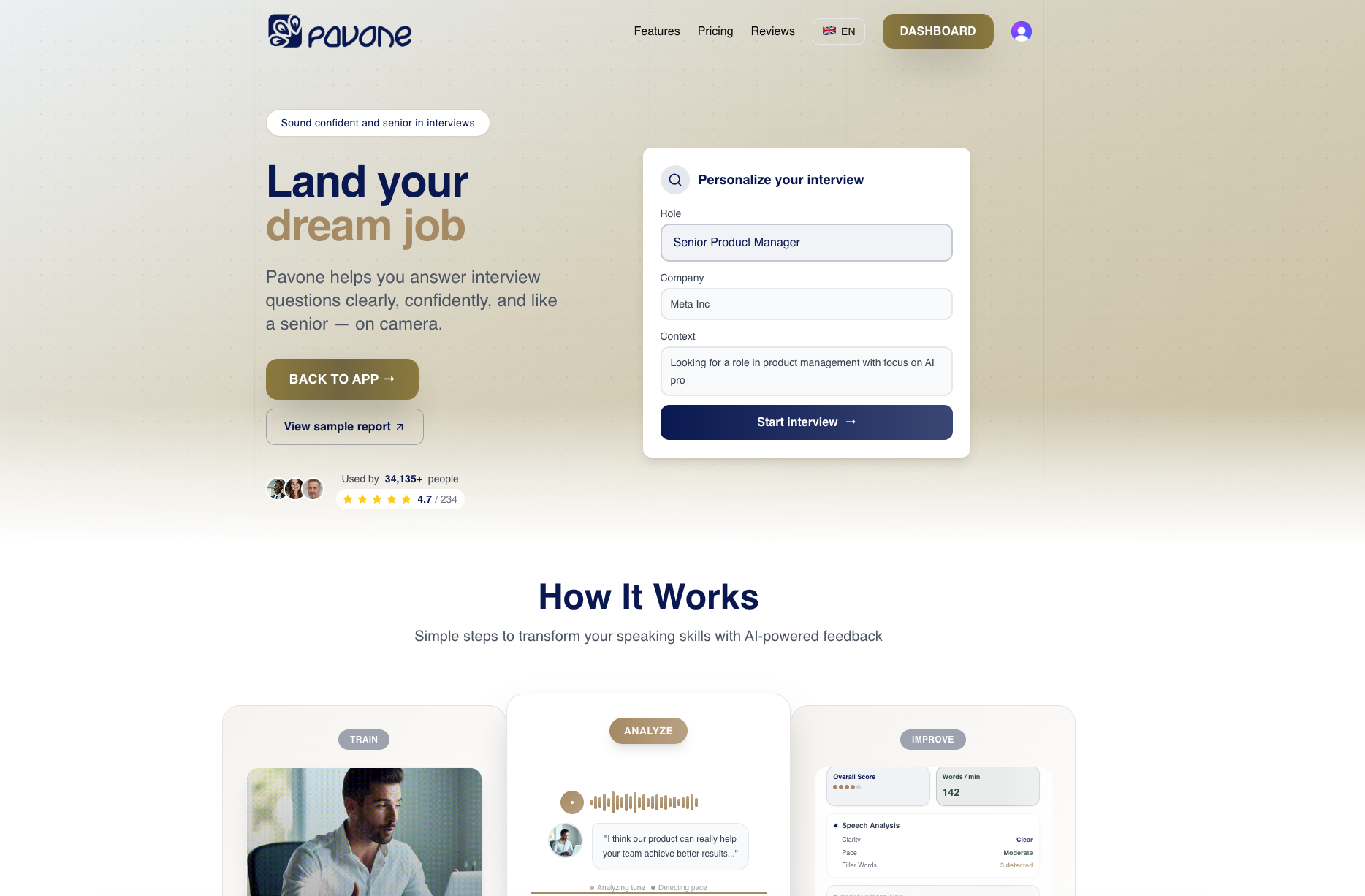
Access expert-led courses and practice modules tailored for mid-senior roles, with detailed feedback after each attempt that highlights specific moments requiring adjustment. Track your improvement over time as your answers become clearer and more confident through repeated, focused practice. Combine automated feedback with the option for professional coaching to refine executive presence and strategic communication style.
Visit the interview preparation guide to start building clear and confident delivery today. Master interview online practice through Pavone’s private, pressure-free environment that fits naturally into your active interview loop. Build interview practice confidence on camera with a personal interview coach available 24/7, designed specifically for professionals who want to reduce anxiety and perform better in real conversations.
Frequently asked questions
How many online mock interviews should I practise before a mid-level interview?
Aim for 5-10 mock sessions focusing on weak rubric areas to build confidence and skill. This number balances adequate practice with insight integration, allowing you to implement feedback between sessions. Regular review of rubric scores helps track improvement and readiness, ensuring you’re genuinely prepared rather than just practised.
Can AI mock interviews replace human coaching for senior roles?
AI offers immediate, objective feedback useful for technical and behavioural scoring across consistent dimensions. However, human coaching adds critical insights on executive presence and context-specific communication that algorithms cannot fully assess. A hybrid approach combining both methods provides optimal preparation for senior positions.
What common mistakes should I avoid during online interview practice?
Avoid relying on biased feedback from friends without interview expertise, as they often focus on content rather than delivery quality. Do not neglect non-verbal cues such as eye contact and speaking pace, which communicate confidence as powerfully as your words. Practise articulating edge cases clearly in technical scenarios to demonstrate thorough critical thinking.
How long should each online mock interview session last?
Effective mock interviews should last 45-60 minutes to mirror actual interview length and build stamina for real conversations. Shorter sessions work for focused practice on specific question types, but full-length mocks help you manage energy and maintain quality throughout extended discussions. Schedule at least three full-length sessions before important interviews.
What rubric dimensions matter most for mid-senior interview preparation?
Focus on clarity, structure, confidence markers, pacing, and impact articulation as core dimensions for mid-senior roles. These factors distinguish candidates who communicate strategically from those who simply answer questions. Senior interviewers assess not just your experience but how effectively you convey complex ideas and demonstrate leadership presence through your delivery.
Recommended
Ready to practice?
Start improving your speaking skills with AI-powered feedback and analysis.
Try Pavone Free