
Master practice interviews online for confident performance

Most professionals spend hours researching common interview questions but still feel unprepared when the camera turns on. The difference between knowing what to say and communicating it confidently on screen is substantial. Feeling underprepared is a common negative experience tied to technical interviews, even amongst experienced candidates. Online practice interviews, particularly those powered by AI, offer a transformative solution. They provide immediate feedback on delivery, structure, and presence, helping you refine how you communicate rather than just what you say. This guide explores evidence-backed methods to practise interviews online effectively, build camera confidence, and significantly improve your hiring outcomes.
Table of Contents
- Why Practising Interviews Online Is Crucial For Professional Success
- How AI And Modular Voice Pipelines Enhance Online Interview Practice
- The Evidence: How Online Practice And AI Improve Interview Confidence And Outcomes
- Best Practices To Maximise The Impact Of Your Online Interview Practice
- Boost Your Confidence With Pavone’s Online Interview Practice Tools
Key takeaways
| Point | Details |
|---|---|
| Online practice builds confidence | Structured rehearsal reduces anxiety and improves on-camera communication skills for video interviews. |
| AI tools deliver faster feedback | Automated analysis identifies weak areas in delivery, tone, and structure more quickly than traditional methods. |
| Modular AI reduces costs | Voice AI pipelines cut preparation platform costs by 50%-80% whilst maintaining high-quality, scalable feedback. |
| Proven hiring success | Candidates using AI practice tools show 20-percentage-point higher success rates in final human interviews. |
Why practising interviews online is crucial for professional success
Mid-to-senior professionals face unique pressures during interviews. You’re expected to demonstrate strategic thinking, leadership presence, and polished communication, all whilst managing the unnatural dynamics of speaking to a camera. Traditional preparation methods like reading articles or mentally rehearsing answers fall short because they don’t simulate the real-time pressure of articulating your thoughts clearly under scrutiny. Online practice interviews address this gap by creating realistic scenarios where you can rehearse responses, refine body language, and build genuine confidence.
Video interviews have become standard across industries, making on-camera communication skills essential. Yet many candidates struggle with maintaining eye contact, managing filler words, or projecting authority through a screen. AI-driven mock interview tools simulate these conditions, allowing you to practise repeatedly in a private, low-stakes environment. This iterative process transforms nervous, rambling answers into concise, confident responses that demonstrate seniority.
Common challenges mid-to-senior professionals face include:
- Anxiety about being recorded and reviewed, leading to stilted or overly rehearsed delivery
- Difficulty structuring answers clearly under time pressure
- Overuse of filler words like “um,” “like,” or “you know” that undermine perceived competence
- Inconsistent pacing, either rushing through answers or losing momentum mid-response
- Poor camera presence, including weak eye contact or distracting body language
Research reveals that technical interview challenges generate high anxiety and feelings of underpreparedness, even amongst experienced professionals seeking senior roles.
The solution lies in deliberate, repeated practice with immediate feedback. Online platforms enable you to record answers, review your performance objectively, and adjust your approach before the stakes are high. This preparation method doesn’t just build confidence; it fundamentally improves how you communicate value to hiring managers.
How AI and modular voice pipelines enhance online interview practice
AI technologies have revolutionised interview preparation by making sophisticated feedback accessible and affordable. Modular voice AI pipelines, which separate speech recognition, natural language processing, and response generation into distinct components, offer significant advantages over integrated all-in-one APIs. These systems reduce costs by 50%-80% compared to bundled solutions, making high-quality practice tools scalable for platforms serving diverse candidate populations.
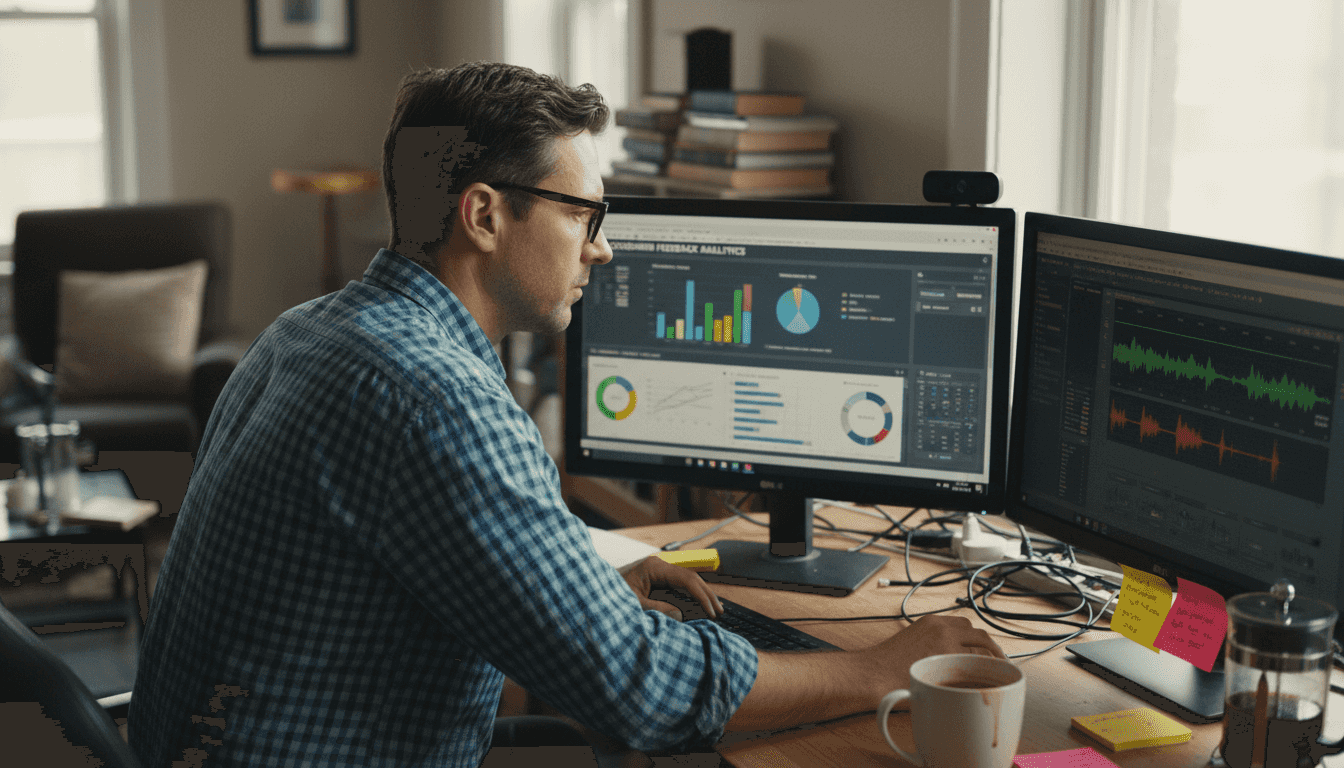
Whilst modular pipelines require more initial setup and technical expertise, they provide superior access to evaluation data. This granularity enables platforms to analyse specific aspects of your delivery, such as word choice, sentence structure, or tonal variation, rather than offering generic feedback. For candidates, this means actionable insights you can immediately apply to improve clarity and confidence.
Deepgram, a leading speech recognition provider, excels in latency and accuracy, particularly for diverse accents including Indian English. Low latency is critical for realistic practice because delayed feedback disrupts the natural flow of conversation, making rehearsal feel artificial. Accurate transcription ensures the AI analyses what you actually said, not a garbled approximation, leading to precise, relevant coaching.
| Feature | Modular voice AI pipelines | Integrated speech-to-speech APIs |
|---|---|---|
| Cost efficiency | 50%-80% lower at scale | Higher per-use costs |
| Latency | Optimised through component selection | Variable, often higher |
| Accuracy | High, especially with specialised providers | Moderate, dependent on bundled models |
| Scalability | Excellent for diverse user bases | Limited by API constraints |
| Setup complexity | Requires technical integration | Plug-and-play simplicity |
Pro Tip: When selecting an AI practice platform, prioritise tools that explicitly support your accent and interview context. Accuracy drops significantly when speech models aren’t trained on your linguistic patterns, leading to misleading feedback that undermines your preparation.
These technological foundations make AI-powered interview coaching practical for professionals who need flexible, private practice without scheduling human coaches. The result is a preparation experience that adapts to your schedule, provides consistent quality, and scales as you refine your skills.
The evidence: how online practice and AI improve interview confidence and outcomes
Research consistently demonstrates that AI mock interviews deliver measurable improvements in candidate performance and hiring success. A comprehensive study found that AI mock interviews improve graduate perceived employability and optimise real interview performance by providing structured practice opportunities that build confidence and articulation skills. These tools don’t just make candidates feel more prepared; they produce objectively better outcomes in actual hiring conversations.
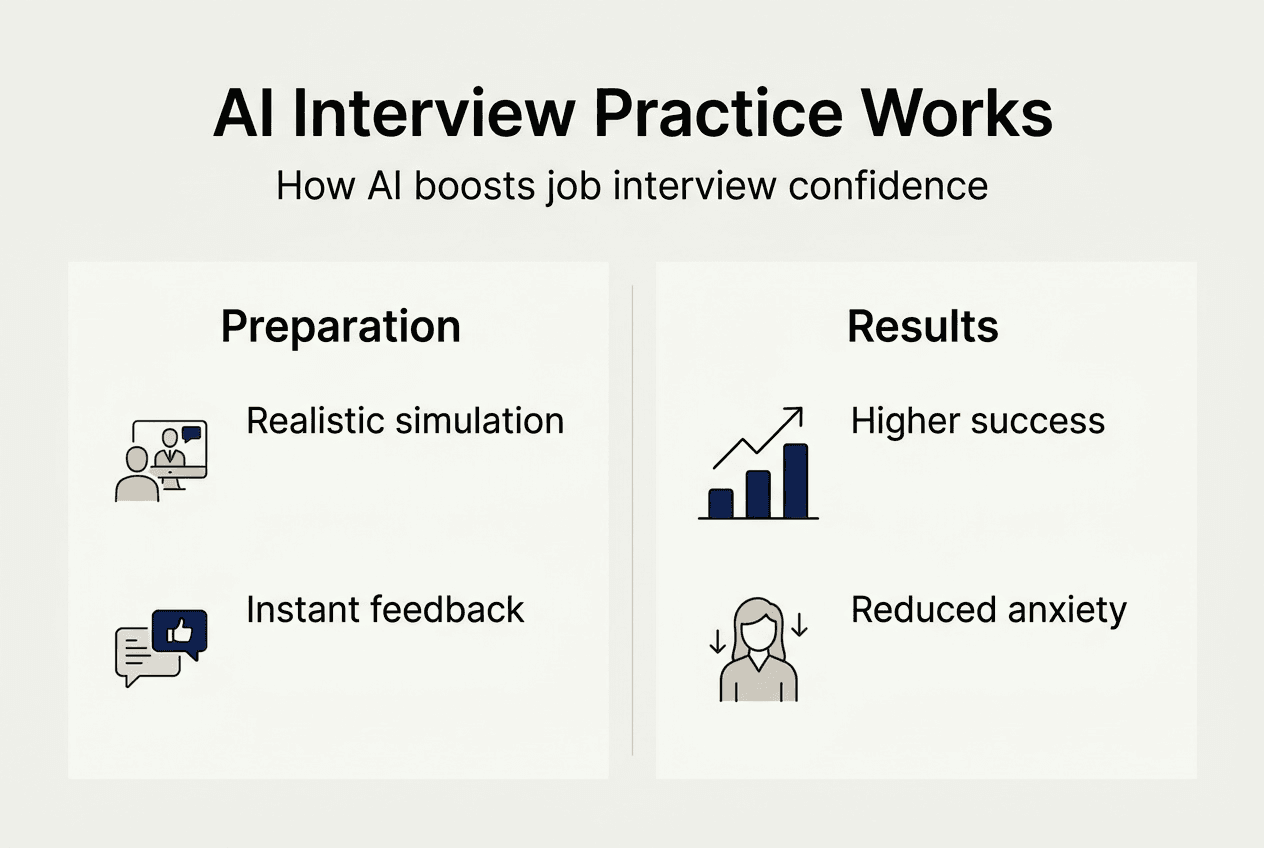
AI-driven mock interview tools realistically simulate technical interviews, creating pressure-tested environments where you can rehearse responses to challenging questions. This simulation effect is crucial because it desensitises you to interview stress, allowing you to focus on content and delivery rather than managing anxiety. Repeated exposure through online practice transforms interviews from high-stakes ordeals into familiar scenarios you’ve navigated successfully dozens of times.
Perhaps most compelling is data showing that candidates who pass AI interviews succeed in final human interviews at a 54% rate compared to 34% for those who don’t, representing a 20-percentage-point lift. This dramatic difference suggests AI practice tools don’t just correlate with success; they actively prepare candidates for the specific communication demands of real interviews.
| Metric | Impact |
|---|---|
| Perceived employability | Significant improvement amongst graduates using AI mock interviews |
| Final interview success rate | 54% for AI-pass candidates vs 34% for others (20-point lift) |
| Recruiter time savings | Automated screening reduces manual interview hours by up to 60% |
| Candidate confidence | Measurable increase in self-reported preparedness and reduced anxiety |
Key benefits of AI mock interview practice include:
- Reduced interview anxiety through repeated exposure to realistic scenarios
- Real-time feedback on delivery, structure, and presence that accelerates improvement
- Identification of resume inflation or skill gaps before high-stakes conversations
- Consistent evaluation standards that help you benchmark progress objectively
- Flexible scheduling that fits preparation into active job searches without coordination overhead
These outcomes aren’t limited to entry-level candidates. Mid-to-senior professionals benefit particularly from AI practice because it addresses the unique challenge of demonstrating executive presence on camera. The tools help you refine subtle communication signals like pacing, tone modulation, and concise framing that distinguish senior candidates from those still developing leadership skills.
Best practices to maximise the impact of your online interview practice
Effective online interview practice requires more than simply recording answers and reviewing feedback. Strategic preparation, deliberate repetition, and focused analysis transform raw practice into genuine skill development. Follow these steps to maximise your improvement:
- Identify 10-15 common interview questions relevant to your target role and seniority level, focusing on behavioural and situational scenarios.
- Record initial responses without preparation to establish a baseline of your natural communication style and identify immediate areas for improvement.
- Review recordings critically, noting filler words, pacing issues, weak eye contact, or unclear structure that undermine your message.
- Practise each question 3-5 times, incorporating feedback and refining your delivery until answers feel natural and confident.
- Simulate realistic interview conditions by dressing professionally, using proper lighting, and minimising distractions during practice sessions.
- Schedule practice sessions at times when you’re alert and focused, treating them as seriously as actual interviews.
- Track your progress over multiple sessions, celebrating improvements in specific metrics like reduced filler words or clearer answer structure.
- Share recordings with trusted peers or mentors for external perspective on how you come across on camera.
Pro Tip: Choose AI platforms that provide automated timely feedback based on generative language models. These systems analyse your responses immediately, highlighting specific moments where clarity faltered or confidence wavered, enabling rapid iteration.
Iterative practice is essential. Your first attempt at answering “Tell me about a time you led a difficult project” will likely be rambling and unfocused. By the fifth attempt, after incorporating feedback on structure and pacing, your answer becomes a compelling narrative that demonstrates leadership and results. This transformation doesn’t happen through mental rehearsal alone; it requires speaking answers aloud, reviewing your performance, and adjusting your approach.
Focus particularly on clarity, tone, and body language. Clarity ensures hiring managers understand your value proposition without confusion. Tone conveys confidence and authority appropriate to senior roles. Body language, even on camera, communicates engagement and professionalism. Mastering these elements through online practice gives you a decisive advantage in competitive hiring processes.
Boost your confidence with Pavone’s online interview practice tools
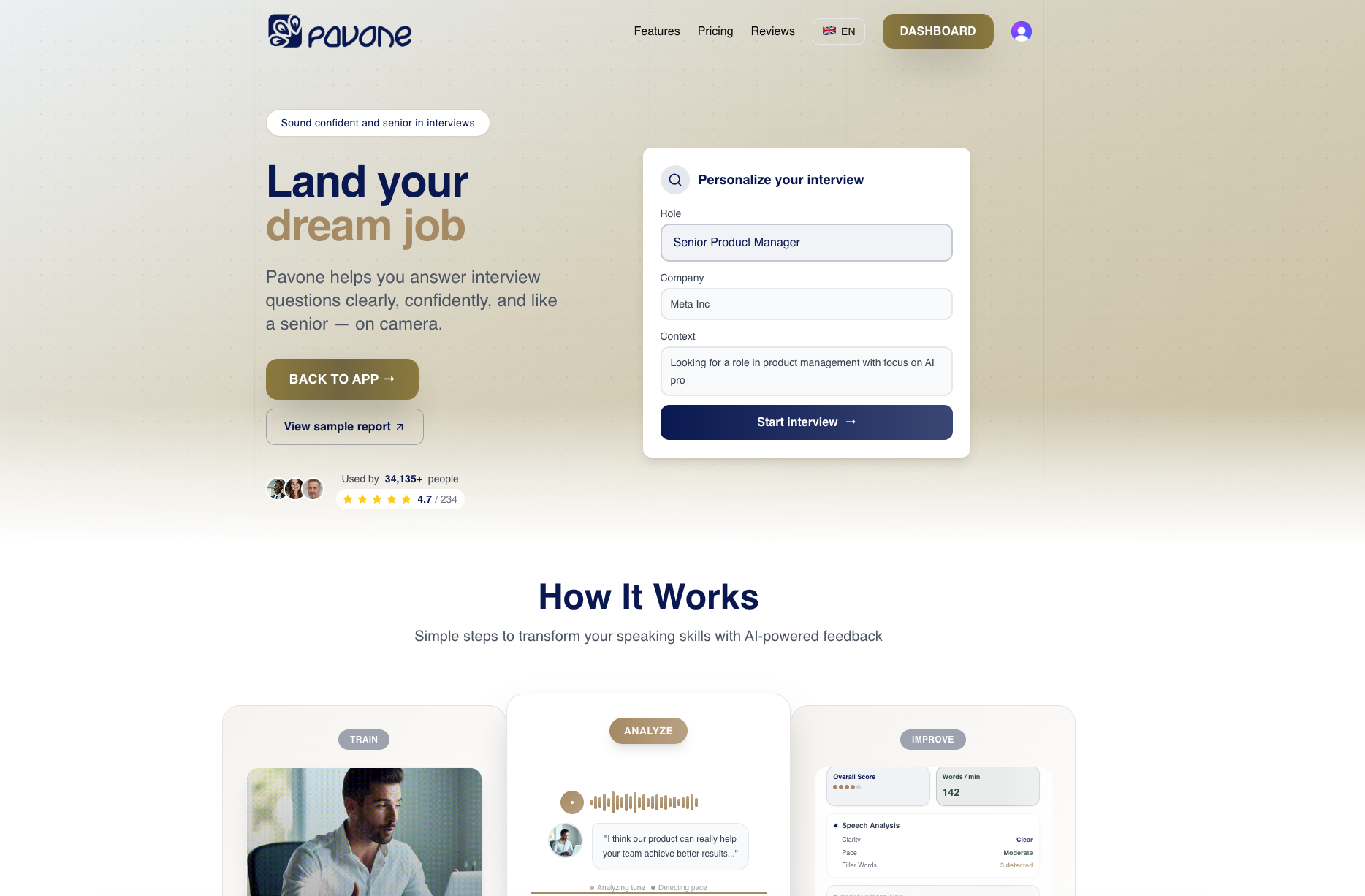
Understanding the benefits of online interview practice is valuable, but applying these insights with the right tools accelerates your progress dramatically. Pavone offers tailored video interview practice designed specifically for professionals seeking to build clarity and confidence on camera. The platform transcribes your answers and analyses key factors like structure, pacing, and delivery, providing immediate, actionable feedback that helps you sound more senior and polished.
Unlike generic preparation resources, Pavone focuses on how you communicate, not just what you say. This distinction matters because hiring managers evaluate your leadership presence and communication skills as much as your technical expertise. The platform’s AI-powered feedback identifies specific moments where your delivery could be stronger, enabling targeted improvement that traditional practice methods miss. Explore confidence-building interview practice techniques, learn how AI mock interviews enhance clarity, and master online interview practice strategies through Pavone Academy’s comprehensive courses. Your next interview deserves preparation that matches your ambition.
FAQ
What are the best ways to practise interviews online?
Use AI-driven mock interviews that simulate realistic conditions, including time pressure and question variety relevant to your target role. Record your responses and review them critically, focusing on clarity, body language, and eliminating filler words. Practise each answer multiple times, incorporating feedback until your delivery feels natural and confident.
How does AI feedback improve interview performance?
AI feedback is faster and more consistent than human evaluations, providing immediate analysis of your delivery, structure, and tone. It helps candidates quickly identify weak areas like rambling answers or poor pacing, enabling targeted improvement. This accelerated feedback loop allows you to refine your communication skills in days rather than weeks.
Can online practice interviews really boost hiring success?
Research demonstrates that candidates practising with AI tools achieve significantly higher hiring rates, with a 20-percentage-point advantage over those who don’t. Consistent practice improves confidence and performance under pressure, helping you articulate value clearly when stakes are highest. The evidence is compelling: structured online practice translates directly into better interview outcomes.
How often should I practise interviews online?
Aim for 2-3 focused practice sessions weekly during active job searches, with each session covering 3-5 questions. Consistency matters more than marathon sessions; regular practice builds muscle memory for clear communication. Adjust frequency based on upcoming interviews, intensifying preparation as important conversations approach whilst maintaining quality over quantity.
What should I focus on when reviewing recorded practice interviews?
Prioritise three areas: structural clarity, delivery confidence, and visual presence. Evaluate whether your answers follow a logical framework like STAR, whether your tone conveys authority appropriate to senior roles, and whether your eye contact and posture project engagement. Identify specific filler words or pacing issues to address in subsequent practice, tracking improvement over multiple sessions.
Recommended
Ready to practice?
Start improving your speaking skills with AI-powered feedback and analysis.
Try Pavone Free