
AI roleplay chat: build confident on-camera delivery

Stepping in front of a camera for a job interview is nerve-wracking, even for seasoned professionals. You know your subject, you’ve prepared your answers, yet something still feels off when the recording light turns red. Your words come out rushed, your eye contact wavers, and filler words creep in uninvited. The good news is that this is a fixable problem, and AI roleplay chat is one of the most practical tools available right now to fix it. In this guide, you’ll learn exactly what AI roleplay chat is, how to use it step by step, what it can and cannot do, and how to measure real, lasting improvement in your on-camera delivery.
Table of Contents
- What is AI roleplay chat for interview practice?
- Step-by-step: How to prepare and use AI roleplay chat
- What you’ll learn: Strengths, limits and expert insights on AI roleplay chat
- Tracking your progress: How to assess and refine your interview performance
- A fresh perspective: When AI roleplay chat transforms interview prep and when it doesn’t
- Accelerate your interview success with expert-led AI roleplay
- Frequently asked questions
Key Takeaways
| Point | Details |
|---|---|
| AI builds confidence | AI roleplay chat gives structured, repeatable practice for stronger interview communication. |
| Feedback is measurable | Data-driven feedback helps you focus precisely on areas for improvement with every session. |
| Blend with human input | For best results, combine AI roleplay with real-person mock interviews and coaching. |
| Track your progress | Use the platform’s analytics to monitor and celebrate growth in verbal and non-verbal delivery. |
What is AI roleplay chat for interview practice?
AI roleplay chat is a technology-driven simulation tool that recreates realistic interview scenarios, asking you tailored questions and responding dynamically based on your answers. Unlike a static list of practice questions, it adapts to what you say, pushing follow-up questions that mirror the unpredictability of a real interview panel. For anyone preparing for a video interview, this kind of responsive practice is genuinely valuable.
The features that set AI roleplay apart from a simple rehearsal are measurable and specific. Platforms in this space offer quantitative speech analysis covering pace in words per minute, filler word frequency, talk-to-listen ratio, and patience pauses. On top of that, many tools score your body language and eye contact, track your progress across multiple sessions, and deliver real-time nudges to keep you on course. Some platforms even use cohort analysis to link consistent practice to outcomes such as 15% faster deal closure in sales roles.
To get started, you’ll need a few practical things in place:
- A stable internet connection and a working webcam
- A quiet, well-lit space that mirrors a professional video call setup
- A willingness to receive direct, sometimes uncomfortable feedback
- A basic understanding of the AI roleplay benefits and limits before your first session
What truly separates AI roleplay from a conventional mock interview is the data. Rather than relying on a friend’s subjective impression, you receive consistent, objective scores after every attempt. When you compare that to the wide range of AI tools now available for professional development, the interview-specific focus of roleplay platforms is a clear advantage.
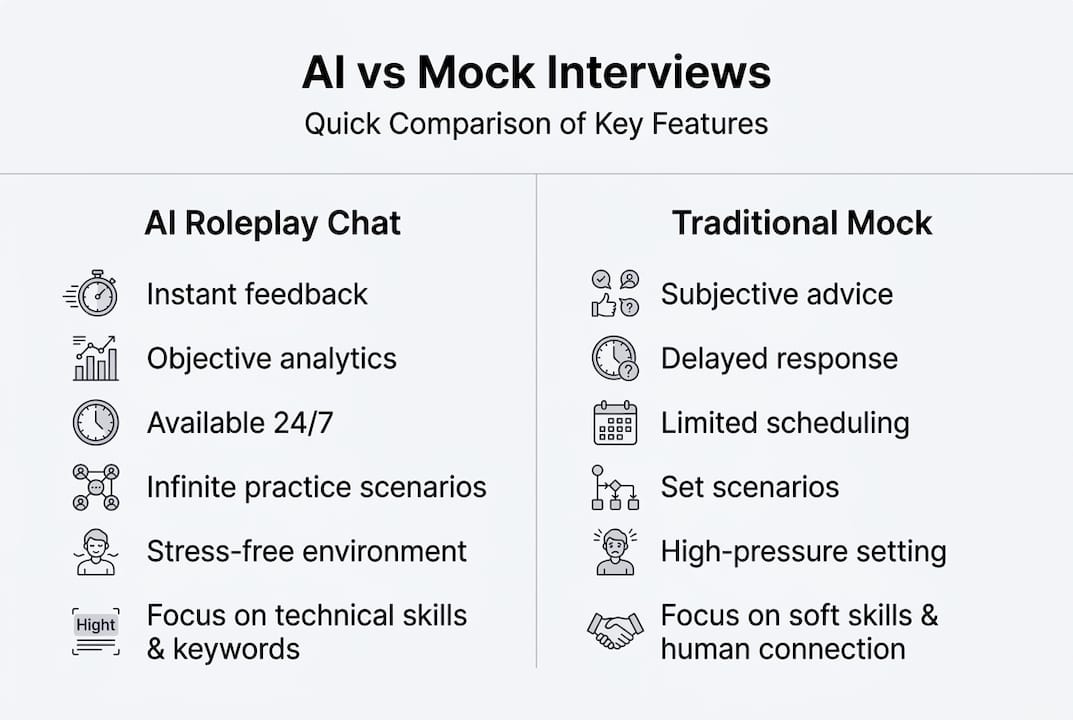
| Feature | AI roleplay chat | Traditional mock interview |
|---|---|---|
| Feedback type | Quantitative, instant | Subjective, delayed |
| Availability | 24/7, on demand | Requires scheduling |
| Body language scoring | Yes | Rarely |
| Progress tracking | Session by session | Manual notes only |
| Filler word detection | Automated | Inconsistent |
Step-by-step: How to prepare and use AI roleplay chat
Once you’re familiar with the basics, it’s time to put AI roleplay chat to work. Getting the most out of it requires more than simply pressing record.
- Set up your environment properly. Check your lighting (face the light source, don’t sit with a window behind you), test your microphone, and remove background distractions. The AI analyses your visual and audio signals, so a poor setup skews your scores unfairly.
- Choose the right scenario difficulty. Start with competency-based questions at a comfortable level, then gradually increase to senior-level scenarios. Jumping straight to the hardest questions before building baseline habits is a common mistake.
- Practise natural delivery, not scripts. Reading from notes kills your eye contact score and makes your pacing erratic. Aim to internalise your key points and speak conversationally.
- Focus on one metric at a time. If your filler word count is high, dedicate a full session to reducing it before tackling pace. Trying to fix everything at once leads to frustration.
- Review your session data immediately. The feedback is most useful when the experience is still fresh. Note two or three specific changes to apply in your next attempt.
- Schedule regular, short sessions. Three 20-minute sessions per week outperform one long cramming session before the interview.
Established tools like Yoodli, Final Round AI, and Mockstar excel at on-camera analysis, but it’s worth noting that using AI assistance during a live interview carries real detection risks. Keep your AI practice firmly in the preparation phase.
Pro Tip: Before each session, set a single, specific goal. For example, “I will pause for two seconds before answering each question.” This focused intention makes your feedback far more actionable. Explore how to master AI interview practice with structured session planning, and see how AI supports confident delivery across different interview formats.
| Approach | Effective | Less effective |
|---|---|---|
| Single metric focus per session | ✓ | ✗ Fixing everything at once |
| Natural, conversational delivery | ✓ | ✗ Reading from a script |
| Regular short sessions | ✓ | ✗ One long cramming session |
| Reviewing data immediately | ✓ | ✗ Skipping the feedback review |
What you’ll learn: Strengths, limits and expert insights on AI roleplay chat
With practical use underway, it’s important to understand exactly what AI roleplay chat can and cannot do, so you set realistic expectations from the start.
The strengths are real and well-documented. AI removes the subjective bias that often creeps into feedback from friends or colleagues who don’t want to seem harsh. It helps you build measurable communication habits, and it delivers instant, consistent feedback every single time you practise. For candidates who struggle with anxiety, this consistency is genuinely reassuring.
“AI tools are highly effective for building delivery confidence and refining habits, but they are limited when it comes to content depth, persuasion, and human nuance. The data-driven approach appeals to many, though it cannot replace the value of human coaching or peer practice.” — Community insight from public speaking practitioners
The limits are equally worth knowing:
- AI struggles to assess the narrative depth of your answers. A well-structured story that moves a panel emotionally is hard to score algorithmically.
- It cannot replicate the spontaneous interjections, sceptical body language, or political dynamics of a real senior interview panel.
- Ethical concerns exist around real-time AI use during live interviews, including detection by employers.
- Some candidates find that over-reliance on AI scores makes them overly mechanical, optimising for metrics rather than genuine connection.
The most balanced approach is to use AI roleplay to build your delivery foundation, then test those habits with a trusted human. As noted in research on reducing interview anxiety, consistent AI practice can meaningfully lower stress levels, particularly for candidates returning to the job market after a gap.
Tracking your progress: How to assess and refine your interview performance
Finally, mastering AI roleplay chat means using data-driven insights to track and accelerate progress toward confident interviews.

The metrics available to you are specific and actionable. Platforms measure pace in words per minute, filler word frequency, talk-to-listen ratio, patience pauses, and body language or eye contact scores. Tracking these across multiple sessions reveals patterns you’d never notice in the moment, such as a consistent speed-up when answering questions about weaknesses, or a spike in filler words when transitioning between points.
| Metric | What it reveals | Target range |
|---|---|---|
| Pace (WPM) | Nervousness or monotony | 130 to 160 WPM |
| Filler word frequency | Thinking habits under pressure | Fewer than 5 per minute |
| Eye contact score | Engagement and confidence | Above 70% of speaking time |
| Talk/listen ratio | Dominance or passivity | 60/40 in your favour |
- Baseline first. Complete two or three sessions without changing anything. This gives you an honest starting point.
- Identify your single weakest metric. Focus your next five sessions on improving just that one area.
- Compare session scores weekly, not daily. Daily fluctuations are normal. Weekly trends show real progress.
- Celebrate small wins. Dropping from 12 filler words per minute to 7 is a significant improvement worth acknowledging.
- Retest under pressure. Once a metric improves in comfortable sessions, practise the same question under time pressure to see if the habit holds.
Pro Tip: Export or screenshot your session data after every practice. Building a simple log helps you spot plateaus early and adjust your focus before bad habits solidify. Research into AI-driven confidence building suggests that candidates who track progress systematically improve up to 40% faster than those who practise without reviewing data. You can also explore practical AI tracking methods to build a consistent review habit alongside your sessions.
A fresh perspective: When AI roleplay chat transforms interview prep and when it doesn’t
After guiding thousands of candidates through AI roleplay practice, we’ve formed a clear view on where this technology genuinely earns its place and where it falls short.
AI roleplay is transformative for delivery confidence. If you struggle with filler words, rushed pacing, or avoiding the camera, structured AI practice fixes those habits faster than almost any other method. Introverts and candidates returning after a career break find it especially powerful because there’s no social pressure, just honest data.
But here’s the uncomfortable truth: too many candidates obsess over perfecting their content while neglecting how they deliver it. AI roleplay corrects that imbalance directly. It forces you to confront your delivery habits in a way that no amount of note-writing ever will.
That said, no AI can replicate a panel of three senior leaders firing unexpected questions while reading your body language in real time. For story-rich, senior-level responses, human practice remains irreplaceable. The candidates who perform best combine consistent AI roleplay to sharpen habits with regular practice conversations with trusted humans to build genuine presence. Learning to speak with confidence in AI-assisted practice is the foundation. Human practice is where you test whether those foundations hold under real pressure.
Accelerate your interview success with expert-led AI roleplay
Ready to turn insights into action? Pavone.ai is built specifically for professionals who want to improve not just what they say, but how they say it on camera.
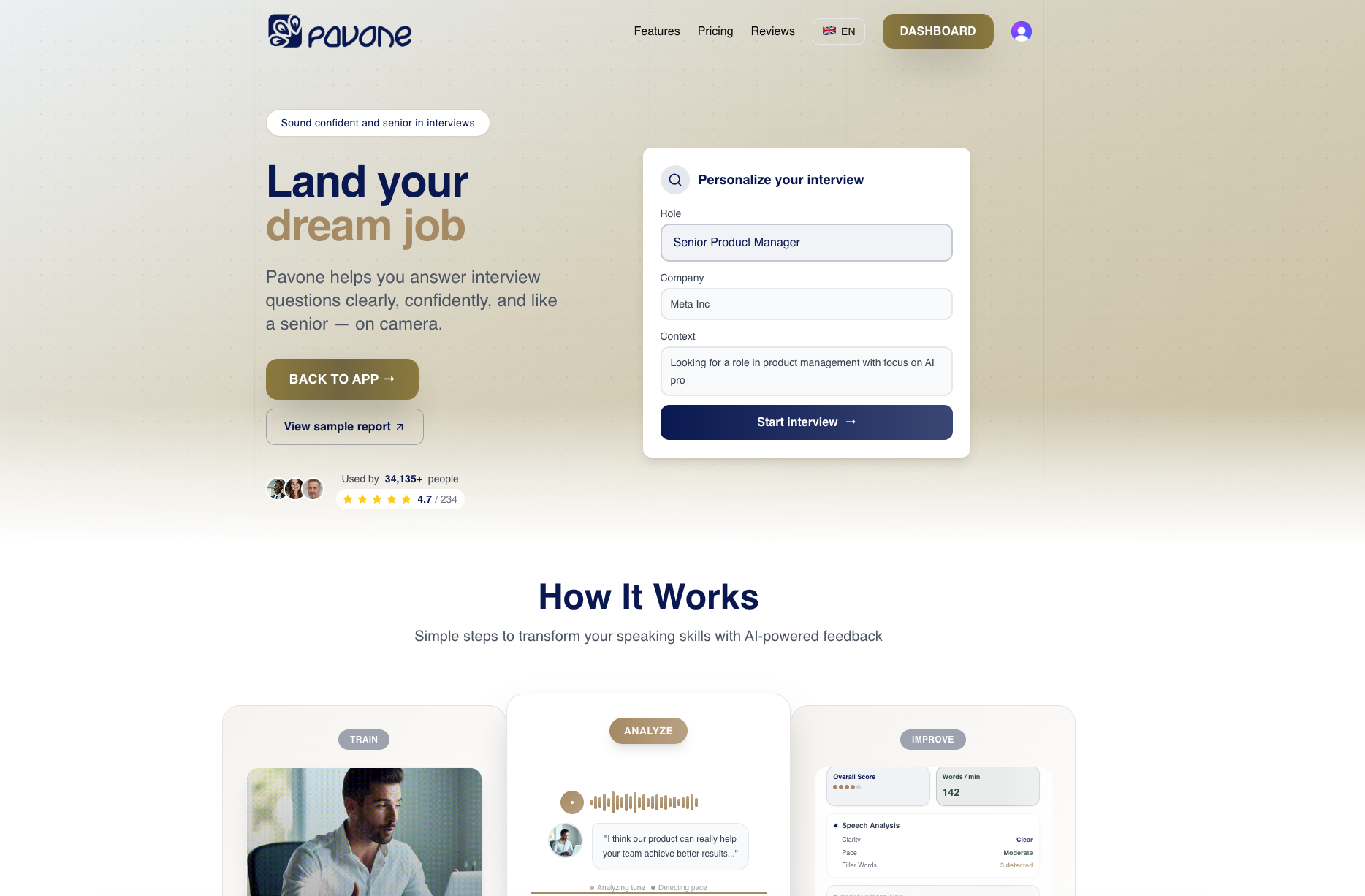
With Pavone, you record real interview-style answers, receive immediate feedback on clarity, pacing, filler words, and confidence, and track your improvement session by session. There’s no setup pressure and no scheduling required. Whether you’re heading into your first senior interview or your tenth, targeted online practice helps you arrive sounding clear, composed, and genuinely ready. Start with our full interview preparation guide and take the next step toward the role you’re aiming for.
Frequently asked questions
What is AI roleplay chat and how does it differ from standard interview practice?
AI roleplay chat delivers simulated interviews with instant, data-driven feedback on speech, body language, and progress over time, going well beyond what a traditional mock interview provides.
Are AI roleplay chats suitable for senior-level interview preparation?
Yes, they help you refine delivery and build confidence, though senior candidates achieve the best results by blending AI practice with human coaching for complex panel dynamics.
What common mistakes should I avoid when using AI roleplay chat?
Avoid over-relying on scripts and remember to use natural body language, as AI analysis rewards authentic, conversational delivery rather than rehearsed recitation.
Is there any risk to using AI roleplay chat during a live job interview?
Yes, using AI tools live is genuinely risky because some platforms detect AI assistance; keep your AI roleplay strictly within your preparation phase.
How do I measure improvement from AI roleplay chat sessions?
Track quantitative metrics such as pace, filler frequency, and eye contact scores across multiple sessions to chart genuine, ongoing progress.
Recommended
Ready to practice?
Start improving your speaking skills with AI-powered feedback and analysis.
Try Pavone Free