
How roleplay AI transforms interview practice: 54% pass rate

TL;DR:
- AI roleplay enhances interview readiness by simulating complex, realistic interview scenarios.
- Using AI practice significantly increases pass rates and reduces anxiety for professionals.
- Combining AI with human practice and self-assessment yields the best preparation outcomes.
Most professionals assume the best way to prepare for interviews is to go through as many real ones as possible. It sounds logical, but it’s also costly, stressful, and inefficient. Every failed interview takes a toll on your confidence, and there’s rarely any structured feedback to help you improve. The good news is that AI-driven practice is changing this entirely, with candidates who use AI roleplay achieving a 54% pass rate to human finals compared to just 34% via traditional resume screening. This guide breaks down exactly how roleplay AI works, what the evidence says, and how you can use it to walk into your next interview feeling genuinely prepared.
Table of Contents
- What is roleplay AI and how does it work?
- The evidence: How AI interview roleplay boosts job readiness
- Reducing anxiety and building confidence through roleplay AI
- Expert insights: Making the most of AI interview roleplay
- Our perspective: Why AI roleplay is only part of the interview equation
- Elevate your interview success with Pavone Academy
- Frequently asked questions
Key Takeaways
| Point | Details |
|---|---|
| AI emulates real interviews | Modern roleplay AI can closely simulate job interview dynamics, including tough scenarios. |
| Data proves AI effectiveness | Empirical studies show AI practice improves pass rates, confidence, and reduces time-to-hire. |
| Reduces anxiety safely | Practising with AI provides a low-pressure, repeatable setting that lessens nerves and builds on-camera presence. |
| Combine AI with real feedback | The best results come from blending AI drills with expert and self-assessment. |
What is roleplay AI and how does it work?
Roleplay AI is a simulated conversational partner designed to replicate real interview conditions. Rather than reading tips or rehearsing answers in your head, you practise by actually speaking, responding, and adapting in real time. The system listens, responds, and challenges you, much like a real interviewer would.
For mid-to-senior professionals, this matters enormously. Your interviews aren’t straightforward question-and-answer sessions. They involve panel dynamics, probing follow-ups, and moments where you’re expected to demonstrate leadership under pressure. Generic preparation simply doesn’t cut it at this level.
Modern AI roleplay for on-camera delivery goes well beyond scripted responses. Advanced platforms handle a wide range of edge cases that mirror real interview complexity:
- Interruptions and objections: The AI can push back on your answers, forcing you to stay composed and articulate under pressure.
- Emotional dynamics: Systems are built to simulate defensive or even manipulative interviewer behaviour, helping you practise keeping your cool.
- Stress interview formats: Deliberately challenging scenarios that test your resilience and confidence.
- Multi-stakeholder panels: Simulated group interviews where you must manage different personas simultaneously.
- Zero-latency responses: Instant replies that keep the conversation flowing naturally, without artificial pauses.
- Confidence assessment: Some platforms include a BS detector for confidence that flags vague or unconvincing answers.
- Screen sharing: Useful for technical or demo-based interviews where you need to present work.
Crucially, the best systems adjust to your career level. A senior manager practising for a director-level role needs different scenarios than a graduate candidate. Chatbot-driven mock interviews can be calibrated to reflect leadership expectations, strategic thinking questions, and complex behavioural scenarios.
| Feature | Basic roleplay AI | Advanced roleplay AI |
|---|---|---|
| Scripted Q&A | Yes | Yes |
| Real-time interruptions | No | Yes |
| Emotional scenario handling | No | Yes |
| Career-level calibration | Limited | Full |
| Confidence assessment | No | Yes |
| Panel simulation | No | Yes |
Pro Tip: Before your first session, set the difficulty level to match your target role. Practising at a slightly higher level than required builds a useful buffer of confidence for the real thing.
The evidence: How AI interview roleplay boosts job readiness
Now that we’ve clarified how roleplay AI works, let’s examine the hard evidence supporting its effectiveness.
The numbers are striking. Candidates who go through AI-assisted interview preparation achieve a 54% pass rate to human final interviews, compared to just 34% for those screened purely on the basis of their CV. That’s a 20 percentage point improvement, which is significant in any competitive hiring market.
Beyond pass rates, the data points to a broader shift in how efficiently recruitment works:
- 44% fewer human interviews are needed when AI pre-screening is involved, freeing up both candidate and employer time.
- 87% of users report that AI practice feels realistic enough to genuinely prepare them for live interviews.
- Platforms like CodeSignal have enabled 3x faster onboarding and a tenfold increase in hiring scale.
- GPT-3.5 based assessments match human grading in mock interview evaluations, validating the quality of AI feedback.
“87% of users found AI practice realistic enough to prepare them for live interviews.” This isn’t a marginal improvement. It’s a structural shift in what effective preparation looks like.
One of the most underrated benefits is consistency. Human mock interviewers vary in their questioning style, depth, and feedback quality. An AI system applies the same rigorous standard every single time. That means you’re not at the mercy of a friend who goes easy on you, or a career coach who focuses on the wrong things.

For professionals who want to reduce interview anxiety, the data is equally encouraging. Repeated exposure to realistic scenarios in a low-stakes environment measurably reduces the physiological stress response over time. You stop dreading the unknown because you’ve already faced it, repeatedly, in practice.
The diversity of scenarios also matters. AI systems can expose you to dozens of different question styles, industries, and interviewer personalities in a single week. That breadth of experience is almost impossible to replicate through real interviews alone, and it’s why RP AI tools for confidence are gaining traction among senior professionals who take preparation seriously.
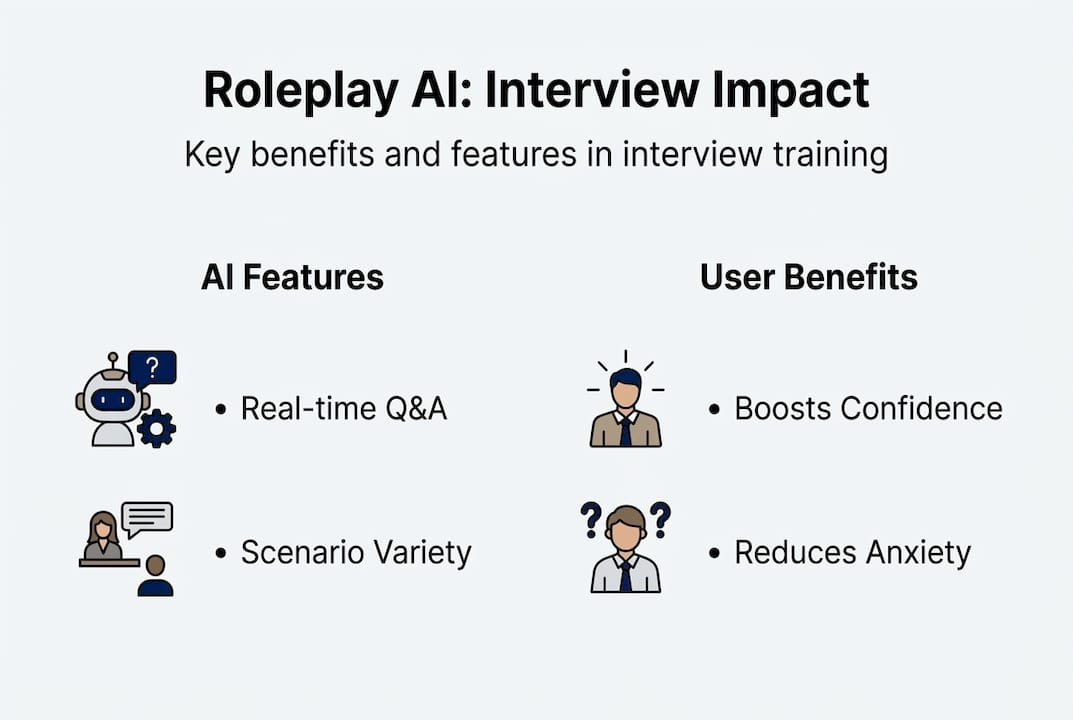
Reducing anxiety and building confidence through roleplay AI
Having reviewed the data-driven benefits, let’s focus on how AI actually helps you overcome anxiety and build trust in your communication.
Interview anxiety is rarely about not knowing your subject. Most senior professionals are highly capable. The anxiety comes from uncertainty: not knowing how you’ll come across, whether your answers will land, or how you’ll handle a curveball question. Roleplay AI addresses exactly this.
Here’s a structured approach to building confidence progressively:
- Start with text-based practice. If speaking on camera feels daunting, begin by typing your answers. This lets you focus on structure and content before adding the pressure of delivery.
- Move to voice-only sessions. Once your answers feel solid, practise speaking them aloud. Focus on pacing and filler words before worrying about visual presence.
- Progress to full video roleplay. Now you’re working on everything together: content, delivery, eye contact, and composure. This is where real interview confidence is built.
- Review and reflect after each session. Don’t just practise and move on. Watch your recordings, note what worked, and identify one thing to improve each time.
Research shows that AI systems score 7.80 out of 10 for conversational quality, compared to 5.41 for human mock interviewers. That consistency is what makes the practice environment so effective for anxiety reduction.
The goal isn’t to become a polished performer. It’s to become so familiar with the process that your natural self can show up confidently.
There are, however, genuine risks to be aware of. Over-reliance on AI practice can create a false sense of readiness, particularly if you never practise with a real human present. You might also develop overly rehearsed answers that sound scripted in live settings. The benefits and limits of AI roleplay are worth understanding clearly before you commit to a single preparation method.
Pro Tip: After each Simuverse AI session, write down three things you noticed about your own delivery. Self-reflection accelerates improvement far more than repetition alone.
For senior candidates specifically, AI interview practice for anxiety reduction can reduce nerves by up to 40%, according to platform data. That’s not a small margin. It’s the difference between walking in composed and walking in rattled.
Expert insights: Making the most of AI interview roleplay
Once you understand the value and have overcome your initial nerves with AI, advanced usage can truly set you apart in competitive mid-to-senior interview settings.
Senior interviews are rarely one-on-one. Panel formats, sequential stakeholder interviews, and cross-functional assessments are common. Using multi-persona interview practice to simulate these dynamics is one of the most effective things you can do. You learn to read the room, manage competing agendas, and stay consistent across different questioning styles.
Here are the strategies that make the biggest difference at this level:
- Integrate leadership frameworks. Practise applying methodologies like MEDDIC (a structured approach to qualifying stakeholder decisions) to your behavioural answers. This signals strategic thinking, not just experience.
- Use multi-persona scenarios. Set up sessions where the AI plays both a sceptical CFO and an enthusiastic hiring manager. Learning to adapt your tone and emphasis in real time is a senior-level skill.
- Benchmark your retention. Experts recommend aiming for 70 to 80% knowledge retention after 30 days of practice. If your answers are still sharp a month later, they’re genuinely embedded, not just memorised.
- Combine AI with honest self-assessment. Record yourself, watch it back without cringing, and ask: would I hire this person? Be honest. AI feedback is valuable, but your own critical eye is irreplaceable.
- Vary your scenarios deliberately. Don’t just practise the questions you feel comfortable with. Seek out the ones that make you hesitate. That discomfort is where the growth happens.
Pro Tip: Use clarity-focused AI tools to identify whether your answers are genuinely concise or just brief. There’s a meaningful difference, and senior interviewers notice it immediately.
The most effective candidates treat AI roleplay as a training environment, not a performance. Each session is an opportunity to experiment, fail safely, and refine. That mindset shift alone makes a significant difference.
Our perspective: Why AI roleplay is only part of the interview equation
Here’s a candid view on what really works in interview preparation, drawn from watching many professionals go through this process.
AI roleplay is genuinely powerful. The data supports it, and the improvements in confidence and structure are real. But there’s a risk that’s rarely discussed: the comfort of AI practice can create a subtle illusion of readiness that doesn’t fully translate to live settings.
Human interviewers read micro-expressions, respond to energy, and make gut-level judgements that no AI currently replicates with full accuracy. The limitations of AI roleplay are real, and ignoring them is a mistake.
The professionals who perform best combine AI practice with spontaneous, human-led conversations. They use AI to build the foundation, then stress-test it with real people who will genuinely challenge them. They also prioritise self-reflection over repetition, understanding that doing the same thing 20 times without reflection rarely produces 20 times the improvement.
AI is a powerful tool. But your interview success ultimately depends on your ability to connect, adapt, and think on your feet in real time. Build that capacity alongside your AI practice, not instead of it.
Elevate your interview success with Pavone Academy
If you’re ready to move from knowing what to do to actually doing it consistently, Pavone Academy is built for exactly that moment.
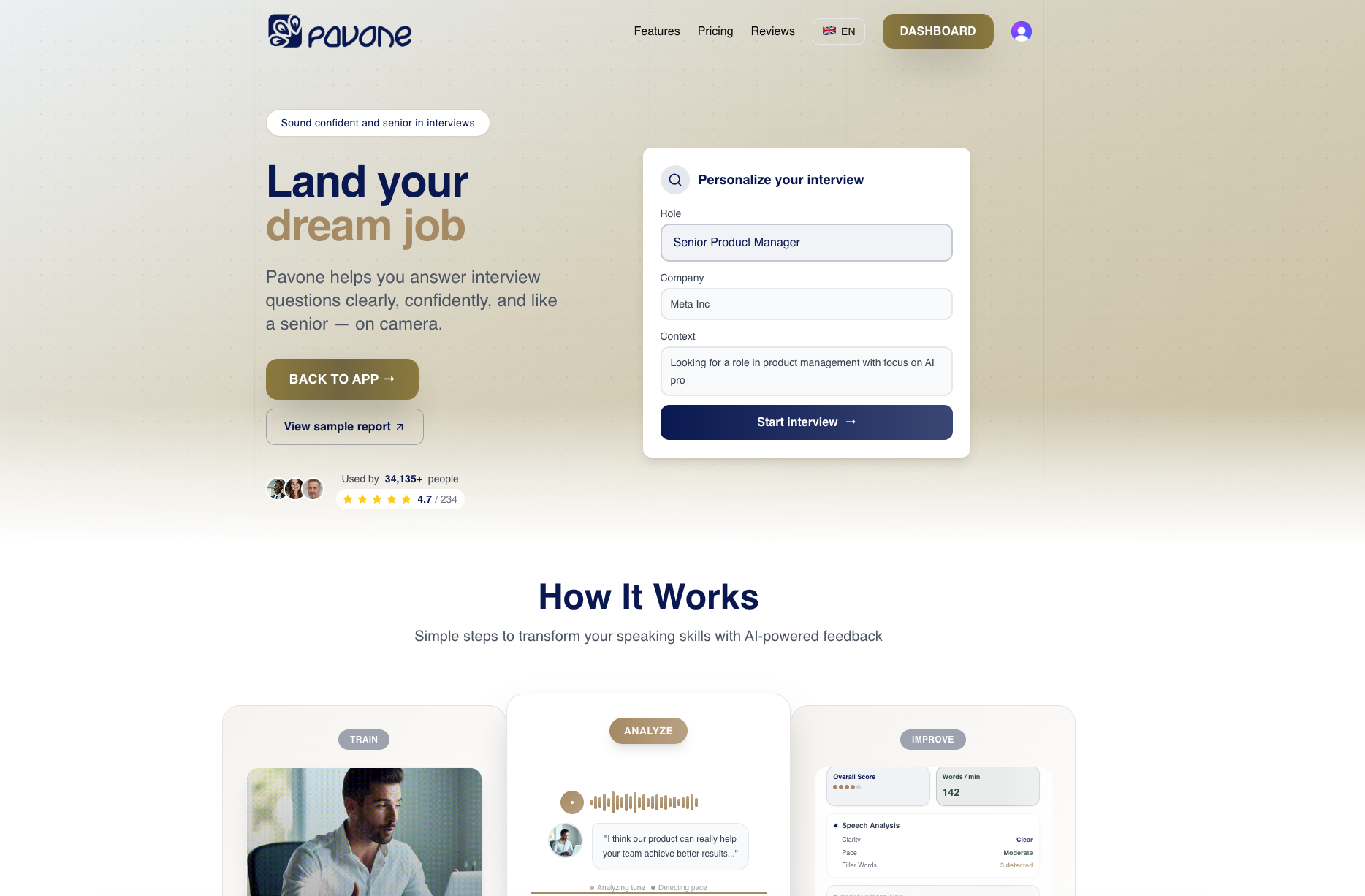
Pavone’s platform gives you a private, pressure-free space to record real interview answers, receive immediate feedback on clarity, pacing, and confidence, and track your improvement over time. Whether you’re working on mastering interview online practice or building genuine composure for video interview preparation, the tools are designed to fit around your schedule without any setup friction. Discover all Pavone Academy tools and start practising in a way that actually moves the needle.
Frequently asked questions
Is roleplay AI as effective as practising with a real person?
Roleplay AI delivers consistent, high-quality practice that rivals human simulations for building core communication skills. 87% of users find it realistic enough to genuinely prepare them for live interviews, though combining both approaches produces the strongest results.
Can roleplay AI prepare me for unexpected or high-stress interview moments?
Yes. Advanced systems are specifically designed to handle interruptions and stress dynamics, including objections, emotional interviewer behaviour, and multi-stakeholder pressure, so you’re not caught off guard in the real thing.
How can I avoid relying too much on AI for my interview preparation?
Balance your AI sessions with human-led mock interviews and honest self-review. AI excels in conversational consistency but doesn’t fully replicate non-verbal depth, so real-world practice remains essential alongside it.
Are there ways to measure my progress with roleplay AI?
Absolutely. Look for platforms that track improvement scores across sessions and benchmark 70 to 80% knowledge retention after 30 days. Consistent scoring improvements over time are a reliable signal that your preparation is genuinely working.
Recommended
Ready to practice?
Start improving your speaking skills with AI-powered feedback and analysis.
Try Pavone Free