
How to ace Amazon interviews: confident on-camera techniques

TL;DR:
- Amazon interviews focus on technical skills and leadership principles, emphasizing clear communication and judgment.
- Preparing deep, versatile STAR stories that reflect ownership, quantifiable results, and genuine insight is crucial.
- On-camera presence, framing responses confidently, and practicing with tools help showcase seniority and composure.
Amazon interviews are not like most technical interviews. They are rigorous, structured, and deliberately designed to test not just what you know, but how you think, communicate, and lead. At the mid-to-senior level, you are expected to demonstrate clear alignment with Amazon’s 16 Leadership Principles across every round, including the pivotal Bar Raiser session. The good news is that confident, structured preparation genuinely makes the difference. This guide walks you through the format, behavioural storytelling, on-camera presence, and the advanced techniques that separate candidates who get offers from those who nearly do.
Table of Contents
- What to expect in an Amazon technical interview
- Preparing your behavioural stories with the STAR method
- Mastering on-camera communication and presence
- Advanced techniques: showing depth under pressure
- Final checks and troubleshooting common mistakes
- Our perspective: what really sets top Amazon candidates apart
- Confident Amazon interview success with expert video practice tools
- Frequently asked questions
Key Takeaways
| Point | Details |
|---|---|
| Structure matters | Frame your answers with STAR and quantify impact for every Leadership Principle. |
| On-camera skills | Confident, clear communication and real-time adaptability are as vital as technical expertise. |
| Bar Raiser focus | Expect probing on failures, ownership, and decision rationale—be ready to think aloud and self-reflect. |
| Avoid common pitfalls | Don’t memorise stories or dodge tough questions; deliver genuine, tailored responses. |
| Practice pays off | Video mock interviews and honest feedback rapidly boost your presence and lessen nerves. |
What to expect in an Amazon technical interview
With a clear goal in mind, let’s break down exactly how Amazon’s interview process is structured and what’s expected of you as a seasoned professional.
Amazon’s interview process typically spans four to six rounds, covering coding, system design, and behavioural deep dives. At the senior level, system design and leadership conversations carry significant weight. You will almost certainly encounter a Bar Raiser: an independent interviewer, often from a different team, whose sole purpose is to uphold Amazon’s hiring bar. They have veto power, and they are exceptionally skilled at probing beneath surface-level answers.
Here is what each round generally covers:
- Coding round: Algorithm and data structure problems, usually on a shared screen
- System design: Architecture, scalability, and trade-off discussions
- Behavioural rounds: Structured questions mapped directly to Amazon’s Leadership Principles
- Bar Raiser round: A cross-functional deep dive into judgement, ownership, and communication
| Round | Focus area | Senior-level emphasis |
|---|---|---|
| Coding | Problem solving | Efficiency and clarity of thought |
| System design | Architecture | Scalability and trade-off reasoning |
| Behavioural | Leadership Principles | Depth, ownership, and impact |
| Bar Raiser | Overall fit | Communication and cultural alignment |
Follow the Amazon interview strategies that account for all four dimensions, not just the technical ones. You can also review a full behavioural and technical round guide to understand what each session demands.
Pro Tip: Prepare at least two to three versatile stories per Leadership Principle. The Bar Raiser will probe each one from multiple angles, so depth matters far more than volume.
Preparing your behavioural stories with the STAR method
With Amazon’s format in mind, your next step is to craft stories that clearly demonstrate your fit for their culture.
The STAR method (Situation, Task, Action, Result) is Amazon’s preferred storytelling framework. But at the senior level, it is not enough to simply follow the structure. The Bar Raiser will probe failures and trade-offs deeply, so your stories need genuine substance. Focus on the “I” in your answers, not “we,” and always quantify your results.
Here is how to build a strong STAR story:
- Choose a situation with real stakes. Avoid low-impact examples. Senior candidates need stories where the outcome genuinely mattered.
- Clarify your specific role. Amazon interviewers want to know what you did, not what the team achieved.
- Detail your actions with precision. Walk through your reasoning, not just your actions.
- Quantify the result. Numbers make results credible. Percentages, revenue figures, and time saved all add weight.
- Reflect on what you learnt. Especially for failure stories, this signals maturity and ownership.
| Shallow STAR story | Deep STAR story |
|---|---|
| “We improved the system’s performance.” | “I redesigned the caching layer, reducing latency by 40% and saving £120k annually.” |
| “The team launched on time.” | “I identified a critical dependency risk six weeks out and restructured the delivery plan, hitting the deadline with zero regressions.” |
Prepare 2-3 stories per principle as a minimum. Aim for stories that stretch across multiple principles, so you are not scrambling to find fresh examples mid-interview. Use the STAR answer builder to structure and pressure-test each one before your session.
Pro Tip: Quantify every result you can, and always show clear personal ownership. If you cannot say “I” with confidence, the story probably needs reworking.
Mastering on-camera communication and presence
Once your stories are ready, it is vital to deliver them with confidence and presence, especially on camera.
Video interviews introduce a layer of complexity that many strong candidates underestimate. Your environment, your posture, and your eye contact all send signals before you say a single word. Practise with mock interviews, record yourself, and review your delivery critically. Small adjustments compound quickly.
Here are the key areas to focus on:
- Lighting: Position a light source in front of you, not behind. A well-lit face signals professionalism and keeps attention on you.
- Eye contact: Look directly into the camera lens, not at the interviewer’s face on screen. This creates the impression of genuine eye contact.
- Posture: Sit upright and slightly forward. It projects engagement and energy without appearing stiff.
- Pacing: Speak deliberately. Pausing before answering is a sign of thoughtfulness, not hesitation.
- Attire: Dress as you would for an in-person senior interview. It also shifts your own mindset into interview mode.
One of the most effective habits you can build is treating the video call as a peer conversation, not a performance. Senior candidates who project calm authority do so because they are genuinely present, not because they have memorised a script.
Do not memorise your answers. Be present and ready for deep probe questions that take your story in an unexpected direction.
For a deeper look at how physical cues affect your perceived seniority, explore body language for tech interviews.
Pro Tip: Record a full mock session and watch it back with the sound off first. You will notice posture, energy, and camera contact issues that you would otherwise miss entirely.
Advanced techniques: showing depth under pressure
After mastering your presence, you will need to excel at the moments when the interview becomes tough and ambiguous.
This is where senior candidates truly differentiate themselves. The Bar Raiser is not just testing your answers; they are testing how you think when pushed. Verbalise your assumptions, risks, and alternatives rather than jumping to conclusions. Thinking aloud is not a weakness at this level; it is a demonstration of structured senior judgement.
Follow this approach when facing a difficult or ambiguous question:
- Pause and acknowledge the complexity. A brief “That’s a good challenge, let me think through it” buys you time and signals composure.
- State your assumptions clearly. “I’m going to assume X because Y” shows rigour.
- Explore trade-offs out loud. Name the options, weigh them, and explain your reasoning.
- Commit to a direction. Senior candidates make decisions. Avoid endless hedging.
- Invite follow-up. “I’d be happy to go deeper on any of those trade-offs” shows confidence and openness.
15 to 25 robust stories are recommended for senior candidates who want genuine versatility across all 16 Leadership Principles. That range gives you enough material to adapt without recycling the same examples repeatedly.
Do not dodge failure questions. Acknowledging a genuine mistake, explaining what you learnt, and demonstrating how you changed your approach is one of the highest-value signals you can send at the senior level. The video practice benefits of rehearsing these moments on camera are significant: you learn to stay composed rather than reactive when the pressure builds.

Final checks and troubleshooting common mistakes
Before you step into your next Amazon interview, take time to do a final review and avoid these missteps.
Even well-prepared candidates can trip up on avoidable errors. Run through this checklist in the 24 hours before your interview:
- Camera, microphone, and internet connection tested and working
- Background is clean, professional, and free of distractions
- Attire chosen and ready the night before
- Key stories reviewed, not rehearsed word for word
- A glass of water nearby and a quiet space confirmed
- Mindset: calm, curious, and ready to have a real conversation
Now, here are the most common mistakes and how to fix them:
| Mistake | Why it costs you | How to avoid it |
|---|---|---|
| Looking off camera | Signals disengagement | Look directly at the lens, not the screen |
| Rambling answers | Loses the interviewer’s attention | Use STAR to stay on track |
| Not quantifying results | Stories feel vague | Add numbers to every result |
| Dodging failure questions | Signals low self-awareness | Prepare honest, reflective failure stories |
| Over-rehearsed delivery | Sounds scripted, not authentic | Know your stories, not your script |
At the senior level, Bar Raisers are specifically watching for candidates who sound robotic, who cannot adapt their story when probed, or who fail to demonstrate genuine ownership. Review your video interview prep steps to ensure your delivery feels natural and authoritative, not rehearsed.
Our perspective: what really sets top Amazon candidates apart
Drawing together the tactical advice above, here is an uncomfortable truth that many guides skip entirely: most technically strong candidates do not fail Amazon interviews because of coding gaps. They fail because their communication does not flex under pressure.
The contrarian view worth holding is this: a smaller set of genuinely deep, adaptable behavioural stories will outperform a large catalogue of shallow ones every time. The Bar Raiser is not counting your examples; they are stress-testing your judgement. A candidate who can take one rich story and explore it from five different angles will always outshine someone who has memorised twenty surface-level answers.
What experienced coaches consistently observe is that mid-to-senior candidates underestimate how much the way they speak matters on camera. Tone, pacing, and composure communicate seniority before the content even lands. Explore behavioural interview insight that goes beyond frameworks and into the communication layer that actually determines outcomes. That is where the real preparation happens.
Confident Amazon interview success with expert video practice tools
Ready to put this into action? Here is how you can move forward with proven tools.
Knowing what to do and being able to do it confidently on camera are two very different things. Pavone.ai bridges that gap by giving you a private space to record real interview-style answers and receive immediate, actionable feedback on clarity, structure, pacing, and delivery.
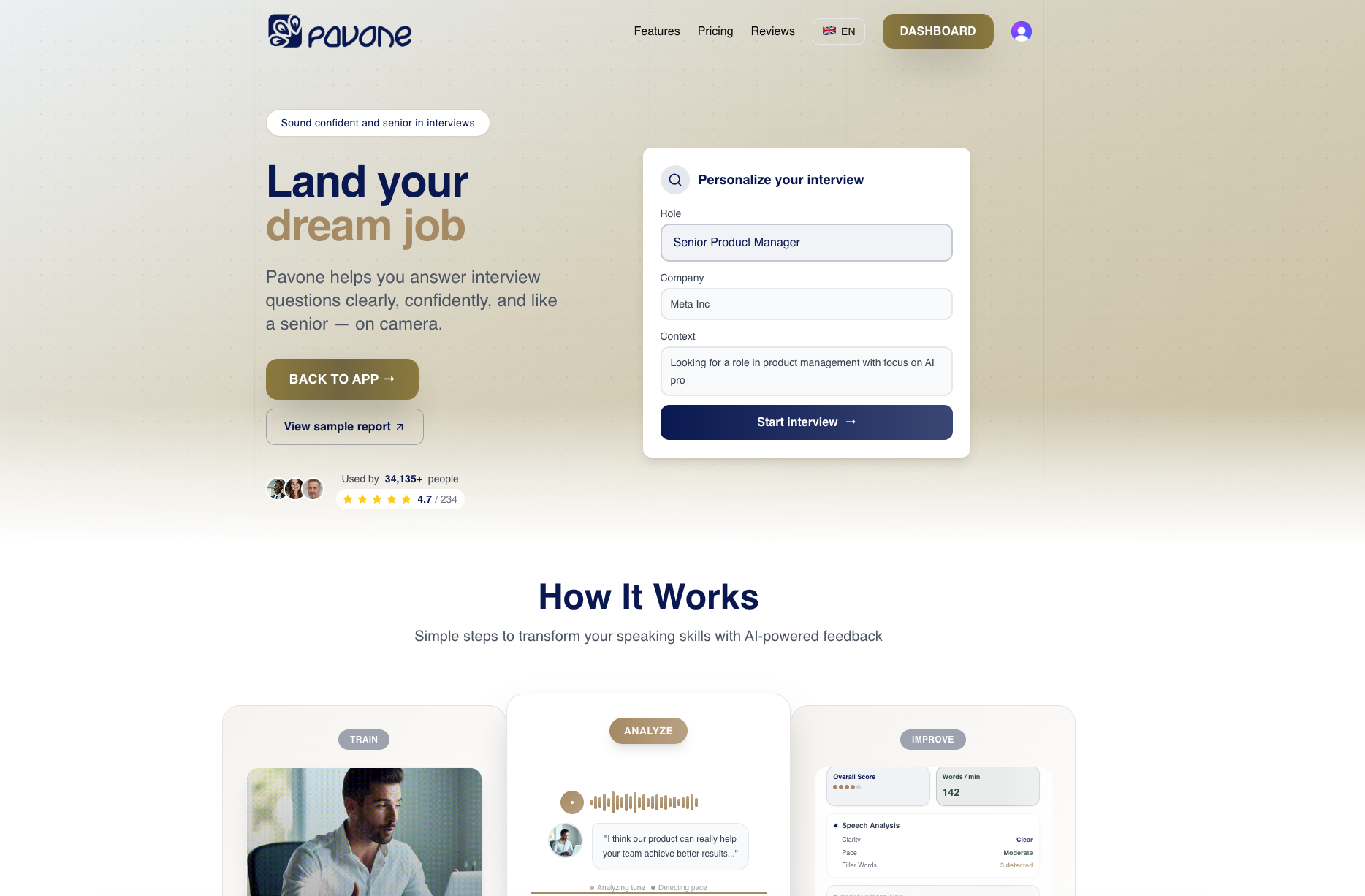
You can practise with an interview question generator tailored to Amazon’s Leadership Principles, build structured answers using the STAR framework, and track your improvement over time. For a focused programme on camera confidence, the job interview video confidence course is built specifically for professionals who want to sound as strong as they are. Start with master interview online practice and see the difference structured video rehearsal makes.
Frequently asked questions
What are Amazon’s Leadership Principles, and why do they matter in interviews?
Amazon’s 16 Leadership Principles shape both technical and behavioural interview questions, with the Bar Raiser probing specifically for genuine alignment and depth in your real-world actions.
How many STAR stories should I prepare for a senior Amazon technical interview?
Aim for 15 to 25 versatile stories, with at least two to three strong examples that clearly demonstrate each major Leadership Principle.
What can I do to calm nerves before an Amazon on-camera interview?
Practise mock interviews on video, focus on structured and deliberate speaking, and approach the session as a professional conversation rather than a test.
Can I use the same behavioural story for more than one Leadership Principle?
Yes, versatile stories can address multiple principles effectively, but adapt your emphasis to match the specific question and avoid sounding like you are reading from a pre-written script.
What are the biggest mistakes to avoid in an Amazon interview?
Avoid rote answers, unquantified results, and dodging failure questions; inauthentic or non-quantified answers are among the most common reasons strong candidates do not progress past the Bar Raiser round.
Recommended
Ready to practice?
Start improving your speaking skills with AI-powered feedback and analysis.
Try Pavone Free