
Apple interview questions: master your mid-senior interview

TL;DR:
- Apple interviews emphasize clear communication and technical ownership over just coding skills.
- Candidates must demonstrate system design, platform knowledge, and problem-solving under pressure verbally.
- Practicing articulate reasoning aloud and understanding Apple-specific technologies are key to success.
Apple interviews are genuinely unlike any other technical hiring process in the industry. The questions are unpredictable, the bar is remarkably high, and the interviewers are looking for something that most candidates overlook entirely: clear, confident communication paired with deep technical ownership. Raw coding ability will only carry you so far. What separates offer recipients from near-misses is the ability to articulate reasoning under pressure, demonstrate platform awareness, and show that you understand the full scope of your decisions. This guide breaks down every major Apple interview format, what interviewers are actually assessing, and the practical techniques you need to perform at your best.
Table of Contents
- Core types of Apple interview questions and what they assess
- Understanding the coding round: thinking beyond code
- System design: communicating complex thinking simply
- Behavioural and project deep dives: balancing insight and clarity
- Comparison of Apple’s interview rounds with other top tech firms
- Why communication trumps technical genius at Apple interviews
- Next steps: refine your Apple interview practice
- Frequently asked questions
Key Takeaways
| Point | Details |
|---|---|
| Apple’s focus is unique | Technical skills are crucial but clear communication and self-driven test generation make the difference. |
| System design is verbal | Prepare for system design questions that demand spoken explanations for complex tech, not just drawings. |
| Context matters | Success is about addressing edge cases, trade-offs, and showing ownership in behavioural answers. |
| Practice out loud | Non-native speakers should practise spoken reasoning and story structure to excel. |
Core types of Apple interview questions and what they assess
Now that you know what’s at stake, let’s break down the types of questions you’ll face. Apple’s hiring process typically spans four distinct question categories, each designed to reveal a different dimension of your capability.
Coding questions test problem-solving precision and platform-specific knowledge. These are not straightforward algorithm drills. Coding rounds emphasise edge cases, optimisation, concurrency, and Apple ecosystem specifics. You are expected to think carefully about what could go wrong, not just what works in the happy path.
System design questions require you to explain complex architectures verbally, often without the aid of a whiteboard or diagram. This tests whether you can make sophisticated thinking accessible to others.
Behavioural and project deep-dive questions probe how you navigate trade-offs, own mistakes, and communicate decisions to stakeholders. Apple wants to understand how you think, not just what you’ve built.
Apple-specific technology questions cover platform APIs, hardware constraints, and privacy frameworks that are unique to the Apple ecosystem. These questions quickly reveal whether you’ve worked with Apple’s platforms or merely adjacent to them.
Across all four types, interviewers are consistently evaluating two things: critical thinking and communication clarity. You’ll notice similarities with Amazon interview questions in structure, but Apple places its own distinct emphasis on ecosystem depth and verbal ownership.
Some sample topics you might encounter include:
- Thread safety and memory management in Swift or Objective-C
- Designing a clipboard sync feature across iOS and macOS
- Describing a time you navigated a difficult technical trade-off
- Explaining how you’d handle rate limiting in a distributed system
Statistic to know: Across senior engineering interviews at top tech firms, candidates who clearly articulate their reasoning are significantly more likely to receive offers than those who produce correct code silently.
Understanding the coding round: thinking beyond code
With an overview of the spectrum, let’s get practical with Apple’s coding round, often described as the trickiest. What makes Apple’s coding interviews distinctive is not the difficulty of the algorithms themselves. It’s the expectation that you will think out loud, anticipate failure modes, and demonstrate ownership of your solution from first principles.
Candidates are asked to generate their own test cases and optimise for Apple platforms. This is a significant differentiator. Rather than waiting for an interviewer to probe your solution, you are expected to stress-test it yourself. Think: what happens with an empty input? What if the dataset is enormous? What if two threads access this simultaneously?
Some coding topics that reflect real Apple priorities include:
- Thread safety: Can you explain how your solution behaves under concurrent access?
- Memory management: Are you handling retain cycles or avoiding unnecessary allocations?
- Platform APIs: Do you know when to use Grand Central Dispatch versus Swift Concurrency?
- Optimisation: Can you identify the bottleneck in your own solution before being asked?
For non-native English speakers, the verbal element of the coding round can feel just as challenging as the technical component. A useful technique is to narrate each decision in short, simple sentences. Instead of trying to explain everything at once, say: “I’m choosing this approach because it avoids unnecessary iteration. Let me walk through a potential edge case.”
You can also use a question generator to practise Apple-style coding prompts ahead of time, building familiarity with the format before you’re under real pressure.
Pro Tip: After writing your solution, pause and say aloud: “Now I’m going to test this with an empty input and a very large input.” This single habit signals maturity and ownership to your interviewer.
System design: communicating complex thinking simply
If you progress past coding, Apple’s system design round is where your big-picture and communication skills come into play. System design focuses on distributed systems, P2P networks, cross-device sync, event stream processing and Apple hardware and privacy integration.
What makes this round particularly demanding is that Apple often expects verbal explanations without diagrams. You need to paint a picture with words alone, describing architecture clearly enough that your interviewer follows every component and constraint.
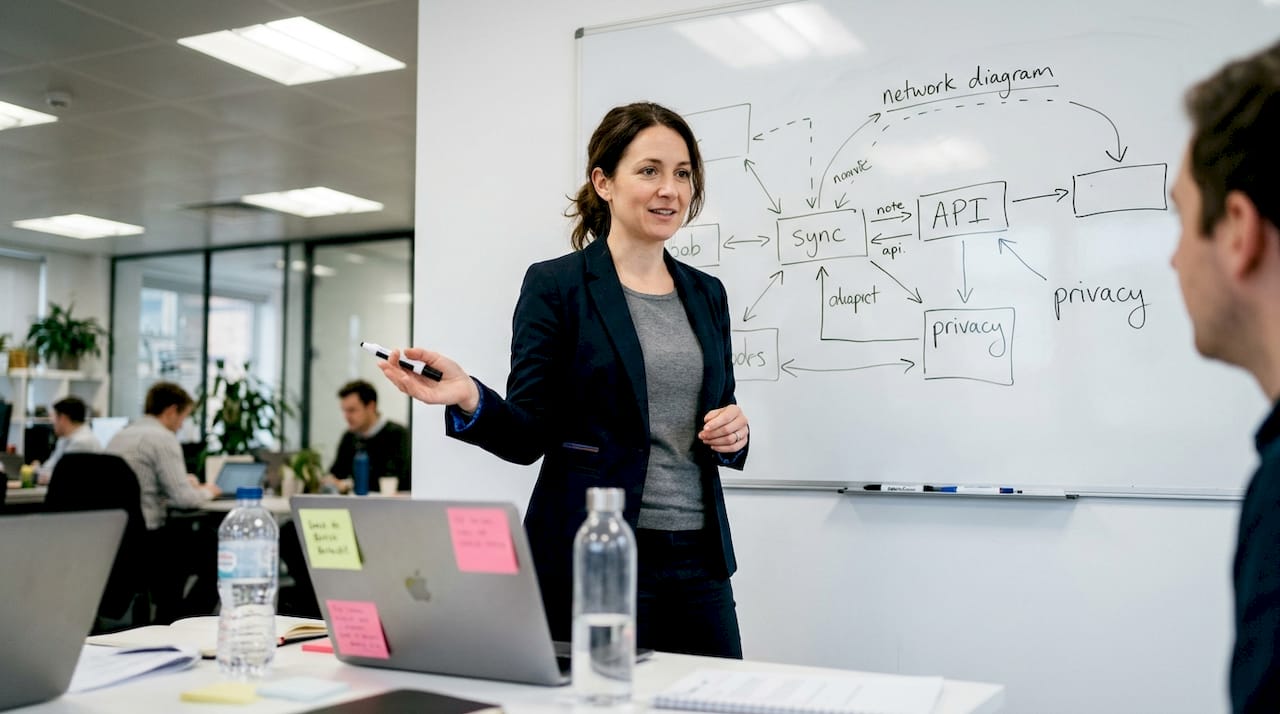
Here is a comparison of common system design topics at Apple, along with what interviewers are actually listening for:
| Topic | What interviewers assess |
|---|---|
| Clipboard sync across iOS and macOS | Cross-device consistency, conflict resolution, privacy handling |
| Event stream processing on AWS | Scalability, fault tolerance, latency trade-offs |
| P2P file sharing (e.g. AirDrop) | Network topology, security, bandwidth efficiency |
| Offline-first mobile sync | Data integrity, eventual consistency, user experience impact |
To structure your verbal answers, use a simple three-part framework: state the problem, describe your approach, and highlight the trade-offs. This gives your answer shape and signals that you think at a systems level, not just a feature level.
If English is not your first language, keep your sentences short and your vocabulary precise. Avoid overly technical jargon unless you can explain it simply in the same breath. For example, rather than saying “we’d leverage eventual consistency via a CRD-based merge strategy,” try: “We’d allow each device to update locally and then merge changes when a connection is restored, prioritising the most recent edit.”
Pro Tip: Study how Apple approaches privacy and hardware integration before your interview. References to on-device processing, secure enclave use, or privacy-by-design thinking will resonate strongly with Apple interviewers. You can draw parallels with Amazon interview strategy frameworks, but always ground your answers in Apple’s specific context.
Behavioural and project deep dives: balancing insight and clarity
Cracking the technicals is half the battle; Apple also dives deep into how you think and communicate under pressure. Behavioural questions at Apple are not about rehearsed stories. They’re designed to reveal how you actually operate when facing ambiguity, conflict, or difficult trade-offs.
Deep project dives reveal trade-offs such as eviction strategies versus alternatives and require genuine ownership. Apple interviewers want to understand why you made a decision, not just what the outcome was.
The STAR framework remains a reliable tool here, adapted specifically for Apple:
- Situation: Set the context briefly. One or two sentences is enough.
- Task: What was your specific responsibility? Be precise.
- Action: Describe what you did, not what your team did. Use “I” not “we.”
- Result: Quantify if possible. What changed because of your decision?
Here is an example of a strong answer to a common Apple behavioural question:
“Tell me about a time you had to make a difficult technical trade-off.” “We were building a caching layer for a high-traffic iOS feature. I had to choose between an in-memory cache that was fast but volatile, and a persistent cache that was safer but introduced latency. I chose the in-memory approach with a graceful fallback, reducing load time by 40%. The trade-off was acceptable because the data was non-critical and could be re-fetched cheaply.”
For non-native speakers, answer clarity is especially important in behavioural rounds. Practise your stories aloud so they flow naturally, and resist the urge to over-explain. A focused, clear answer signals confidence far more than an exhaustive one.
Comparison of Apple’s interview rounds with other top tech firms
With Apple’s format covered, see how it compares to other leading tech interview processes. Understanding these differences helps you target your preparation and avoid generic advice that won’t serve you in an Apple room.
| Criterion | Apple | Amazon | Tesla |
|---|---|---|---|
| Coding focus | Edge cases, platform APIs, concurrency | Data structures, algorithms, scalability | Systems programming, real-time constraints |
| System design | Verbal, privacy-first, cross-device | Diagrammatic, distributed systems at scale | Hardware integration, embedded systems |
| Behavioural evaluation | Project ownership, trade-off reasoning | Leadership Principles alignment | Fast execution, hands-on problem-solving |
| Communication emphasis | Very high, especially verbal clarity | Structured narrative expected | Direct, solution-focused |
Apple places special weight on ecosystem integration, platform-specific APIs, and verbal clarity. This sets it apart from both Amazon interview rounds and Tesla interview preparation, where the emphasis leans more towards scalability or speed respectively.
Key Apple differentiators to keep in mind:
- Apple interviewers probe how you think, not just whether you arrive at the right answer
- Privacy and on-device processing knowledge is genuinely valued, not optional
- Verbal communication quality is assessed throughout every round, not just in behavioural sections
- Generating your own test cases is expected, not impressive. It’s the baseline
For Apple specifically, your preparation should prioritise communication and platform awareness above all else.
Why communication trumps technical genius at Apple interviews
Looking across the data and expert advice, here’s a perspective rarely emphasised in mainstream prep guides: the candidates who stumble in Apple interviews are rarely the ones with the weakest code. They’re the ones who can’t explain what they built or why.
This is particularly acute for non-native English speakers, who may produce technically excellent solutions but lose marks when it comes to verbal system design or articulating trade-offs under pressure. The uncomfortable truth is that Apple’s interviewers are often evaluating your judgment and ownership as much as your output. A clear, reasoned explanation of an imperfect solution frequently outperforms a perfect solution delivered in silence.
Verbal system design and generating your own tests show ownership and clarity. These are the signals Apple is really seeking. The story you tell about your decision matters as much as the decision itself.
Our advice: practise speaking your reasoning aloud, every single session. Not to sound polished, but to build the reflex of externalising your thinking. This is a skill, and it responds to repetition. Consider recording yourself answering practice questions to spot where your communication breaks down. Working on confident communication on camera is one of the most underrated preparation strategies available.
Next steps: refine your Apple interview practice
If you’re ready to practise and refine what you’ve learned, take the next step with these specialised resources. Knowing the format is one thing; performing under real conditions is another entirely.
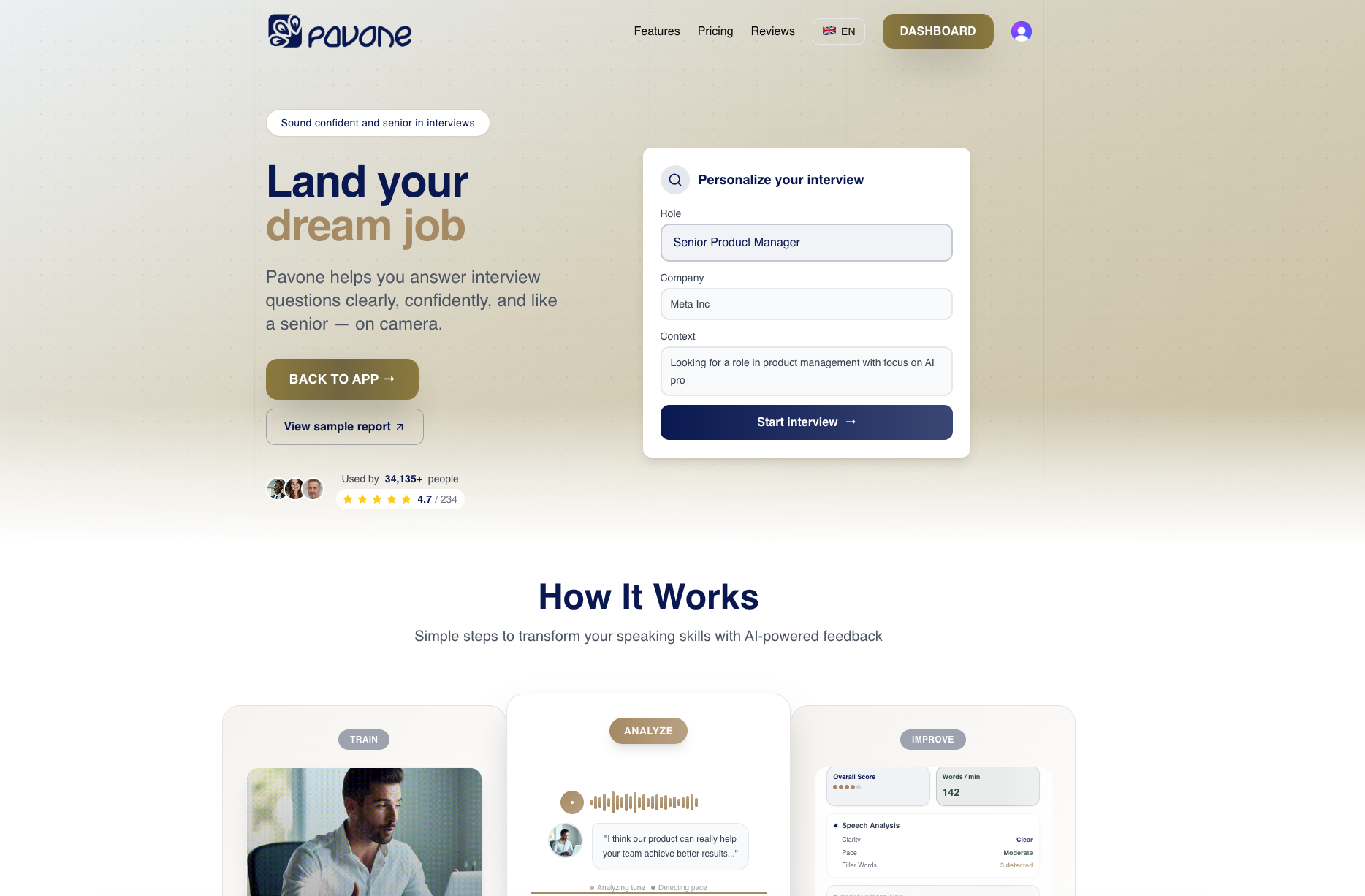
Pavone.ai gives you a private space to record real interview-style answers and receive immediate, actionable feedback on your clarity, structure, pacing, and confidence. You can use the interview question generator to simulate Apple-style prompts and practise online interview sessions that mirror real pressure. For building the verbal confidence that Apple interviewers reward, explore guidance on mastering answer confidence. Every session sharpens the communication habits that actually move the needle.
Frequently asked questions
What is the most common Apple coding interview question format?
Apple typically asks candidates to solve scenarios involving real-world edge cases and then generate their own test cases out loud, demonstrating ownership of the solution from start to finish.
How does Apple’s system design round differ from other companies?
Apple focuses on verbal explanations, where candidates must describe distributed systems and privacy integrations clearly without relying on diagrams or visual aids.
How can non-native English speakers stand out in Apple interviews?
Focus on clear structure and verbalising your thought process at every stage; use frameworks like STAR for behavioural questions and practise answering aloud regularly to build the reflex of confident, coherent communication.
What topics should I focus on for system design at Apple?
Prioritise distributed systems, cross-device sync, event streaming, and Apple hardware or privacy issues, as these reflect the real challenges Apple’s engineering teams face daily.
Recommended
Ready to practice?
Start improving your speaking skills with AI-powered feedback and analysis.
Try Pavone Free