
Master Apple interview questions: ace your engineering role

TL;DR:
- Apple’s interview process values problem-solving, collaboration, creativity, and communication over technical knowledge alone.
- Candidates should prepare for a mix of technical, system design, behavioral, and values-focused questions with structured, flexible responses.
- Practice with varied, feedback-driven mock interviews and focus on genuine understanding rather than memorized answers enhances success.
Landing a software engineering role at Apple is one of the most competitive achievements in the industry. Apple’s interview process is notoriously rigorous, testing not just your technical ability but your communication, creativity, and cultural alignment. Many candidates arrive well-prepared on paper yet stumble because they focus on memorising answers rather than building genuine, adaptable skills. This guide breaks down the most common Apple company interview questions, explains exactly what interviewers are looking for, and gives you a clear, structured approach to preparation that will help you walk into any Apple interview with real confidence.
Table of Contents
- Understanding Apple’s interview criteria
- Core types of Apple interview questions
- Sample Apple interview questions and answers
- Comparing Apple’s interview approach to other tech giants
- Deciding how to practise for Apple interviews
- Why custom practice beats memorising answers at Apple
- Supercharge your Apple interview readiness with expert tools
- Frequently asked questions
Key Takeaways
| Point | Details |
|---|---|
| Know what Apple wants | Apple prioritises problem-solving, collaboration, and communication in software engineering candidates. |
| Practise with real questions | Working through Apple-style interview questions prepares you for the specifics of their process. |
| Structure your answers | Frameworks like STAR and clear, logical approaches stand out during Apple’s interviews. |
| Feedback builds confidence | Deliberate practice and constructive feedback increase success rates in Apple interviews. |
Understanding Apple’s interview criteria
Before you practise a single answer, you need to understand what Apple is actually evaluating. Most candidates assume the bar is purely technical. It is not. Apple values problem-solving, collaborative skills, and innovation in its software engineering candidates, which means your ability to articulate your thinking is just as important as getting the right answer.
Apple interviewers are trained to look beyond surface-level responses. They want to see how you approach ambiguity, how you communicate trade-offs, and whether you can work constructively with others when the path forward is unclear. Technical correctness matters, but so does the quality of your reasoning out loud.
Here is what Apple consistently evaluates across its engineering interviews:
- Technical depth: Can you solve complex problems and explain your approach clearly?
- Collaboration: Do you listen, adapt, and build on feedback during the conversation?
- Creative problem-solving: Can you generate multiple solutions and weigh them honestly?
- Communication: Do you structure your answers so the interviewer can follow your logic?
- Company fit: Do your values and working style align with Apple’s culture?
“The biggest mistake candidates make is treating Apple interviews like a coding exam. Apple wants to see how you think, not just what you know.”
For Apple interview insights from graduates, the consistent theme is that candidates who articulate their process and acknowledge trade-offs leave a far stronger impression than those who rush to a solution.
Core types of Apple interview questions
Now that you understand Apple’s criteria, it is time to get specific about the kinds of questions you will face. Apple’s interviews blend technical, behavioural, and hypothetical questions to test a candidate’s range of abilities across multiple dimensions.
Here is a breakdown of the five main question types:
- Technical challenges: Coding problems, algorithm design, and debugging tasks. Apple tends to favour practical, real-world scenarios over abstract puzzles.
- System design: Questions asking you to architect a scalable system, such as designing a notification service or a distributed caching layer.
- Behavioural questions: Scenarios exploring how you have handled conflict, failure, or ambiguity in past roles. These map directly to Apple’s cultural values.
- Hypothetical questions: “What would you do if…” questions that test your judgement and creative thinking under pressure.
- Apple values-focused questions: Questions about why you want to work at Apple, what you admire about their products, and how you align with their mission.
A common pitfall is treating each type in isolation. In practice, Apple interviewers often pivot between types mid-conversation. A technical question can quickly become a behavioural one if they ask how you handled a similar challenge in a previous role.

Pro Tip: Before your interview, practise your video response strategies for each question type separately. This builds the mental flexibility to switch modes naturally when the conversation shifts.
It is also worth investing time in managing interview stress before the day itself. Anxiety is one of the main reasons strong candidates underperform. Building a calm, confident baseline through repeated practice is one of the most underrated preparation strategies available. For a broader view of how personal branding for candidates can sharpen your overall presence, it is worth exploring how your narrative ties together across all question types.
Sample Apple interview questions and answers
Recognising the main types is only the beginning. Let us look at concrete Apple questions and how outstanding candidates respond.
| Question | Type | Difficulty | What it assesses |
|---|---|---|---|
| “Design a system to handle millions of push notifications” | System design | High | Architecture, scalability thinking |
| “Tell me about a time you disagreed with a teammate” | Behavioural | Medium | Collaboration, communication |
| “How would you improve the iPhone camera app?” | Hypothetical | Medium | Creativity, product thinking |
| “Implement a function to detect a cycle in a linked list” | Technical | High | Algorithms, code clarity |
| “Why do you want to work at Apple specifically?” | Values-focused | Medium | Cultural fit, motivation |
Structured answers using frameworks like STAR are favoured at Apple, particularly for behavioural and hypothetical questions. STAR stands for Situation, Task, Action, and Result. It gives your answer a clear shape that is easy to follow.
Here is a step-by-step approach to structuring your responses:
- Pause briefly before answering. This signals confidence and gives you a moment to organise your thoughts.
- State your approach upfront. Tell the interviewer what framework or strategy you will use before you dive in.
- Walk through your reasoning. Do not just give the answer. Narrate your thinking so the interviewer can follow along.
- Acknowledge trade-offs. Strong candidates name the limitations of their chosen approach and explain why they chose it anyway.
- Close with a clear result or recommendation. Leave the interviewer with a crisp, memorable conclusion.
Pro Tip: Review Apple answer frameworks to practise structuring responses before your interview. Candidates who read about industry interview experience often find that real-world examples reinforce these frameworks far more effectively than theory alone.
Comparing Apple’s interview approach to other tech giants
What sets Apple’s interview process apart becomes even clearer when it is compared directly with other tech giants.
| Factor | Apple | Amazon | Microsoft | |
|---|---|---|---|---|
| Question style | Practical, values-driven | Algorithmic, puzzle-heavy | Behavioural (Leadership Principles) | Scenario-based, collaborative |
| Core values focus | High | Moderate | Very high | Moderate |
| System design weight | High | High | Medium | High |
| Communication emphasis | Very high | Medium | High | Medium |
| Interview pacing | Conversational | Structured | Structured | Flexible |
Apple’s technical interviews focus more on practical application and communication than on algorithmic puzzles alone. This is a meaningful distinction. If you have recently prepared for Google interviews, you may be over-indexing on abstract problem-solving and under-investing in the narrative quality of your answers.
Here are the most common preparation pitfalls when switching from another company’s interview style:
- Over-relying on LeetCode-style drilling when Apple wants to hear your reasoning, not just your solution.
- Ignoring cultural fit questions because you are focused on technical readiness.
- Underestimating system design if you have been preparing for a company that weights algorithms more heavily.
For a deeper look at how to adapt your approach, explore Google interview strategy as a useful contrast. Understanding what makes Apple different from graduate perspectives reinforces why a tailored approach matters so much.
Deciding how to practise for Apple interviews
With Apple’s process and questions in mind, the final step is to build a rigorous, targeted practice plan. Preparation without structure is just repetition. You need a method that builds real skill, not just familiarity.
Here is a step-by-step practice method designed specifically for Apple interviews:
- Map your weak areas first. Identify whether your gaps are technical, behavioural, or communication-based before you start practising.
- Record yourself answering questions. Watching your own responses reveals pacing issues, filler words, and structural weaknesses that you simply cannot notice in the moment.
- Use Apple-specific question sets. Generic interview prep will not prepare you for Apple’s values-focused pivots. Seek out questions tailored to Apple’s culture and engineering context.
- Seek real-time feedback. Practising alone has limits. Use a platform or peer group that can give you honest, specific feedback on your delivery and structure.
- Review and iterate. After each practice session, identify one concrete thing to improve. Small, consistent adjustments compound quickly.
Practising with mock interviews and real-time feedback can increase your performance by up to 25%, which is a significant edge in a competitive process.
Pro Tip: Work on your video confidence techniques alongside your content preparation. How you come across on screen matters, especially in early screening rounds. For broader preparation ideas, general interview preparation tips can help you round out your approach.
Why custom practice beats memorising answers at Apple
Here is the uncomfortable truth that most preparation guides will not tell you. Memorising polished answers is one of the least effective ways to prepare for an Apple interview. It feels productive because you are producing something, but it builds a brittle kind of readiness.
Apple interviewers are specifically trained to probe beneath rehearsed responses. They ask follow-up questions designed to test whether you genuinely understand what you just said. A memorised answer collapses the moment the conversation takes an unexpected turn, and at Apple, unexpected turns are the norm.
What actually works is deliberate, varied practice with honest feedback. When you practise the same question ten different ways, you stop reciting and start thinking. You build the mental agility to adapt your answer to whatever direction the interviewer takes. Candidates who reflect on their performance after each session, identify what fell flat, and adjust accordingly are the ones who walk into the real interview feeling genuinely prepared.
The goal is not to have a perfect answer ready. The goal is to become the kind of candidate who can construct a strong answer to almost anything. That skill only comes from real Apple interview lessons and consistent, feedback-driven practice.
Supercharge your Apple interview readiness with expert tools
For those who want to accelerate their Apple interview readiness, the right tools make all the difference.
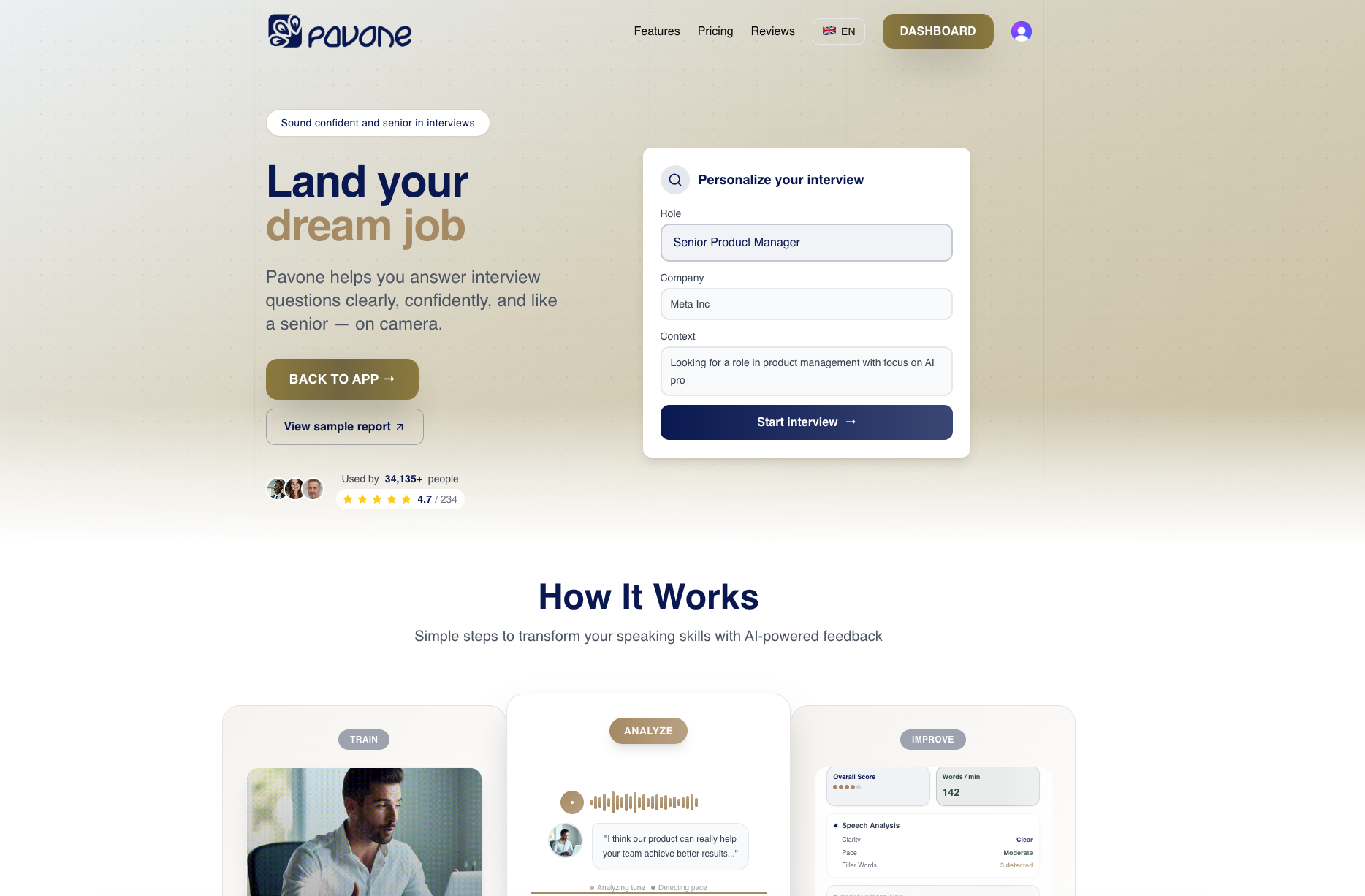
Pavone.ai is built for exactly this kind of preparation. You can record your answers to Apple-style questions on camera, receive immediate feedback on your clarity, structure, pacing, and confidence, and track how your delivery improves over time. There is no setup, no pressure, and no waiting for a coach to be available. Use the Apple interview question generator to practise with targeted, realistic questions, and explore the online interview practice modules to sharpen your responses before the real thing. Your next Apple interview deserves more than guesswork.
Frequently asked questions
How many interview rounds are there for software engineers at Apple?
Typically, Apple conducts 3-5 rounds, including phone screens, onsite interviews, and team matches. Apple interview processes for software engineers usually include multiple technical and behavioural rounds.
What topics should I focus on for Apple software engineering interviews?
Prioritise data structures, algorithms, system design, and behavioural scenarios linked to Apple’s values. Apple’s interviews require knowledge of algorithms, system design, and core engineering principles.
How do I stand out in Apple interviews besides technical ability?
Show creativity, clear communication, and genuine alignment with Apple’s mission and culture. Apple values innovation and cultural fit alongside technical strength, so your narrative matters as much as your code.
Should I practise with mock interviews for Apple?
Absolutely. Using mock interviews with real feedback significantly boosts your Apple interview performance. Mock interviews improve readiness for real Apple interviews by building both confidence and structural clarity in your answers.
Recommended
Ready to practice?
Start improving your speaking skills with AI-powered feedback and analysis.
Try Pavone Free