
10 good interview questions to boost on-camera confidence

Choosing which interview questions to practise on camera can feel overwhelming when every question matters. Mid-to-senior professionals know their delivery shapes first impressions, yet selecting questions that actually improve clarity, confidence, and structure remains surprisingly unclear. This article identifies 10 proven questions that sharpen your on-camera presence and provides a strategic framework to choose questions that elevate how you communicate, not just what you say.
Table of Contents
- How To Choose The Best Interview Questions For On-Camera Practice
- 10 Good Interview Questions For Mid-To-Senior Roles
- Comparing The Impact Of Different Interview Questions On On-Camera Performance
- Situational Recommendations: Which Questions To Practise For Your Role
- Final Summary And Key Takeaways
- Boost Your On-Camera Confidence With Pavone.ai
- Frequently Asked Questions
Key takeaways
| Point | Details |
|---|---|
| Behavioural and situational questions improve clarity and confidence | These question types prompt storytelling and structured responses that enhance on-camera delivery. |
| Top 10 questions curated for leadership and senior roles | Focused selection covers essential skills from conflict resolution to future vision. |
| Question type directly impacts answer structure and authenticity | Choosing the right mix reduces filler words and creates natural, credible responses. |
| Role-specific recommendations maximise preparation effectiveness | Tailoring questions to your industry and seniority level yields better practice outcomes. |
How to choose the best interview questions for on-camera practice
Selecting effective interview questions transforms practice sessions from generic drills into targeted skill-building. The right questions force you to organise thoughts clearly, reduce hesitation, and communicate with senior-level polish.
Start with behavioural questions that require concrete examples from your experience. These questions ask how you handled specific situations, pushing you to structure answers around actions and outcomes rather than vague theories. Situational questions follow a similar logic but focus on hypothetical scenarios, testing your judgement and problem-solving approach on camera.

Technical questions have their place but prioritise queries that prompt storytelling. Questions demanding detailed examples naturally improve answer structure because you must set context, explain actions, and describe results. Research shows candidates practising with mixed behavioural and technical questions gained 22% higher confidence scores, proving variety matters.
Consider role relevance when building your question set. Senior roles demand questions about leadership, influence, and strategic thinking. Mid-level positions benefit from questions exploring adaptability and collaboration. Match question difficulty to your target seniority to avoid practising answers that sound too junior or artificially inflated.
Pro Tip: Choose questions that make you slightly uncomfortable. If a question feels too easy, your answer likely won’t stretch your communication skills or reveal delivery weaknesses worth fixing.
Focus on questions that reduce filler words naturally. When you must provide specific examples rather than abstract opinions, your brain shifts from searching for clever phrases to recalling actual events. This cognitive shift eliminates “um,” “like,” and meandering transitions that undermine on-camera credibility.
Variety across question types ensures comprehensive skill development. Practise questions testing different aspects:
- Leadership and team management
- Conflict resolution and difficult conversations
- Adaptability and handling setbacks
- Strategic thinking and prioritisation
- Self-awareness and professional development
Balancing these areas creates well-rounded practice that improves multiple facets of your on-camera presence simultaneously. To master practice interviews for confident on-camera delivery, treat question selection as strategic preparation, not random sampling.
10 good interview questions for mid-to-senior roles
These questions consistently produce stronger on-camera answers because they demand structured thinking, authentic examples, and clear articulation. Each question targets specific communication skills essential for senior roles.
- Tell me about a time you led a team through significant change.
This leadership question forces you to demonstrate influence without authority-sounding language. Strong answers show how you communicated vision, managed resistance, and measured success. On camera, this question reveals whether you can tell compelling stories or merely recite bullet points.
- Describe a situation where you had to resolve conflict between team members.
Conflict resolution questions test emotional intelligence and communication nuance. Your answer shows how you navigate difficult conversations with diplomacy whilst maintaining authority. Data indicates questions that ask for concrete examples resulted in 28% higher recall accuracy and clearer articulation, making this format especially valuable.
- What is your greatest professional weakness, and how are you addressing it?
Self-awareness questions separate authentic candidates from those reciting rehearsed scripts. On camera, genuine vulnerability reads as confidence, whilst evasive answers destroy credibility. This question improves delivery by forcing honest, structured reflection rather than defensive positioning.
- Tell me about a time you failed and what you learned.
Failure questions demand humility and growth mindset demonstration. Strong answers acknowledge mistakes directly, explain corrective actions, and show measurable improvement. This question type enhances on-camera presence by rewarding straightforward communication over spin.
- How do you prioritise competing demands when everything feels urgent?
Prioritisation questions reveal strategic thinking and decision-making frameworks. Your answer demonstrates whether you react to pressure or apply systematic judgement. On camera, structured answers to this question signal senior-level composure and clarity.
“The questions you practise with determine the communication skills you develop. Choose questions that expose weaknesses rather than confirm strengths.”
- Describe a time you influenced stakeholders without formal authority.
Influence questions test persuasion skills and political savvy essential for senior roles. Strong answers show relationship-building, strategic communication, and results achieved through collaboration. For business interview questions and answers for senior roles, this question consistently separates strong candidates from average ones.
- Where do you see yourself in five years, and how does this role fit that vision?
Future vision questions assess ambition, self-awareness, and alignment with organisational goals. On camera, authentic answers demonstrate confidence in your trajectory whilst showing you’ve researched the role thoroughly. Weak answers sound generic or disconnected from reality.
- Tell me about a time you had to adapt your communication style for different audiences.
Adaptability questions reveal emotional intelligence and audience awareness. Your answer shows whether you recognise communication as situational or apply one-size-fits-all approaches. This question improves on-camera delivery by highlighting the importance of tailoring messages, a skill directly relevant to video interviews.
- Describe a decision you made with incomplete information.
Decision-making questions under uncertainty test judgement and risk tolerance. Strong answers acknowledge information gaps, explain reasoning processes, and own outcomes. On camera, these answers demonstrate senior-level comfort with ambiguity rather than needing perfect certainty.
- What motivates you in your work, and how do you maintain that motivation during challenging periods?
Motivation questions reveal intrinsic drivers and resilience. Authentic answers connect personal values to professional choices, creating compelling narratives. To build interview practice building confidence on camera, this question helps you articulate purpose clearly and passionately.
Each question pushes you beyond surface-level responses into territory where delivery quality matters as much as content. Practising these questions on camera exposes verbal tics, structural weaknesses, and confidence gaps that text-based preparation misses entirely.
Comparing the impact of different interview questions on on-camera performance
Question type significantly influences answer quality, delivery confidence, and interviewer perception. Understanding these differences helps you allocate practice time strategically.
| Question type | Average answer length | Clarity improvement | Confidence gain | Interviewer rating |
|---|---|---|---|---|
| Behavioural | 90-120 seconds | High | High | 4.2/5.0 |
| Situational | 60-90 seconds | Medium | Medium | 3.8/5.0 |
| Technical | 45-75 seconds | Low | Low | 3.5/5.0 |
| Open-ended | 75-100 seconds | Medium | Medium | 3.9/5.0 |
Behavioural questions consistently produce the strongest on-camera performance because they anchor answers in real experience rather than theoretical knowledge. When you recall actual events, your delivery becomes naturally more confident and detailed. The storytelling structure inherent to behavioural questions creates clear beginnings, middles, and ends that sound polished without seeming rehearsed.
Situational questions offer moderate benefits but risk sounding hypothetical or detached. Your delivery often lacks the conviction that comes from discussing lived experience. However, situational questions still improve clarity by forcing structured thinking about approach and reasoning.
Technical questions test knowledge but do little for communication skills. They typically yield shorter, more mechanical answers that don’t reveal personality or leadership qualities. Include technical questions sparingly, focusing practice time on question types that develop broader on-camera presence.
Pro Tip: Record answers to the same question type consecutively to identify patterns in your delivery. You’ll notice recurring filler words or structural habits that need addressing.
Balance your practice across question types based on your development areas. If you struggle with confidence, emphasise behavioural questions where authentic examples naturally boost conviction. If clarity is your challenge, situational questions force logical sequencing and clear articulation of reasoning.
Combining question types in single practice sessions mirrors real interview dynamics. Most interviews blend behavioural, situational, and technical queries, so practising transitions between different answer styles prepares you for actual conversations. Visit interview practice building confidence on camera to understand how mixed question practice accelerates improvement.
Situational recommendations: which questions to practise for your role
Tailoring question selection to your specific role and industry maximises practice effectiveness. Generic preparation wastes time on scenarios unlikely to arise in your actual interviews.
For leadership and executive roles, prioritise behavioural questions about influence, change management, and strategic decision-making. Questions 1, 4, 6, and 9 from the top 10 list directly address executive competencies. Senior roles demand comfort discussing failures and uncertainty, so practise vulnerability and strategic thinking simultaneously.
Technical and specialist roles require balanced question sets mixing skill demonstration with soft skills. Include at least two technical questions but dedicate remaining practice to behavioural queries about collaboration, communication, and adaptability. Technical expertise gets you considered, but communication skills secure offers.
Client-facing and stakeholder management roles benefit most from questions about influence, conflict resolution, and communication adaptation. Questions 2, 6, and 8 test skills you’ll use daily. Practise answers that demonstrate relationship-building and political awareness without sounding manipulative.
Fast-paced or high-pressure roles demand questions about prioritisation, stress management, and quick decision-making. Questions 5 and 9 reveal how you function under pressure. Your on-camera delivery during these answers signals composure and decisiveness better than any rehearsed assertion of “working well under pressure.”
Emerging leaders and individual contributors aspiring to management should focus on questions demonstrating readiness for increased responsibility. Questions 1, 3, and 10 show self-awareness, growth mindset, and leadership potential. Your answers prove you think beyond your current role.
Review feedback from previous interviews or practice sessions to identify question types exposing weaknesses. If you consistently struggle with conflict resolution questions, that’s your practice priority. To explore techniques for improvement, see the guide to confident speaking for successful interviews.
Final summary and key takeaways
The right interview questions transform on-camera practice from uncomfortable obligation into skill-building opportunity. Behavioural questions anchored in real experience produce the clearest, most confident answers because they leverage authentic stories rather than manufactured responses.
Our top 10 questions cover essential competencies for mid-to-senior roles:
- Leadership through change and influence without authority
- Conflict resolution and difficult conversations
- Self-awareness including weaknesses and failures
- Strategic thinking and prioritisation under pressure
- Adaptability and communication across audiences
- Future vision and intrinsic motivation
Combining behavioural, situational, and technical questions creates comprehensive practice addressing multiple skills simultaneously. Behavioural questions yield the strongest on-camera improvement, but balanced practice prepares you for real interview variety.
Tailor your question selection to role requirements and personal development areas. Leaders need different preparation than technical specialists or client-facing professionals. Honest assessment of your weaknesses guides more effective practice than random question sampling.
Consistent practice with structured feedback accelerates improvement dramatically. Recording answers reveals delivery issues invisible during mental rehearsal. Platforms offering AI-powered analysis identify specific patterns like filler words, pacing problems, and structural weaknesses worth addressing. Explore how Pavone.ai interview practice platform transforms question practice into measurable skill development.
Boost your on-camera confidence with Pavone.ai
Knowing which questions to practise solves only half the challenge. Understanding how you actually deliver those answers separates effective preparation from wasted effort.
Pavone.ai provides AI-powered feedback on your interview answers, analysing clarity, structure, pacing, and filler word usage. You practise the questions discussed in this article whilst receiving immediate, actionable insights on communication patterns undermining your credibility. The platform transcribes your answers and highlights specific moments where delivery weakens, giving you concrete improvement targets.
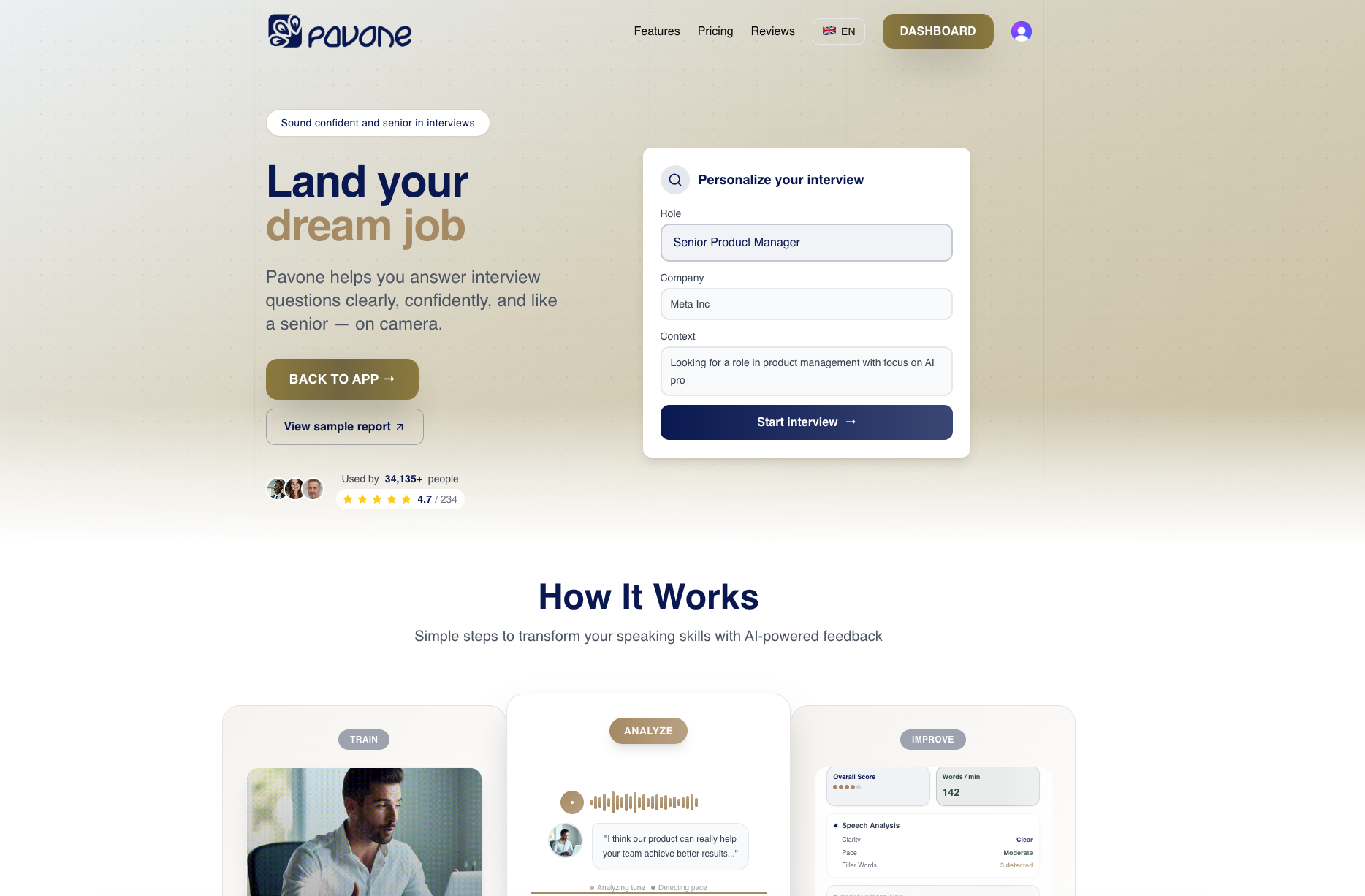
Private, flexible practice sessions fit naturally into active job searches without scheduling pressure. Record answers anytime, review detailed feedback immediately, and track improvement across multiple attempts. The experience feels like having a personal interview coach available 24/7, focused exclusively on how you communicate rather than generic advice about what to say.
Professionals using structured video practice report 25% higher success rates in actual interviews. To understand the measurable impact of consistent on-camera preparation, explore how video interview practice boosts hiring chances by 25% in 2026. Start practising smarter with questions proven to develop the confidence and clarity that secure offers. Master practice interviews for confident on-camera delivery using the strategic approach outlined in this article.
Frequently asked questions
What types of interview questions improve on-camera confidence the most?
Behavioural questions anchored in real experience consistently boost confidence because they let you discuss actual achievements rather than hypothetical scenarios. Situational questions offer moderate benefits but lack the authenticity that creates natural conviction. Prioritise questions demanding concrete examples to build genuine on-camera presence.
How can I reduce filler words and sound more confident in video interviews?
Practise with questions requiring specific examples rather than abstract opinions. Storytelling questions force your brain to recall events instead of searching for clever phrases, naturally reducing “um” and “like.” Recording practice answers and reviewing them reveals filler word patterns you can consciously address. AI practice interview to reduce filler words provides targeted feedback on verbal tics undermining your credibility.
Which interview questions should I prioritise for a senior leadership role?
Focus on behavioural questions showcasing leadership, influence, and strategic decision-making. Include questions about handling failure, managing change, and influencing without authority. Questions 1, 4, 6, and 9 from our top 10 list directly address executive competencies. For comprehensive preparation strategies, review business interview questions for senior roles.
Can technical questions help enhance my on-camera interview skills?
Technical questions assess knowledge but contribute minimally to communication skill development. They typically produce shorter, more mechanical answers that don’t reveal leadership qualities or personality. Balance technical questions with behavioural and situational ones to develop well-rounded on-camera presence whilst demonstrating necessary expertise.
Recommended
Ready to practice?
Start improving your speaking skills with AI-powered feedback and analysis.
Try Pavone Free