
Master eye contact for confident job interviews in 2026

Most candidates believe eye contact matters less on camera than in person. Research shows the opposite is true. Looking directly into the camera lens creates parasocial interaction, where interviewers feel a genuine personal connection despite the digital barrier. For mid-to-senior roles, this skill separates candidates who merely answer questions from those who command presence and trust. This guide explains what eye contact truly means in video interviews, how technology measures your performance objectively, and practical strategies to refine your delivery before your next interview.
Table of Contents
- What Is Eye Contact And Why Does It Matter In Video Interviews?
- How Technology Measures Eye Contact And Emotional Cues In Interviews
- Balancing Eye Contact: Cultural Norms And Common Pitfalls
- Practical Strategies To Improve Your Eye Contact And Confidence On Camera
- Boost Your Interview Success With Expert Coaching
- Frequently Asked Questions
Key takeaways
| Point | Details |
|---|---|
| Camera eye contact builds trust | Looking into the lens simulates direct connection, increasing perceived authenticity and engagement with remote interviewers. |
| Technology assesses your delivery | Facial emotion recognition and gaze tracking provide objective feedback on eye contact patterns and emotional cues during interviews. |
| Cultural context shapes norms | Eye contact expectations vary significantly across cultures and industries, requiring tailored approaches for different audiences. |
| Balance prevents negative impressions | Excessive eye contact can appear aggressive or insincere, whilst insufficient contact suggests disengagement or low confidence. |
| Practice creates measurable improvement | Regular rehearsal with feedback tools builds natural eye contact habits that enhance your on-camera presence. |
What is eye contact and why does it matter in video interviews?
Eye contact in video interviews means directing your gaze into the camera lens rather than at the interviewer’s image on your screen. This distinction is critical. When you look at their face on your monitor, they see you looking downward or sideways, breaking the visual connection that builds rapport and trust.
Effective camera eye contact dissolves the digital barrier between you and the interviewer. It creates what researchers call parasocial interaction, where viewers feel personally connected to you despite the screen separating you. This psychological phenomenon explains why successful television presenters and content creators seem to speak directly to each individual viewer.
Your digital presence depends heavily on consistent, natural eye contact. Interviewers assess your confidence, clarity, and professionalism within the first 30 seconds of an interview. Strong eye contact signals all three qualities immediately, whilst poor eye contact raises doubts about your engagement and authenticity.
Consider these fundamental benefits:
- Trust building: Direct camera gaze demonstrates honesty and openness, essential qualities for senior positions requiring stakeholder management.
- Engagement demonstration: Consistent eye contact proves you are fully present and invested in the conversation, not distracted or disinterested.
- Confidence projection: Maintaining steady eye contact conveys self-assurance and composure under pressure, critical traits for leadership roles.
- Authenticity signalling: Natural eye contact patterns suggest genuine responses rather than rehearsed or evasive answers.
For mid-to-senior candidates, mastering this skill becomes even more important. Hiring managers expect executive presence, and eye contact forms the foundation of that presence on camera. When you combine strong eye contact with thoughtful video interview preparations, you create a compelling first impression that positions you as the senior professional you are.
“The camera becomes your interviewer’s eyes. Treat it as you would direct eye contact in a face-to-face conversation, and you will create the same connection remotely.”
Understanding this principle transforms how you approach every video interview. The camera is not a recording device. It is your direct line to the interviewer’s perception of your competence and character.
How technology measures eye contact and emotional cues in interviews
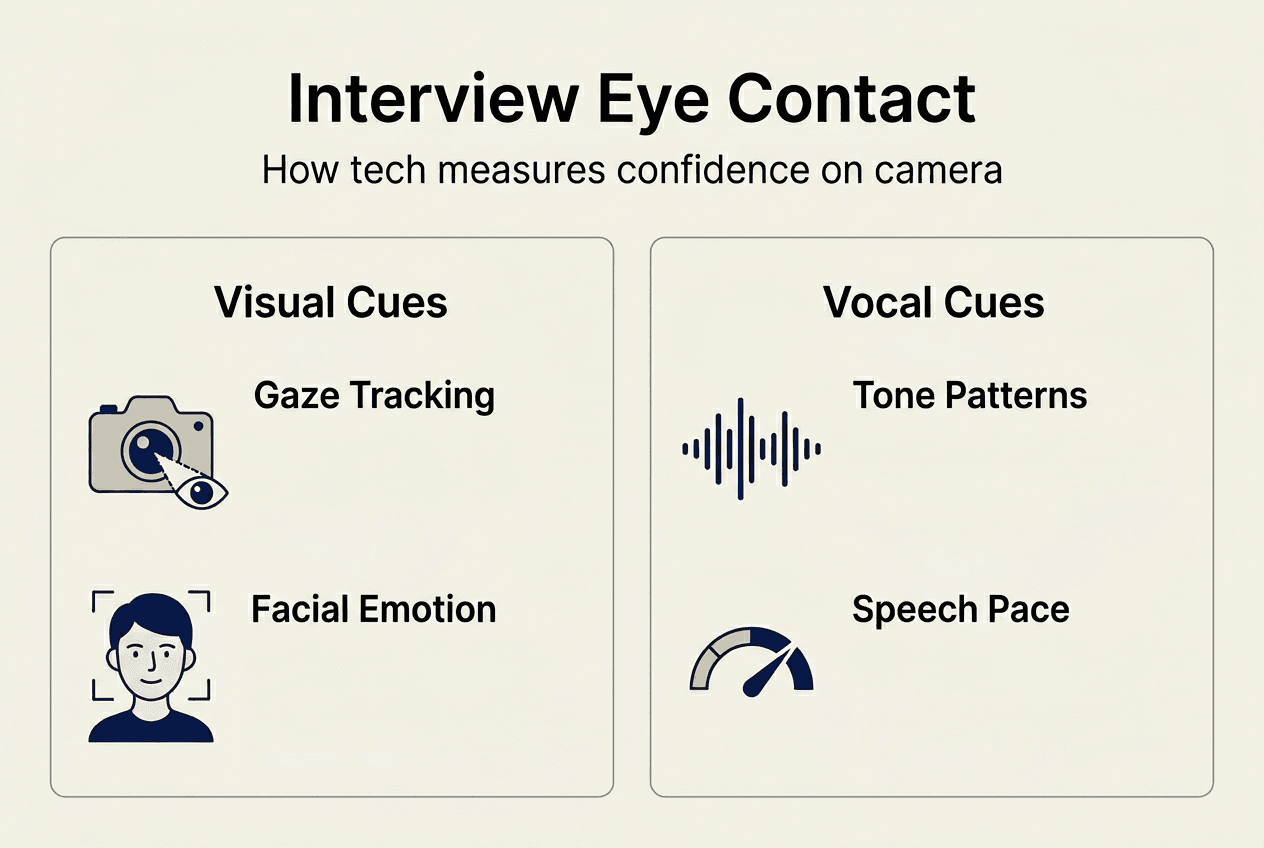
Modern interview platforms use sophisticated technology to evaluate your performance objectively. The Interview Video Analysis System integrates three core components: Facial Emotion Recognition (FER), Gaze Tracking, and Audio Analysis, achieving 86% emotion recognition accuracy.
Facial Emotion Recognition identifies seven key emotions during your interview: happiness, sadness, anger, surprise, fear, disgust, and neutrality. The system analyses micro-expressions that reveal your authentic emotional state, helping interviewers assess whether your answers align with genuine conviction or rehearsed responses. This technology reduces bias by providing objective data rather than relying solely on subjective impressions.
Gaze tracking measures several critical metrics:
- Eye contact duration: How long you maintain focus on the camera versus looking away.
- Directional changes: Patterns of where your eyes move when thinking or responding.
- Blink frequency: Natural blinking patterns versus excessive blinking that may indicate stress.
- Gaze stability: Whether your eye movements appear confident and deliberate or scattered and uncertain.
These gaze tracking measurements link directly to engagement and confidence levels. Candidates who maintain steady camera contact whilst demonstrating natural gaze shifts score higher on authenticity and composure metrics.
| Technology Component | What It Measures | Interview Insight Provided |
|---|---|---|
| Facial Emotion Recognition | Seven core emotions via micro-expressions | Authenticity and emotional alignment with responses |
| Gaze Tracking | Eye contact patterns, blinks, directional shifts | Engagement level, confidence, and cognitive processing |
| Audio Analysis | Voice tone, pace, clarity, filler words | Communication effectiveness and nervousness indicators |
| Combined Data | Holistic behavioural profile | Objective performance assessment reducing interviewer bias |
Audio analysis complements visual data by examining your vocal delivery. The system tracks speaking pace, tonal variation, clarity, and frequency of filler words like “um” or “uh.” When combined with eye contact data, these metrics paint a complete picture of your interview presence.
Understanding these technological assessments helps you appreciate why eye contact matters beyond human judgement alone. Platforms offering AI interview practice leverage similar technology to give you immediate feedback on your delivery, allowing you to refine your eye contact and emotional expression before real interviews.
Pro Tip: Record yourself answering common interview questions whilst focusing on the camera lens. Review the footage to identify moments when your gaze drifts, then practise maintaining steadier eye contact during those specific question types. This targeted approach accelerates improvement more effectively than general practice.
The objectivity of these systems benefits candidates who might face unconscious bias in traditional interviews. When your eye contact and emotional cues are measured consistently across all candidates, your actual performance speaks louder than subjective impressions. This shift towards data-driven assessment makes preparing confident video interviews more predictable and fair.
Balancing eye contact: cultural norms and common pitfalls
Eye contact norms vary dramatically across cultures, industries, and individual preferences. What appears confident in one context may seem aggressive or disrespectful in another. Understanding these nuances prevents well-intentioned eye contact from backfiring during international or cross-cultural interviews.
Research shows optimal eye contact duration differs significantly worldwide. Overuse may appear aggressive or insincere in some contexts, whilst insufficient eye contact suggests disengagement or dishonesty in others. This cultural variation creates a genuine challenge for candidates interviewing with global organisations or diverse panels.
Consider these cultural contrasts:
- United Kingdom and North America: Moderate to strong eye contact signals confidence and honesty. Interviewers expect you to maintain eye contact 60-70% of the conversation, with natural breaks when thinking or transitioning topics.
- East Asian cultures (Japan, Korea): Prolonged direct eye contact can appear confrontational or disrespectful, especially towards senior interviewers. Candidates often demonstrate respect through more frequent gaze shifts and softer eye contact.
- Middle Eastern contexts: Strong eye contact between same-gender individuals shows respect and sincerity. However, cross-gender eye contact norms may differ based on religious and cultural practices.
- Southern European cultures (Italy, Spain): Intense, sustained eye contact during conversation is common and expected, signalling engagement and passion for the topic.
Beyond cultural differences, excessive eye contact creates specific problems even within Western business contexts. Staring without natural breaks appears robotic or rehearsed. It can make interviewers uncomfortable, triggering negative impressions about your social awareness and emotional intelligence.
Common pitfalls include:
- The unblinking stare: Forgetting to blink naturally whilst focusing on the camera creates an unsettling, intense impression that undermines rapport.
- Constant camera lock: Never looking away, even when thinking or processing questions, appears artificial and suggests you are performing rather than conversing.
- Overcorrection: Candidates who learn eye contact matters sometimes overcompensate, maintaining such rigid focus that they seem aggressive or insincere.
- Screen watching: Looking at the interviewer’s image instead of the camera breaks eye contact from their perspective, the most common technical mistake.
Pro Tip: Research your interviewer’s cultural background when possible. If interviewing with a Japanese company, practise slightly softer eye contact with more natural gaze shifts. For UK or US firms, aim for steady camera focus with brief, purposeful breaks when considering complex questions. This cultural intelligence demonstrates senior-level awareness.
Your body language in interviews extends beyond eye contact alone. Facial expressions, posture, and gestures must align with your eye contact patterns to create a cohesive, authentic presence. Mismatched signals, such as strong eye contact combined with closed body language, confuse interviewers and weaken your overall impression.

The key is calibration. Monitor the interviewer’s response to your eye contact level. If they seem uncomfortable, soften your gaze slightly and incorporate more natural breaks. If they appear disengaged, increase your camera focus to recapture their attention. This adaptive approach demonstrates the interpersonal sensitivity expected in senior roles.
Practical strategies to improve your eye contact and confidence on camera
Improving your eye contact requires deliberate practice with objective feedback. Follow these steps to build natural, confident camera presence before your next interview:
-
Position your camera at eye level: Place your webcam directly in front of your face, aligned with your natural eye line. This positioning makes looking into the lens feel more like natural conversation rather than an awkward upward or downward gaze.
-
Mark your camera lens: Place a small, removable sticker or dot near your camera lens as a visual reminder of where to focus. This physical cue helps retrain your instinct to look at the interviewer’s face on screen.
-
Practise the 80/20 rule: Aim to maintain camera eye contact 80% of the time, with 20% for natural gaze shifts when thinking, processing questions, or referencing notes. This balance appears natural rather than rigid.
-
Record and review systematically: Film yourself answering common interview questions whilst focusing on the camera. Watch the footage specifically to identify moments when your gaze drifts, noting patterns like looking away during difficult questions.
-
Use AI feedback tools: Platforms offering AI mock interview coaching analyse your eye contact patterns objectively, providing specific timestamps where your focus wavers and quantifying your overall camera engagement.
-
Simulate real interview conditions: Practise with the same lighting, background, and technology setup you will use in actual interviews. Familiarity with your environment reduces cognitive load, making natural eye contact easier.
-
Build progressive difficulty: Start with 30-second answers whilst maintaining strong eye contact, then gradually increase to 2-3 minute responses. This progressive approach builds stamina without overwhelming you.
Maintaining natural gaze shifts prevents the robotic stare that undermines authenticity. When processing a complex question, it is acceptable to break eye contact briefly whilst thinking. This pattern appears more genuine than maintaining constant camera lock. The key is returning your focus to the lens when delivering your answer, especially during critical points you want to emphasise.
Pro Tip: Use technology as your practice partner. AI interview platforms provide instant, objective feedback on your eye contact percentage, blink rate, and gaze stability. This data-driven approach identifies specific improvement areas faster than self-assessment alone. Regular practice with these tools creates measurable progress you can track over time.
Research confirms technology-mediated interviews impact candidates’ organisational perceptions differently than face-to-face interviews. Candidates who master on-camera delivery overcome this disadvantage, creating equally strong impressions remotely. Your eye contact becomes the equaliser that bridges the digital gap.
Iterative practice builds genuine confidence. Each rehearsal session strengthens your muscle memory for camera focus, making it feel increasingly natural. Within 5-7 practice sessions, most candidates report significant improvement in their comfort maintaining eye contact whilst speaking. This confidence translates directly to reduced anxiety and stronger performance in real interviews.
Combine eye contact practice with comprehensive interview preparation covering content, structure, and delivery. Your answers matter, but how you deliver them through confident eye contact and clear communication determines whether interviewers remember you as a compelling candidate or just another qualified applicant.
Consider your practice schedule. Consistency matters more than duration. Three 15-minute practice sessions weekly produce better results than one 90-minute marathon session. Distributed practice allows your brain to consolidate learning between sessions, making natural eye contact feel effortless rather than forced.
Boost your interview success with expert coaching
Mastering eye contact and on-camera delivery requires more than understanding principles. You need structured practice with immediate, actionable feedback that identifies exactly where your delivery needs refinement.
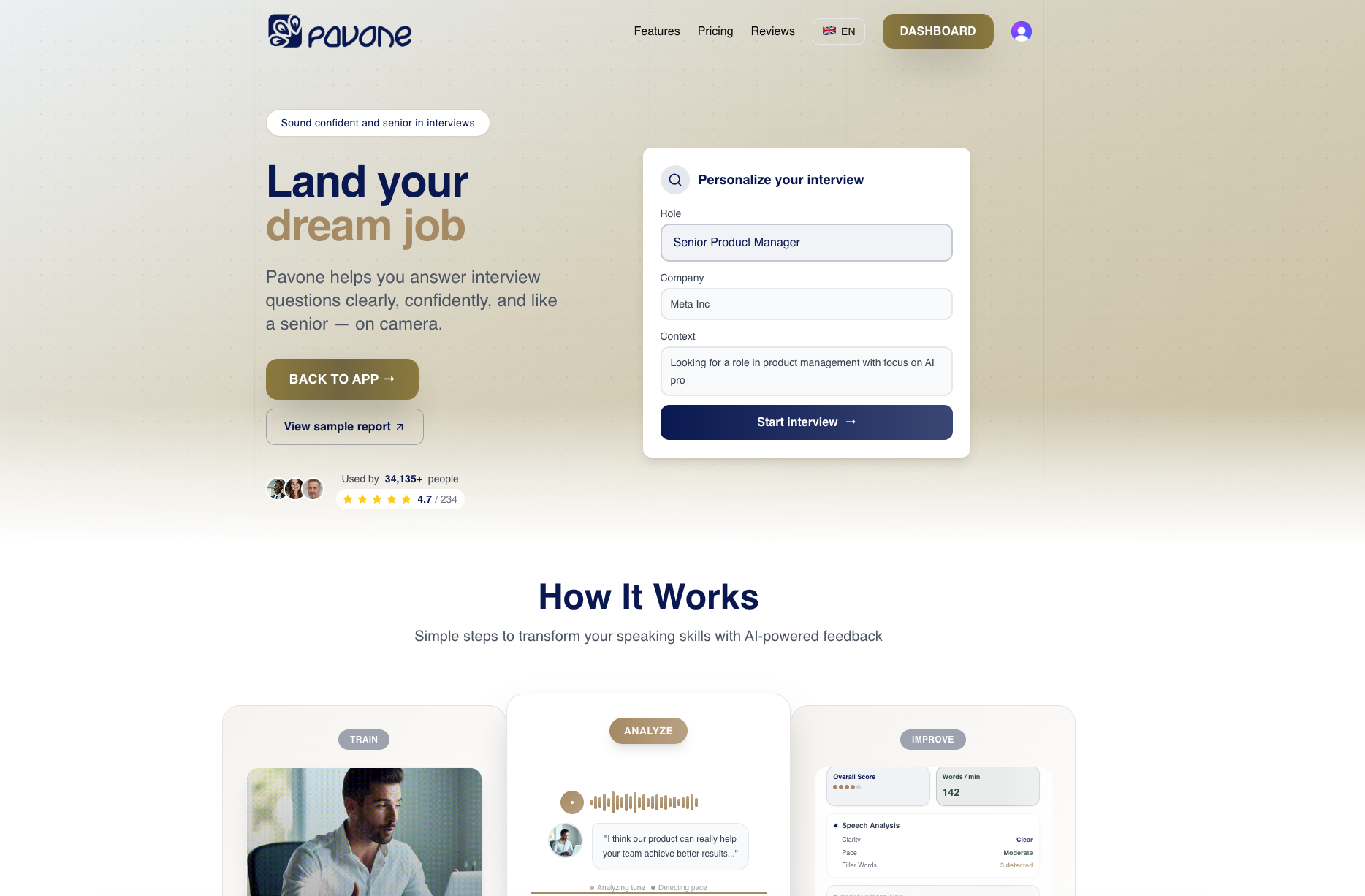
Pavone Academy offers specialised courses designed specifically for professionals preparing for mid-to-senior role interviews. Our AI-powered platform analyses your eye contact patterns, facial expressions, and vocal delivery in real time, providing the same objective assessment used by leading interview systems. You receive specific feedback on eye contact percentage, blink frequency, and gaze stability, allowing you to track measurable improvement with each practice session.
Our interview preparation guide walks you through comprehensive strategies covering content development, structural frameworks, and delivery techniques. Combined with confident video interview preparation modules, you build the complete skill set required to excel in remote interview formats.
Professional coaching through Pavone helps you identify blind spots in your delivery that self-assessment misses. Our technology highlights specific moments when your eye contact wavers, your pacing rushes, or your confidence dips, giving you targeted areas to improve. This precision accelerates your progress far beyond general practice alone.
Pro Tip: Utilise Pavone’s practice modules at least three times weekly in the fortnight before your interview. Regular exposure to AI feedback creates lasting improvements in your natural eye contact and overall presence, making confident delivery feel automatic rather than forced.
Frequently asked questions
What is the best way to maintain eye contact on camera?
Position your camera at eye level and focus directly on the lens rather than the interviewer’s image on screen. Place a small visual marker near your camera as a reminder, and practise the 80/20 rule: maintain camera focus 80% of the time with 20% for natural gaze shifts when thinking.
How long should I hold eye contact during a virtual interview?
Aim for 60-70% camera eye contact throughout the conversation for UK and North American interviews. Break eye contact naturally when processing complex questions or transitioning topics, then return focus to the lens when delivering your answer. Continuous staring appears unnatural, whilst too little suggests disengagement.
Can too much eye contact harm my interview impression?
Yes. Excessive, unbroken eye contact appears aggressive, insincere, or robotic. Interviewers expect natural gaze patterns that include occasional breaks for thinking and processing. Constant camera lock without blinking or looking away triggers discomfort and raises questions about your social awareness and authenticity.
How do cultural differences affect eye contact in international interviews?
Eye contact norms vary significantly worldwide. Western cultures generally expect moderate to strong eye contact as a confidence signal, whilst East Asian contexts may interpret intense eye contact as confrontational. Research your interviewer’s cultural background when possible and adjust your eye contact intensity accordingly to demonstrate cultural intelligence.
Are there tools to help me practise eye contact for interviews?
AI-powered interview platforms analyse your eye contact patterns objectively, providing specific feedback on camera focus percentage, gaze stability, and blink rate. These tools identify exactly when and why your eye contact wavers, allowing targeted improvement. Regular practice with objective feedback accelerates progress more effectively than unstructured rehearsal alone.
Recommended
Ready to practice?
Start improving your speaking skills with AI-powered feedback and analysis.
Try Pavone Free