
Master interview question answers with confidence

Most candidates preparing for mid-to-senior roles focus heavily on what to say in interviews, yet research shows that 70% of hiring preference depends on how answers are delivered when technical skills are equal. Your communication style, including clarity, pacing, and confidence on camera, matters more than perfect content. This guide reveals practical frameworks and delivery techniques to help you structure answers effectively, reduce anxiety, and communicate with authority in video and face-to-face interviews.
Table of Contents
- Understanding The Importance Of How You Answer, Not Just What
- Structural Frameworks For Clear, Confident Answers
- Communicating Effectively On Camera: Clarity, Pacing And Reducing Fillers
- Common Misconceptions That Undermine Interview Preparation
- Bridging Understanding To Practical Improvement With Technology
- Boost Your Interview Performance With Pavone’s AI-Driven Practice
- Frequently Asked Questions
Key takeaways
| Point | Details |
|---|---|
| Communication style outweighs content | When technical skills match, interviewers prioritise clear, confident delivery over detailed knowledge. |
| STAR framework improves satisfaction | Structured answers using the STAR method increase interviewer engagement by over 20%. |
| Pacing and filler reduction matter | Speaking at 150 words per minute and reducing fillers boosts perceived professionalism significantly. |
| Over-scripting backfires | Memorising scripts increases anxiety by 15% and reduces natural, authentic delivery. |
| Video feedback accelerates growth | AI-powered practice reduces nervousness by 40% and speeds improvement compared to traditional methods. |
Understanding the importance of how you answer, not just what
Most senior-level candidates assume that demonstrating deep technical knowledge guarantees interview success. This misconception leads them to over-prepare content whilst neglecting delivery. Interviewers rate confident, concise answers 35% higher than verbose responses, even when the latter contains more information.
Your communication style shapes interviewer perceptions more powerfully than you might expect. Clarity, pacing, and confidence signal leadership readiness and senior capability. Over half of candidates mistakenly prioritise memorising facts over practising delivery, resulting in nervous, rambling answers that undermine their expertise.
Common anxiety stems from this content-first approach. When you focus on remembering every detail, you create cognitive overload that disrupts natural speech patterns. This manifests as hesitation, filler words, and uneven pacing during actual interviews.
Consider these key factors that shape interviewer impressions:
- Clear articulation demonstrates professionalism and reduces misunderstandings
- Confident delivery signals competence and leadership potential
- Structured answers keep listeners engaged and make key points memorable
- Appropriate pacing ensures comprehension without overwhelming the interviewer
“The way you communicate your experience matters as much as the experience itself. Senior roles require leaders who can articulate ideas clearly under pressure.”
Mastering confident speaking strategies transforms how interviewers perceive your suitability for senior positions. With this context on communication’s critical role, the article now explores proven frameworks to structure answers clearly and confidently.

Structural frameworks for clear, confident answers
The STAR method provides a simple yet powerful framework for organising your responses. STAR stands for Situation, Task, Action, and Result. This structure ensures your answers remain complete, relevant, and easy to follow.
Using the STAR framework increases interviewer satisfaction by over 20% because it eliminates rambling and keeps responses focused. Each component serves a specific purpose: Situation sets context, Task clarifies your responsibility, Action demonstrates your approach, and Result proves impact.
Structured answers naturally reduce filler words because you know what comes next. This predictability helps maintain ideal pacing and prevents the mental scrambling that produces ‘um’ and ‘like’. Your cognitive energy shifts from remembering what to say to delivering it confidently.
| Framework | Best for | Key benefit |
|---|---|---|
| STAR | Behavioural questions | Complete, structured narrative with clear outcomes |
| PAR (Problem-Action-Result) | Problem-solving scenarios | Focuses on solution approach and measurable impact |
| CAR (Challenge-Action-Result) | Overcoming obstacles | Highlights resilience and adaptability under pressure |
| SOAR (Situation-Obstacle-Action-Result) | Complex challenges | Adds nuance by separating context from specific barriers |
These frameworks work best when adapted flexibly rather than followed rigidly. The goal is clarity, not robotic recitation. Choose the structure that fits your story naturally and adjust based on question type.
Practising with AI interview practice techniques helps you internalise these frameworks until they become second nature. You want the structure to guide your thinking without constraining your authenticity.
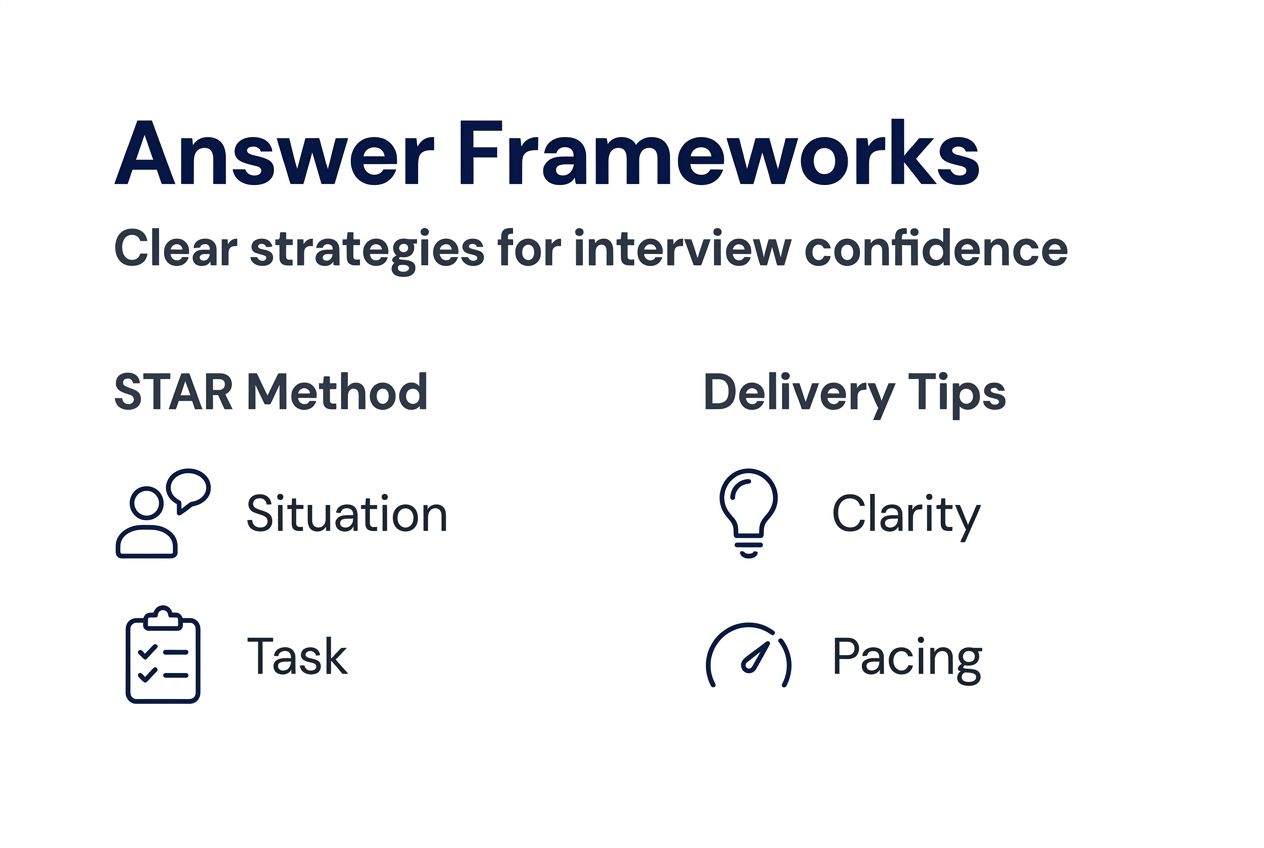
Pro Tip: Outline three to four STAR stories covering different competencies before interviews. Knowing these frameworks allows you to adapt them quickly to unexpected questions without scrambling for examples.
Having learned how to structure answers effectively, the guide now turns to delivering them with clarity and confidence on camera.
Communicating effectively on camera: clarity, pacing and reducing fillers
Your delivery mechanics matter enormously in video interviews, which now dominate initial screening rounds. Speaking at approximately 150 words per minute optimises listener comprehension and engagement. Too fast overwhelms interviewers, too slow loses their attention.
Filler words undermine perceived confidence and professionalism. Research shows that reducing fillers by half can boost perceived confidence by 25%. These verbal crutches, such as ‘um’, ‘like’, and ‘you know’, signal uncertainty even when your content is strong.
Clear articulation prevents misunderstandings and demonstrates polish. Mumbling or trailing off at sentence ends makes you seem hesitant or unprepared. Enunciate final consonants and maintain consistent volume throughout your answers.
Follow this approach to improve clarity, pacing, and filler reduction:
- Record yourself answering common interview questions
- Count filler words and measure speaking speed using transcription tools
- Identify patterns, such as fillers appearing when transitioning between points
- Practise pausing briefly instead of filling silence with verbal crutches
- Review recordings weekly to track measurable improvement over time
Regular practice builds muscle memory for optimal delivery. Your brain learns to organise thoughts during brief pauses rather than while speaking, eliminating the need for fillers.
Video interview confidence tips help you adapt to the unique demands of on-camera communication. Camera presence requires different techniques than face-to-face conversations, including maintaining eye contact with the lens and managing your on-screen energy.
Building on-camera confidence takes consistent exposure. The more you practise speaking to a camera, the less awkward it feels. This familiarity translates directly into reduced anxiety and smoother delivery during actual interviews.
Pro Tip: Record yourself daily for just five minutes answering random interview questions. Review the footage to spot filler usage and uneven pacing, then refine your delivery incrementally rather than trying to fix everything at once.
Beyond delivery techniques, many candidates hold misconceptions that negatively impact their preparation quality, which the next section addresses.
Common misconceptions that undermine interview preparation
Memorising scripted answers seems like thorough preparation but actually increases anxiety by 15%. Scripts create pressure to recall exact wording, which disrupts natural delivery and makes you sound robotic. When you forget a line, panic sets in.
Many candidates focus purely on content quality, ignoring that 70% of hiring preference depends on communication style when knowledge levels are equal. You could have the perfect answer written down, but if you deliver it poorly, the content value disappears.
Practising only through writing or casual conversation misses critical benefits of video review. Written practice doesn’t reveal filler words, pacing issues, or facial expressions. Conversational practice with friends lacks the pressure and formality of real interviews.
Long, detailed answers score 35% lower than confident, concise replies. Interviewers want focused responses that demonstrate your point efficiently. Rambling signals poor communication skills and inability to prioritise information.
These harmful beliefs persist because they feel productive:
- Scripts provide false security through the illusion of control
- Detailed content feels more impressive than clear, simple communication
- Writing answers seems easier than the discomfort of recording yourself
- Peer feedback feels less intimidating than objective AI analysis
“The best interview preparation embraces discomfort. Recording yourself feels awkward initially, but that awkwardness is exactly what you need to overcome before real interviews.”
AI-based immediate feedback outperforms traditional peer critiques by speeding improvement 20%. Friends offer subjective opinions based on personal preferences. AI provides objective metrics on pacing, clarity, and structure that you can measure and improve systematically.
Avoiding these interview preparation pitfalls requires shifting focus from content perfection to delivery excellence. Your goal is natural, confident communication, not flawless recitation.
Correcting these misconceptions prepares readers to effectively leverage technology and iterative practice, as explained next.
Bridging understanding to practical improvement with technology
AI-powered video feedback transforms interview preparation by providing objective, actionable insights. Traditional practice lacks specific metrics, leaving you guessing about what to improve. AI measures pacing, filler word frequency, and clarity with precision.
Video practice reduces anxiety by 40% through repeated exposure. The camera becomes familiar rather than intimidating. This familiarity builds genuine confidence that carries into real interviews, where nervousness no longer sabotages your performance.
Platforms like Pavone.ai analyse your delivery across multiple dimensions simultaneously. You receive feedback on structure, pacing, confidence markers, and filler words after each practice session. This comprehensive analysis reveals patterns you cannot spot through self-assessment alone.
| Practice method | Feedback speed | Objectivity | Anxiety reduction | Convenience |
|---|---|---|---|---|
| AI video practice | Immediate | High (data-driven metrics) | 40% improvement | Anytime, anywhere |
| Peer feedback | Delayed (days) | Low (subjective opinions) | Moderate | Requires scheduling |
| Career coaches | Session-based | Medium (experienced but variable) | Good | Expensive, limited availability |
| Self-review only | Immediate | Very low (hard to spot own issues) | Minimal | Anytime but less effective |
Experts recommend iterative practice through technology as the most effective preparation strategy. Small, frequent practice sessions with immediate feedback create faster improvement than occasional long sessions without metrics.
The technology advantage lies in consistency and scalability. AI doesn’t get tired, distracted, or subjective. Every practice session receives the same rigorous analysis, allowing you to track progress objectively over weeks.
Practising on-camera interviews regularly builds skills that transfer directly to real situations. The format, pressure, and self-awareness required mirror actual interview conditions, making your preparation highly relevant.
AI mock interview benefits extend beyond immediate feedback. The platform identifies trends across multiple sessions, showing whether your filler words are decreasing or your pacing is stabilising. This longitudinal view motivates continued improvement.
Pro Tip: Schedule three 15-minute video practice sessions weekly rather than one long session. Review your metrics after each to identify one specific improvement area, then focus on that element in your next session for systematic skill building.
With these tools and strategies, readers can confidently prepare and perform better on camera, which the promotional section will link to practical training solutions for.
Boost your interview performance with Pavone’s AI-driven practice
Your interview success depends on clear, confident delivery, and Pavone.ai provides the tools to achieve it. Our AI-powered platform analyses your video answers in real time, offering actionable feedback on pacing, structure, and filler word usage.
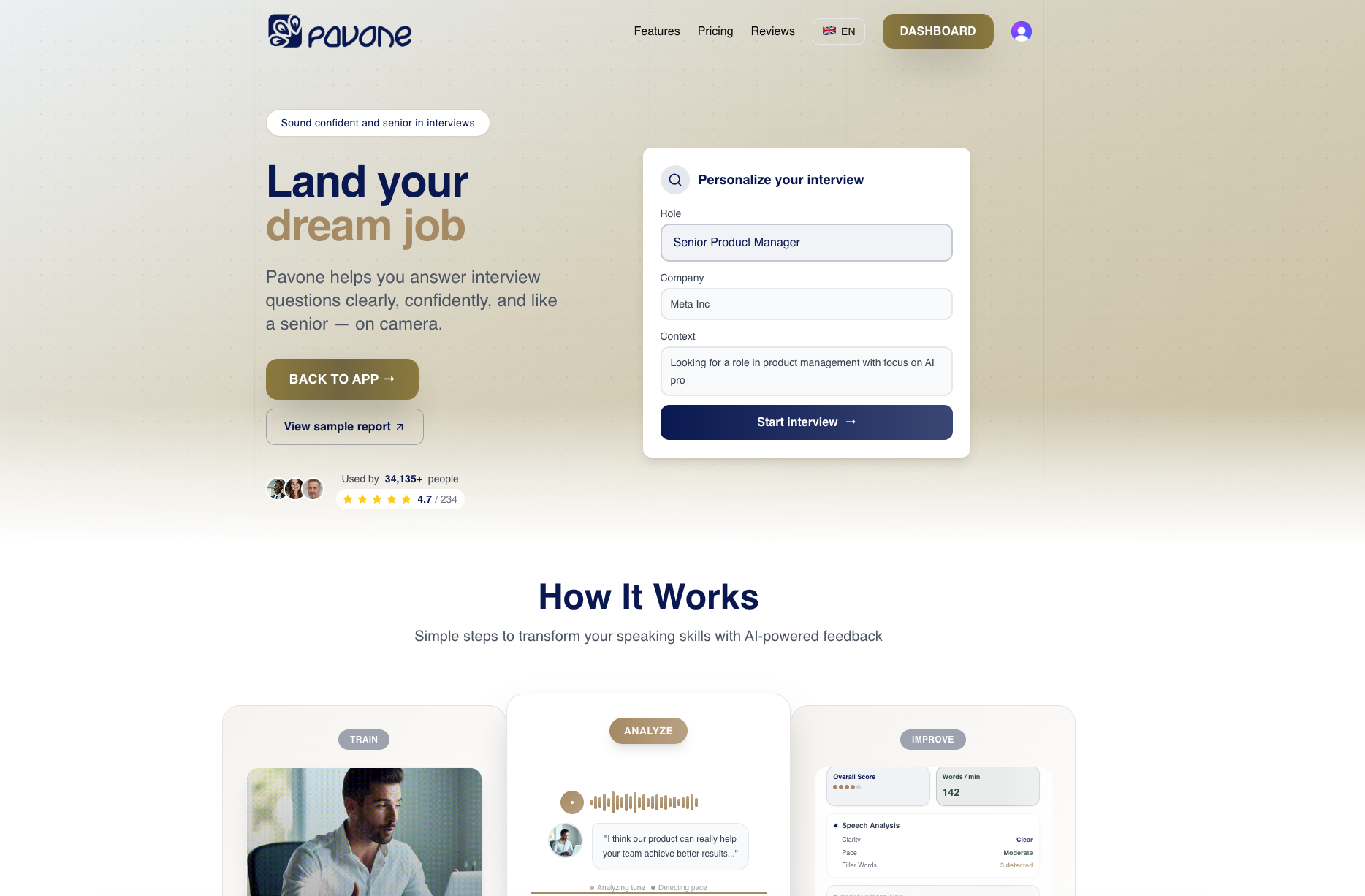
You can practise anytime that suits your schedule, receiving personalised coaching that adapts to your progress. Regular sessions reduce anxiety and build the on-camera confidence that impresses hiring managers. Whether you’re preparing for your next opportunity or want to sharpen your skills proactively, Pavone helps you communicate with the clarity and authority that senior roles demand.
Explore our comprehensive interview preparation guide to get started, improve your video interview skills, or dive into AI interview practice for immediate improvement.
Frequently asked questions
What is the best method to structure answers for senior-level interviews?
Use the STAR method to organise answers by outlining Situation, Task, Action, and Result clearly. This framework ensures thoroughness whilst keeping responses focused and prevents rambling that loses interviewer attention.
How can I reduce filler words during interview answers?
Record your answers and identify frequent fillers like ‘um’ and ‘like’ through transcription review. Practise pausing briefly to replace fillers and use AI tools for objective feedback that tracks reduction over time.
Why is pacing important during interview answers?
Pacing at approximately 150 words per minute maximises clarity and keeps interviewers engaged throughout your response. Too fast overwhelms listeners, whilst too slow loses their attention and makes you seem uncertain.
How does video feedback reduce interview anxiety?
Familiarity with speaking on camera decreases nervousness because the format becomes routine rather than novel. Real-time AI feedback helps refine answers systematically, increasing self-assurance as you see measurable progress over practice sessions.
Recommended
Ready to practice?
Start improving your speaking skills with AI-powered feedback and analysis.
Try Pavone Free