Master mock job interviews for mid-senior role success

Mid-to-senior level interviews demand more than technical expertise. You face complex behavioural scenarios, leadership assessments, and high-pressure video conversations where communication clarity matters as much as your answers. Many talented candidates struggle with on-camera presence, answer structure, and confidence under scrutiny. Mock interviews for mid-to-senior roles simulate full interview processes with behavioural, system design, and coding rounds using STAR/PAR methods in 45-60 minute sessions. This guide shows you how to prepare, execute, and learn from mock interviews to transform your delivery and secure the roles you deserve.
Table of Contents
- Understanding Structured Mock Job Interviews For Mid-To-Senior Roles
- Preparing Your Camera Setup And Delivery For Video Mock Interviews
- Leveraging Ai And Human Feedback For Effective Mock Interview Practice
- Executing Mock Interviews Effectively And Maximising Learning From Feedback
- Boost Your Mid-Senior Interview Skills With Pavone Academy
Key takeaways
| Point | Details |
|---|---|
| Structured practice builds accuracy | Behavioural and technical mock rounds with frameworks like STAR improve answer organisation and confidence significantly. |
| Camera setup drives engagement | Eye-level framing with 70-80% lens contact and proper lighting creates natural, professional video presence. |
| Hybrid feedback accelerates growth | Combining AI-powered volume practice with human nuance assessment develops skills faster than either approach alone. |
| Realistic pressure testing matters | Simulating time constraints, follow-up questions, and stress conditions prepares you for actual interview dynamics. |
Understanding structured mock job interviews for mid-to-senior roles
Structured mock interviews replicate the complete interview journey you’ll face for senior positions. These sessions mirror real hiring processes with distinct stages: technical problem-solving, behavioural storytelling, and leadership scenario discussions. Unlike casual practice chats, structured mocks follow proven frameworks that organise your thinking and presentation.
The STAR method (Situation, Task, Action, Result) and PAR approach (Problem, Action, Result) give your behavioural answers clear narrative arcs. These frameworks prevent rambling whilst ensuring you communicate impact and outcomes effectively. Typical mock sessions run 45-60 minutes, matching real interview lengths, followed by focused debriefs where you receive specific feedback on delivery, structure, and content quality.
For technical components, you’ll work through coding challenges, system design questions, or case studies relevant to your field. The focus extends beyond correct solutions to how you think aloud, handle edge cases, and respond under pressure. Senior roles demand strategic thinking, so mocks assess whether you can articulate trade-offs and justify decisions clearly.
Here’s how a typical structured mock interview unfolds:
- Opening introduction where you present your background concisely in 2-3 minutes
- Behavioural round covering 2-3 scenarios using STAR/PAR frameworks
- Technical or case study segment with problem-solving and follow-up questions
- Leadership or strategic thinking discussion for senior-level assessment
- Your questions for the interviewer to demonstrate engagement
- Detailed debrief covering strengths, improvement areas, and specific action points
Common components you’ll practise include:
- Conflict resolution scenarios demonstrating emotional intelligence and diplomacy
- Project leadership examples showing cross-functional collaboration and stakeholder management
- Technical problem-solving with clear explanation of your reasoning process
- Strategic decision-making cases requiring trade-off analysis and business justification
- Team management situations highlighting coaching, delegation, and performance improvement
Structured mocks help you master simulated interview skills by creating realistic conditions where mistakes become learning opportunities. The repetition builds muscle memory for answer frameworks whilst the feedback sharpens your delivery. You’ll discover blind spots in your communication style and develop strategies to address them before high-stakes conversations.
Preparing your camera setup and delivery for video mock interviews
Video interviews dominate modern hiring, especially for remote roles and initial screening rounds. Your on-camera presence influences how interviewers perceive your confidence, professionalism, and communication skills. Technical setup and delivery habits either support or undermine your message, so optimising both is essential.
Camera should be at eye level with 70-80% eye contact during speaking; soft front lighting and stable mic/internet are essential. Position your laptop or external camera so the lens sits level with your eyes, creating natural sight lines that simulate face-to-face conversation. Looking down at a laptop screen makes you appear disengaged, whilst looking up seems awkward and unnatural.
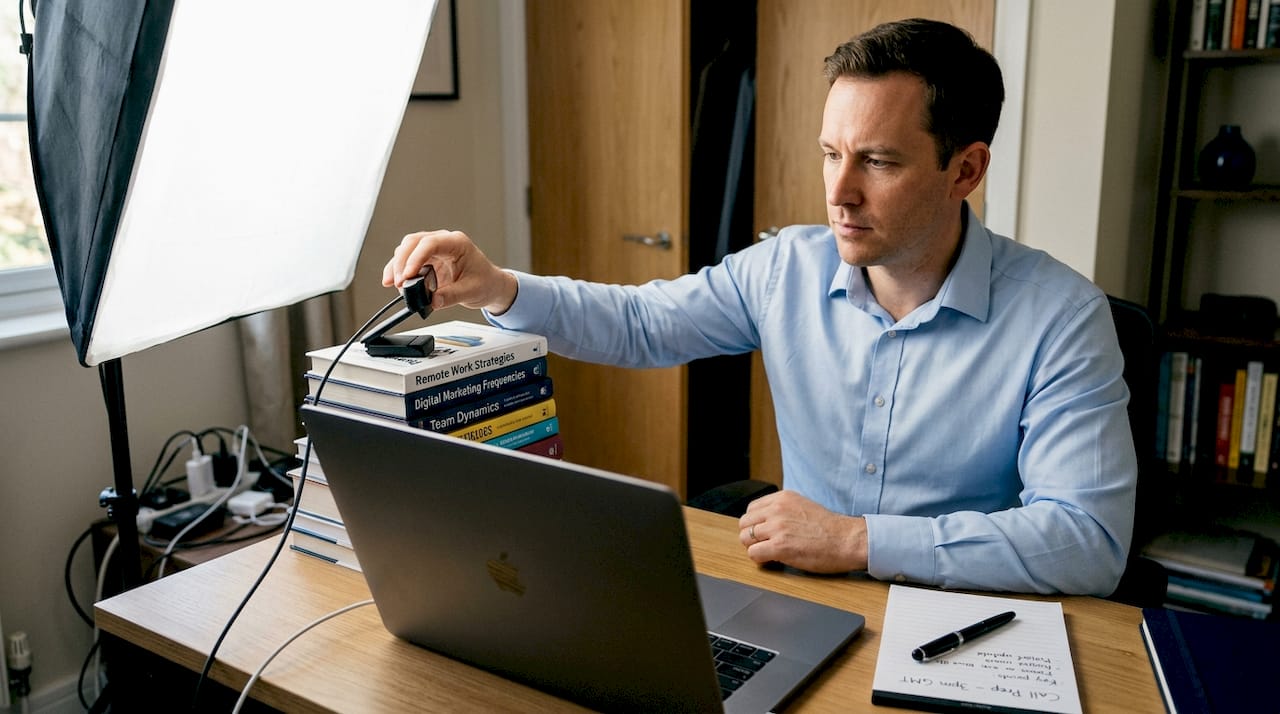
Maintain your gaze on the camera lens, not the screen, for 70-80% of your speaking time. This creates the impression of direct eye contact with your interviewer. You can glance at the screen briefly to check their reactions or reference notes, but the lens should be your primary focus point. This habit feels strange initially but becomes natural with practice.
Lighting transforms how professional and alert you appear on camera. Position a soft light source in front of you, slightly above eye level, to eliminate shadows and create even illumination across your face. Avoid sitting with windows behind you, as backlighting turns you into a silhouette. Natural light from a window beside you works well if you can control brightness with curtains.
Frame yourself from mid-chest upwards with a small amount of space above your head. This composition feels natural and allows hand gestures to remain visible when you emphasise points. Choose a clean, uncluttered background that won’t distract interviewers from your message.
Technical reliability matters as much as visual presentation:
- Test your microphone quality and adjust input levels to prevent distortion or faintness
- Verify internet connection stability and close bandwidth-heavy applications during sessions
- Use wired ethernet connections when possible to reduce dropout risk
- Keep a backup device ready in case of technical failures
- Silence phone notifications and close unnecessary browser tabs
Your posture and physical delivery affect how confident you sound. Sit upright with shoulders back, which opens your chest cavity and improves voice projection. Keep minimal notes off-camera for quick reference, but avoid reading from scripts or looking down frequently. Your hands should remain visible for natural gesturing that reinforces key points.
Pro Tip: Record yourself answering practice questions and watch the playback with sound off. This reveals distracting mannerisms, awkward facial expressions, or posture issues you don’t notice whilst speaking. Focus on one improvement area per practice session rather than trying to fix everything simultaneously.
Developing strong interview preparations video confidence requires deliberate practice with immediate feedback. Your delivery should feel conversational rather than rehearsed, with natural pacing that gives interviewers time to process your points. Speak slightly slower than your natural pace, as nervousness often accelerates speech and reduces clarity.
Leveraging AI and human feedback for effective mock interview practice
The most effective preparation strategies combine AI-powered practice tools with human reviewer insights. Each approach offers distinct advantages, and using both accelerates your skill development significantly. Structured mock interviews have higher predictive validity and hybrid AI-human approaches balance volume with nuanced feedback for mid-to-senior roles.
AI-powered mock interview platforms support unlimited repetition without scheduling constraints or social pressure. You can practise the same question multiple times, experimenting with different answer structures and delivery styles. The technology transcribes your responses, analyses speech patterns, and provides immediate scoring on clarity, pacing, filler word usage, and answer structure. This instant feedback loop helps you identify improvement areas quickly.
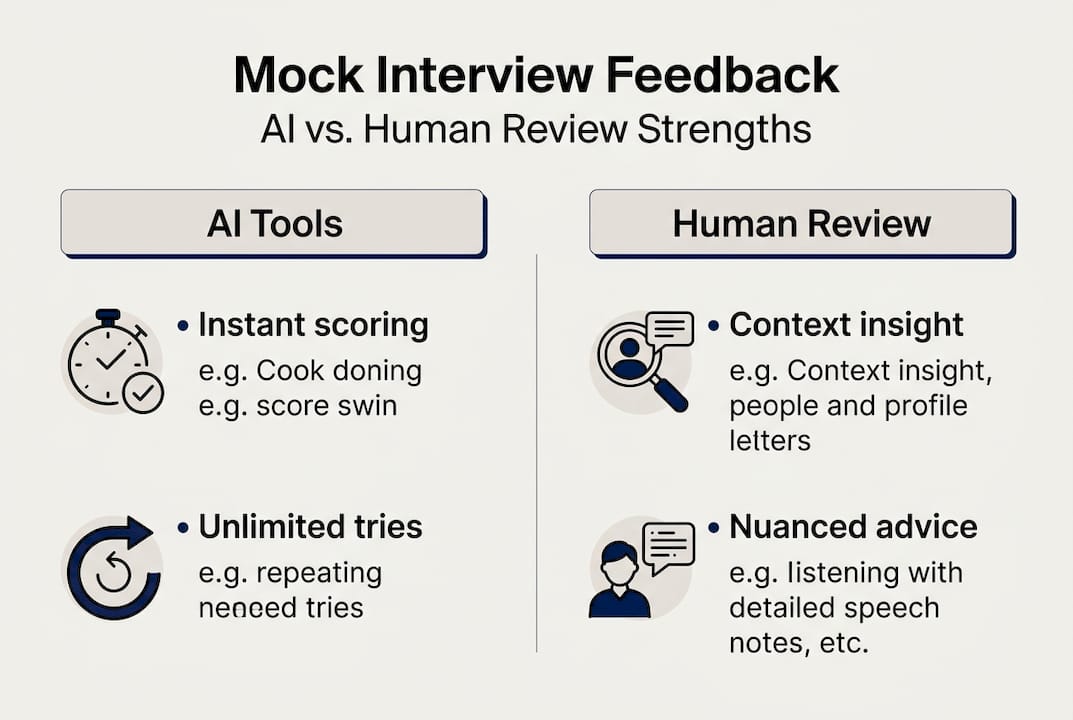
AI mock interviews improve perceived employability and real performance; GPT-3.5 automated scoring aligns with human raters. The consistency of AI evaluation means you can track progress objectively over time, seeing measurable improvements in specific metrics like answer conciseness or confidence markers.
Human reviewers bring contextual understanding and nuanced assessment that AI cannot replicate. Experienced interviewers evaluate how well your examples demonstrate leadership qualities, whether your strategic thinking matches senior-level expectations, and if your communication style builds rapport. They spot subtle issues like defensive body language, overconfidence, or insufficient business impact framing that automated systems miss.
| Approach | Strengths | Limitations | Best Use Cases |
|---|---|---|---|
| AI-only | Unlimited practice volume, instant feedback, objective metrics, 24/7 availability, tracks progress over time | Misses contextual nuance, cannot assess strategic thinking depth, limited leadership evaluation | Initial skill building, delivery mechanics, reducing filler words, building answer structure habits |
| Human-only | Contextual insights, leadership assessment, rapport evaluation, strategic thinking feedback, industry-specific guidance | Limited availability, scheduling constraints, inconsistent feedback quality, higher cost per session | Final preparation, senior role practice, industry-specific scenarios, leadership storytelling refinement |
| Hybrid | Combines volume with nuance, accelerates learning, provides both mechanics and strategy feedback, cost-effective | Requires coordination between tools, potential feedback conflicts, needs interpretation skills | Comprehensive preparation, mid-to-senior roles, balanced skill development, continuous improvement cycles |
The hybrid approach works best when you use AI platforms for high-volume foundational practice, then schedule human reviews periodically to assess strategic elements and refine your approach. Start with AI sessions to build basic delivery confidence and answer structure. Once your mechanics improve, add human feedback to evaluate whether your examples demonstrate appropriate seniority and leadership impact.
Pro Tip: Alternate between AI and human feedback sources rather than trying to implement all suggestions simultaneously. Spend a week focusing on AI-identified delivery issues like pacing or filler words, then shift to human feedback about strategic framing or leadership presence. This focused approach prevents overwhelm and produces faster improvement.
Developing strong ai mock interview confidence clarity requires treating both feedback types as complementary rather than competing. AI excels at identifying patterns across multiple attempts, whilst humans assess whether individual answers would resonate with actual hiring managers. Together, they create a complete picture of your interview readiness.
Executing mock interviews effectively and maximising learning from feedback
Running effective mock interviews requires replicating real interview conditions as closely as possible. The more realistic your practice environment, the better prepared you’ll be for actual conversations. Casual practice without pressure fails to expose the performance gaps that emerge under stress.
Follow these steps to conduct high-quality mock interview sessions:
- Schedule dedicated time blocks matching real interview lengths without interruptions or distractions
- Dress professionally as you would for actual interviews to prime your mindset appropriately
- Set up your camera, lighting, and audio exactly as you will for real video interviews
- Use a timer to enforce strict time limits on each answer, typically 2-3 minutes for behavioural questions
- Record every session for later review, even if you receive live feedback during the mock
- Take brief notes immediately after each question on what felt difficult or unclear
- Complete a full debrief within 24 hours whilst the experience remains fresh in your memory
Simulate real interview pressure including time constraints and follow-ups; debrief on blind spots such as rushing and poor answer structure. Ask your practice partner or use AI tools that generate follow-up questions based on your initial responses. Real interviewers probe deeper when answers seem incomplete or raise new questions, so practising this dynamic prepares you for unexpected directions.
Introduce artificial stress elements to build resilience. Set aggressive time limits, practise with unfamiliar questions you haven’t prepared, or conduct back-to-back mock sessions when you’re already tired. These conditions reveal how your performance degrades under pressure and help you develop coping strategies.
Common mistakes to identify and correct during review:
- Rushing through answers without pausing to organise thoughts before speaking
- Using vague language like “we did” instead of “I led” that obscures your specific contributions
- Failing to quantify impact with metrics, percentages, or concrete outcomes
- Rambling past the main point without clear conclusion or takeaway
- Neglecting to connect examples back to the role requirements or company needs
- Displaying defensive body language when questioned about decisions or outcomes
- Overusing filler words (um, like, you know) that undermine perceived confidence
Reviewing recorded sessions critically accelerates improvement more than live feedback alone. Watch yourself with a specific focus each time: one viewing for content structure, another for body language, a third for vocal delivery. This targeted analysis helps you spot patterns you miss when concentrating on answering questions.
Apply feedback systematically rather than trying to fix everything simultaneously. Choose one or two specific improvements for your next practice session. If feedback highlights rushed pacing, focus exclusively on slowing down and adding deliberate pauses. Once that becomes natural, shift attention to another area like strengthening your impact statements.
For senior-level roles, emphasise leadership dimensions beyond technical competence. Your answers should demonstrate strategic thinking, stakeholder management, team development, and business impact. Practice articulating how you influenced outcomes beyond your direct control and navigated organisational complexity. These elements distinguish senior candidates from mid-level ones who focus primarily on task execution.
Developing strong prepare for interview guide habits means treating mock interviews as genuine learning experiences rather than boxes to tick. Each session should push you slightly beyond your comfort zone, exposing new weaknesses whilst reinforcing emerging strengths. The discomfort signals growth.
Boost your mid-senior interview skills with Pavone Academy
Mastering mock interviews requires expert guidance, realistic practice conditions, and actionable feedback that drives measurable improvement. Pavone Academy specialises in helping mid-to-senior level candidates transform their interview performance through AI-driven coaching and video-based practice.
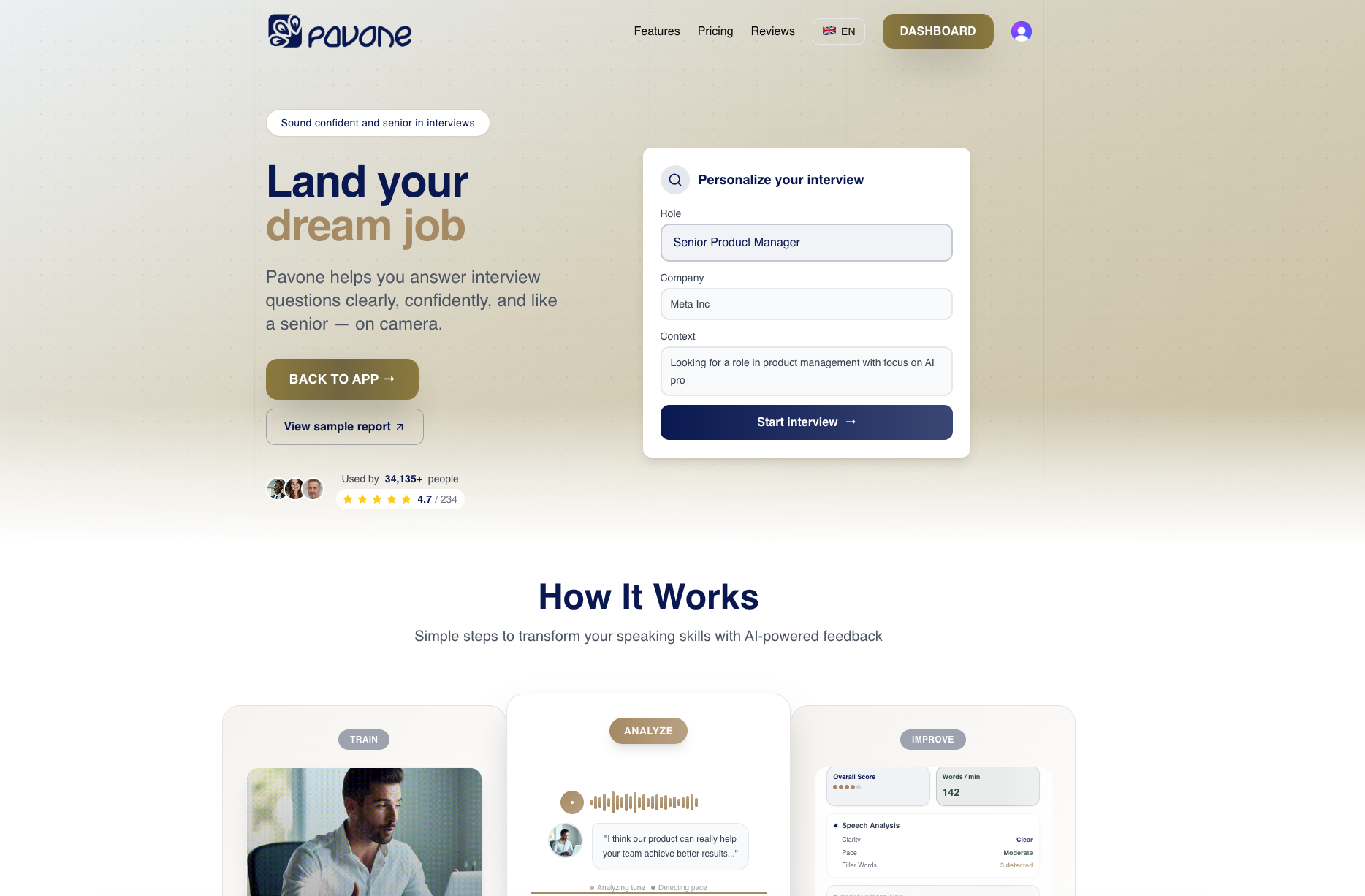
Our platform combines the volume advantages of AI feedback with the contextual insights you need for senior roles. You’ll practise answering real interview questions on camera, receive immediate analysis of your delivery, clarity, and structure, then track your progress as your confidence grows. The experience fits naturally into your interview preparation routine with short, focused sessions you can complete anytime.
Explore our detailed guides on how to prepare for interviews effectively, develop ai mock interview confidence and clarity, and master video interview communication skills. Whether you’re entering an active interview loop or building skills proactively, Pavone Academy provides the coaching and practice environment to help you perform at your best when opportunities arise.
FAQ
What are the common mistakes to avoid in mock job interviews?
Rushing through answers without pausing to organise your thoughts first undermines clarity and structure. Poor eye contact with the camera lens makes you appear disengaged or nervous, whilst neglecting the STAR or PAR frameworks leads to rambling stories without clear outcomes. Skipping the debrief session or dismissing feedback prevents you from identifying blind spots that will resurface in real interviews.
How can AI specifically benefit my mock interview practice?
AI platforms offer instant scoring on delivery mechanics like pacing, filler words, and answer structure, with unlimited practice opportunities at any time. The technology identifies patterns across multiple attempts, showing you exactly which areas improve and which remain problematic. This objective, consistent feedback accelerates skill development significantly compared to sporadic human-only practice, especially for foundational communication skills. Developing strong ai mock interview confidence and clarity gives you measurable progress tracking.
What’s the best way to improve on-camera communication during video mock interviews?
Position your camera at eye level and maintain lens contact for 70-80% of your speaking time to create natural engagement. Use soft, even lighting from in front of you whilst keeping your posture upright with minimal off-camera notes. Practise speaking slightly slower than your natural pace with deliberate pauses between key points, which gives interviewers time to process your message whilst making you sound more confident and measured. Recording sessions and reviewing them helps identify distracting mannerisms or delivery issues you don’t notice whilst speaking. Building strong video interview communication skills requires consistent practice with immediate feedback.
How many mock interviews should I complete before a real interview?
Complete at least 3-5 full-length structured mock interviews before important conversations, spacing them over 1-2 weeks rather than cramming them into a single day. This interval allows you to implement feedback between sessions and build genuine skill improvements rather than just memorising answers. For senior roles with multiple interview rounds, increase this to 6-8 mocks covering different question types and scenarios. Quality matters more than quantity, so ensure each session includes thorough feedback and focused improvement work.
Recommended
Ready to practice?
Start improving your speaking skills with AI-powered feedback and analysis.
Try Pavone Free