Ace Tesla interview questions: mid-senior guide 2026
Landing a mid-senior role at Tesla is not simply a matter of knowing your algorithms. The interview process is deliberately designed to test how you think under pressure, how clearly you communicate complex ideas, and whether you can demonstrate real ownership of technical problems. Tesla prioritises practical hardware-integrated challenges over pure theory, which means your ability to articulate your reasoning on camera is just as important as getting the right answer. This guide walks you through exactly what to expect, how to prepare, and how to show up with the confidence and clarity that Tesla’s panels are looking for.
Table of Contents
- What to expect in a Tesla interview
- How to prepare: sharpen your technical knowledge and interview skills
- Structuring your responses for maximum clarity
- Practising for on-camera confidence and impact
- Troubleshooting and common pitfalls
- Measuring your readiness and next steps
- Boost your interview confidence with Pavone Academy
- Frequently asked questions
Key Takeaways
| Point | Details |
|---|---|
| Know Tesla’s interview style | Expect real-world technical questions emphasising systems thinking and confident communication. |
| Practise verbalising solutions | Explaining your thought process aloud is as crucial as technical ability for on-camera interviews. |
| Structure and clarify answers | Well-organised, step-by-step answers impress Tesla interviewers far more than rushed code. |
| Simulate real interview conditions | Practising with a timer and recording yourself builds genuine confidence for the real thing. |
| Learn from mistakes | Identifying and correcting common pitfalls sharpens your performance for mid-senior technical roles. |
What to expect in a Tesla interview
Now that you appreciate why the Tesla interview is different, let’s break down the structure and topics you’ll encounter. Tesla’s process for mid-senior candidates typically spans multiple rounds, combining technical screens with deeper system design and engineering judgement sessions. The Tesla interview process is structured to reveal how you approach real-world problems, not just whether you can recite textbook solutions.
You can expect questions across these core areas:
- Coding challenges: LeetCode medium level problems including number of islands, kth largest element, dynamic programming, data stream processing, and string transformations.
- System design: Distributed systems, real-time data pipelines, and vehicle-integrated architectures.
- Hardware and embedded systems: Questions that test your awareness of physical constraints and integration challenges.
- Engineering judgement: Scenarios where you must weigh trade-offs and justify decisions under ambiguity.
| Interview area | Example question type |
|---|---|
| Coding | Data stream median, island counting |
| System design | Real-time vehicle monitoring system |
| Hardware integration | Embedded sensor data handling |
| Engineering judgement | Trade-off analysis under constraints |
Achieving corporate interview clarity in each of these areas requires more than technical knowledge. Your body language for technical interviews and vocal delivery send strong signals about your seniority and confidence.
“Tesla’s interviewers are looking for candidates who can own a problem end-to-end, communicate their reasoning clearly, and adapt quickly when challenged.”
How to prepare: sharpen your technical knowledge and interview skills
With those unique features and expectations in mind, here’s how to prepare efficiently for success. Effective preparation for a Tesla interview means working across three domains simultaneously: technical depth, structured communication, and on-camera delivery.
- Map your core domains. Identify the specific coding patterns, system design principles, and hardware concepts most relevant to your target role. Focus on graphs, dynamic programming, and real-time data structures for coding rounds.
- Practise verbalising your solutions. Explaining solutions aloud clearly and confidently is a skill in itself. Do not just solve problems silently; narrate your thinking as you go.
- Use structured answer frameworks. For every question, practise moving through problem definition, approach, implementation, edge cases, and optimisations in a logical sequence.
- Review coding question examples from verified sources to calibrate the difficulty and style of what you will face.
- Build your on-camera habit. Consistent practising on-camera interview skills is the fastest way to reduce nerves and improve your delivery.
- Strengthen your answer confidence. Work on answering interview questions confidently by reviewing your recordings and identifying where your pacing or structure breaks down.
Pro Tip: Ask a trusted colleague to conduct a mock interview with you over video call. The discomfort of being watched is exactly what you need to simulate before the real thing.
Structuring your responses for maximum clarity
Preparation is vital, but how you communicate your thinking can make the difference. Let’s focus on how to structure responses effectively.
A well-structured response gives the interviewer a crystal clear mental roadmap of your thinking. The goal is never to jump straight to a solution. Instead, move through these stages deliberately:
- Define the problem: Restate it in your own words and confirm your understanding.
- Outline your approach: Explain which algorithm or design pattern you are considering and why.
- Implement step by step: Write or describe your solution while narrating your decisions.
- Address edge cases: Verbalise your thought process, discuss trade-offs, Big O complexity, and potential failure modes.
- Propose optimisations: Suggest improvements and acknowledge real-world hardware constraints where relevant.
| Response quality | Example behaviour |
|---|---|
| ✗ Poorly structured | Jumps to code immediately, silent throughout, ignores edge cases |
| ✓ Well structured | Defines problem, narrates approach, discusses trade-offs, proposes optimisations |
Always discuss alternative approaches, even briefly. Saying “I considered a hash map here but chose a sorted array because of memory constraints” signals genuine engineering judgement. Practising interview answers with clarity will help you internalise this habit before the pressure of the real interview.
Pro Tip: If you feel overcoming interview anxiety is your biggest challenge, focus your practice on narrating your thinking out loud. The act of speaking your reasoning reduces cognitive load and makes you sound far more senior.
Practising for on-camera confidence and impact
Knowing what to say is the start. Communicating confidently under the pressure of a camera is equally essential.
Set up a realistic interview environment at home. Use the same device and background you plan to use on the day. Then record yourself answering questions under timed conditions. Watch the recordings back critically.
- Simulate the real environment. Sit at a desk, use a headset if needed, and ensure your lighting is clear. Small details affect how confident you appear.
- Practise under time pressure. Time-pressured practice builds the mental stamina to stay composed when the clock is running.
- Review your recordings honestly. Look for filler words, downward vocal tone, and moments where your explanation loses structure.
- Iterate quickly. Record, review, adjust, and repeat. Three focused sessions per week will produce noticeable improvement within a fortnight.
Common on-camera mistakes to avoid:
- Looking away from the camera when thinking, which reads as uncertainty
- Speaking too quickly when nervous, which reduces clarity
- Using filler words such as “um” and “like” excessively
- Failing to pause before answering, which can make responses feel rushed
“The candidates who perform best on camera are not the ones who never feel nervous. They are the ones who have practised enough that their nerves no longer show.”
Building confidence on camera takes repetition, not perfection. Each session you complete makes the next one easier. Pair your recordings with structured feedback on mastering confident answers to accelerate your progress.
Troubleshooting and common pitfalls
Even strong candidates can stumble. Here’s how to spot and avoid common traps, and what to do if things go wrong.
For mid-senior roles, Tesla expects system design fluency covering real-time vehicle monitoring, distributed systems, and hardware-embedded scenarios. Candidates who treat these as purely software problems often fall short.
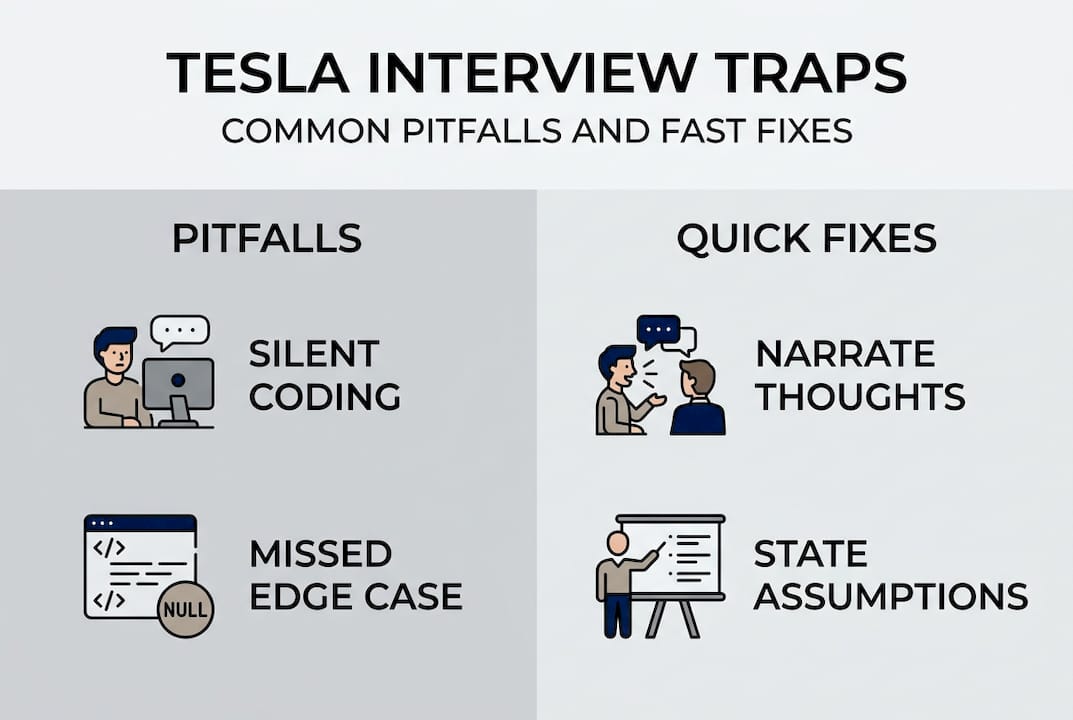
The most frequent pitfalls include:
- Rushing to code without first clarifying the problem or confirming requirements with the interviewer
- Ignoring hardware constraints in system design answers, which signals a lack of real-world experience
- Staying silent while solving, which prevents the interviewer from following your reasoning
- Failing to justify decisions, particularly around trade-offs between speed, memory, and reliability
- Giving up when stuck rather than communicating your current thinking and next steps
If you get stuck, do not freeze. Say something like: “I know I need to handle this edge case. Let me think through the options.” Interviewers value composure and structured thinking far more than instant answers. Building answer confidence through regular practice is the most reliable way to stay calm when a question catches you off guard.
Pro Tip: Before every practice session, spend two minutes reviewing the most common pitfalls above. Awareness alone reduces the likelihood of falling into these traps during the real interview.
Measuring your readiness and next steps
After your preparation and practice, it’s crucial to check your readiness before you face the Tesla panel.
Use this checklist to assess where you stand across both technical and communication dimensions:
- Can you solve LeetCode medium problems within 30 minutes while narrating your approach?
- Can you design a distributed system with hardware integration and explain your trade-offs clearly?
- Have you recorded at least five full mock answers and reviewed them critically?
- Have you received external feedback on your delivery, structure, and pacing?
- Can you recover composure and continue clearly when you hit an unexpected question?
If you identify gaps, prioritise them by impact. Weak on-camera delivery is often more damaging than minor technical gaps, because Tesla prioritises end-to-end ownership and rapid, clear execution. Seek feedback from peers, mentors, or AI-based mock interview tools to get an honest external view.
If nerves are your primary concern, working through resources on relieving tech interview anxiety can help you reframe the experience and approach the panel with genuine composure.
Boost your interview confidence with Pavone Academy
If you want a final edge, Pavone Academy offers specialist courses and practice tools built specifically for technical, on-camera interview readiness. Whether you need to sharpen your delivery, reduce filler words, or build the habit of structured responses, the platform gives you a private, pressure-free space to practise and improve.
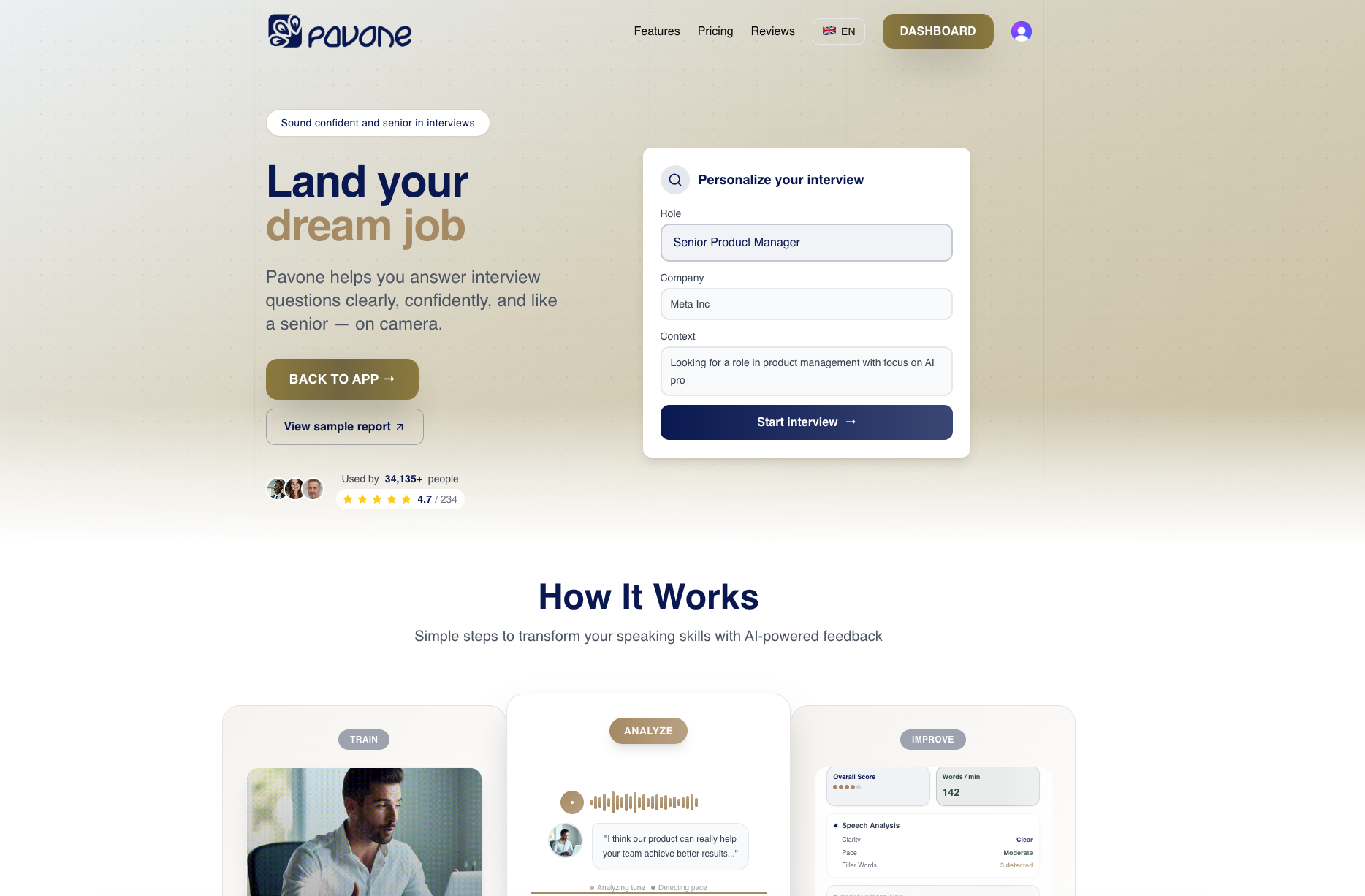
Start with the video interview preparation programme to build a strong foundation, then track your progress using video interview practice results to see how your performance improves over time. For a structured approach to consistent improvement, explore master interview online practice and turn your preparation into a genuine competitive advantage before your Tesla interview.
Frequently asked questions
What are the most common coding topics in Tesla interviews?
Most coding questions are LeetCode medium level, covering arrays, strings, dynamic programming, and data stream tasks such as calculating mean, median, and mode in real time.
How should I prepare for on-camera interviews at Tesla?
Practise explaining solutions aloud under time limits and use mock interviews to assess your delivery, structure, and pacing before the real session.
Do Tesla interviews focus more on practical or theoretical problems?
Tesla places higher value on practical, hardware-integrated problems over abstract theory, especially for mid-senior roles where end-to-end ownership is expected.
What are key mistakes to avoid in a Tesla interview?
Avoid jumping to code without clarifying requirements, and always verbalise your thought process including trade-offs, Big O complexity, and potential failure modes throughout your answer.
Can I recover if I get stuck during a Tesla technical interview?
Absolutely. Communicate where you are, describe your next steps, and stay composed. Tesla’s panels value structured thinking and engineering judgement over instant, silent solutions.
Recommended
Ready to practice?
Start improving your speaking skills with AI-powered feedback and analysis.
Try Pavone Free