
Ace Apple interview questions: expert strategies for 2026

TL;DR:
- Fewer than 10% of external candidates secure top Apple ICT6 roles, emphasizing the need for thorough preparation.
- Successful candidates demonstrate a balance of technical skills, clear communication, and strong behavioral storytelling.
- Practice with simulated, video-based mock interviews and specific frameworks like STAR enhances readiness for Apple’s multi-stage process.
Fewer than 1 in 10 external candidates secure a top ICT6 role at Apple. That figure surprises most people, because the assumption is that Apple interviews are simply about cracking hard coding problems. In reality, the candidates who succeed are those who combine solid technical ability with sharp behavioural storytelling and crystal clear on-camera communication. This guide walks you through every major stage of Apple’s process, from structure and technical rounds to behavioural strategy and delivery tips, so you can walk into your interview loop feeling prepared, not just hopeful.
Table of Contents
- How Apple interviews are structured for success
- Core Apple technical questions: beyond coding drills
- Mastering behavioural and leadership rounds
- Communication tips for mid-senior and non-native candidates
- What most guides miss about succeeding at Apple interviews
- Ready to practise Apple interview questions with expert guidance?
- Frequently asked questions
Key Takeaways
| Point | Details |
|---|---|
| Apple’s unique process | Expect more rounds, deeper behavioural focus, and team-specific calibration compared to other big tech firms. |
| Beyond basic coding | Apple values clear system design thinking, practical coding skills, and structured communication more than algorithm memorisation. |
| STAR for behavioural | Prepare genuine STAR stories demonstrating Apple values like simplicity, privacy, and collaboration for all leadership rounds. |
| Communication mastery | Effective on-camera delivery and clear structure are especially important for non-native speakers and remote interview rounds. |
| Practise with realism | Simulate real Apple interviews using online platforms to boost confidence and stand out in the selection process. |
How Apple interviews are structured for success
Having set expectations for the rigour of Apple’s process, it’s vital to break down exactly how these interviews unfold and what makes each stage unique.
Apple’s mid-to-senior interview process for software engineering roles (ICT3 to ICT6) typically spans 4 to 8 weeks and includes a recruiter screen, one or two technical phone screens, and an onsite or virtual loop of 5 to 8 rounds. That is a significant commitment of time and energy, and understanding the shape of it helps you pace your preparation sensibly.
Typical stages at a glance:
- Recruiter screen: A 30-minute conversation focused on your background, motivations, and basic role fit. This is not a technical round, but your clarity and enthusiasm matter here.
- Technical phone screen: Usually one or two sessions covering coding problems and sometimes light system design. Expect to code in a shared environment with a live interviewer.
- Onsite or virtual loop: The heart of the process. You will meet 5 to 8 interviewers across coding, system design, and behavioural rounds. Each interviewer submits independent feedback, and calibration happens after.
- Hiring committee review: Apple uses a decentralised model. The hiring manager and team have significant influence, which means team fit is assessed seriously at every stage.
How the process differs by level:
| Level | Focus areas | Rounds |
|---|---|---|
| ICT3 (junior-mid) | Coding, fundamentals | 4-5 rounds |
| ICT4 (mid) | Coding, some design | 5-6 rounds |
| ICT5 (senior) | Design, leadership, coding | 6-7 rounds |
| ICT6 (staff/principal) | System design, strategy, influence | 7-8 rounds |
One thing many candidates underestimate is how much team-specific calibration matters. Apple does not have a single monolithic engineering culture. Teams working on privacy infrastructure, for example, have different expectations than those building consumer-facing features. Researching the specific team you are interviewing with is time well spent.
Pro Tip: Use a STAR answer builder to structure your preparation by level. The higher the role, the more Apple expects you to demonstrate influence and strategic thinking, not just execution.
Core Apple technical questions: beyond coding drills
Once you are oriented on interview structure, knowing exactly what technical ability Apple measures, and how, is the foundation for targeted preparation.

Apple’s coding rounds are practical over algorithmic. You are less likely to face abstract puzzles and more likely to encounter problems grounded in real product scenarios. Think shuffling functions, expression parsers, or building components that mirror actual Apple product challenges. Pure LeetCode grinding will not be enough.
Common technical question patterns:
- Data structures in context: Linked lists, trees, and hash maps appear frequently, but framed around practical tasks rather than textbook definitions.
- String and array manipulation: Often tied to parsing or processing real-world data formats.
- System design with constraints: You may be asked to design a photo sync service or a local search feature, where privacy and on-device constraints are central to the solution.
- API design and storage trade-offs: Apple values candidates who think about UX impact, not just backend efficiency.
- Edge cases and failure modes: Interviewers actively want to hear you reason about what breaks, not just what works.
What separates good answers from great ones:
| Approach | Average candidate | Strong candidate |
|---|---|---|
| Problem framing | Jumps to code | Clarifies assumptions first |
| Trade-off discussion | Avoids it | Raises it proactively |
| Privacy consideration | Ignores it | Builds it in naturally |
| Communication | Silent while coding | Thinks aloud throughout |
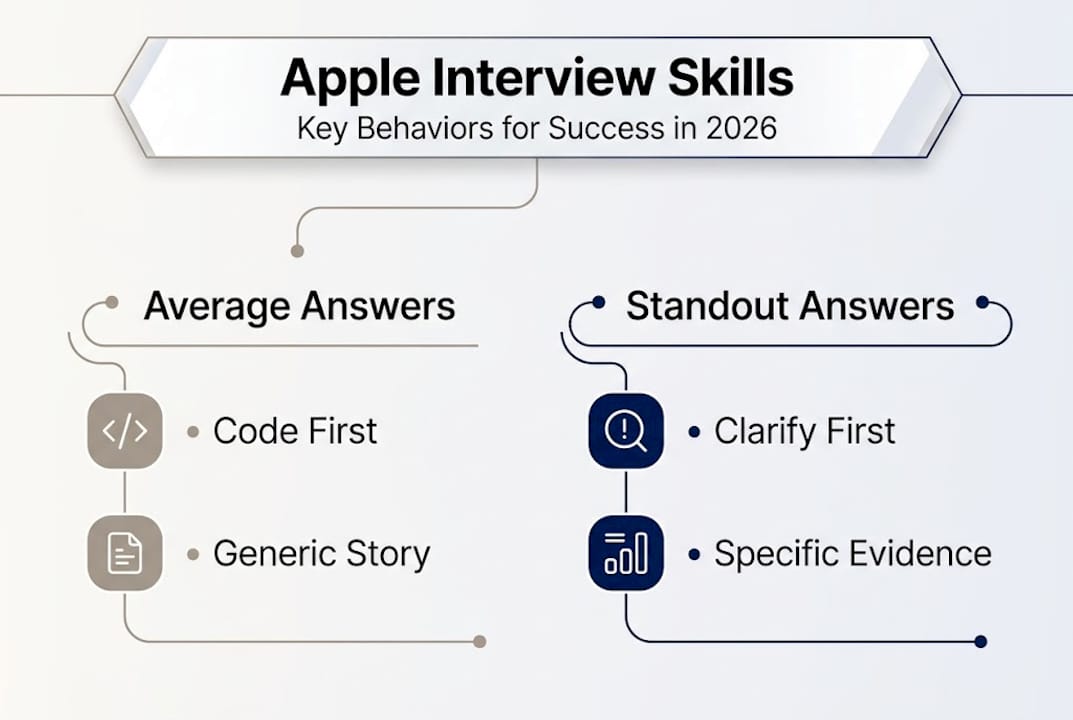
Pro Tip: Before your loop, review top technical interview questions with a focus on how you verbalise your reasoning. Apple interviewers are assessing your thought process as much as your final answer.
Mastering behavioural and leadership rounds
With technical expertise established, the deciding factor for many Apple candidates is their approach to behavioural and leadership interviews, often underestimated until it is too late.
At Apple, behavioural rounds carry significant weight. You will be expected to share STAR or SOAR-structured stories covering collaboration, navigating ambiguity, cross-organisational influence, mentoring, and innovation under real constraints. These are not warm-up questions. They are often the deciding factor between two technically strong candidates.
“Apple’s behavioural interviews are not a formality. They are looking for evidence that you can operate with autonomy, influence without authority, and learn from setbacks without deflecting responsibility.”
Themes that come up repeatedly:
- A time you disagreed with a decision and how you handled it
- An example of driving change without formal authority
- A project that failed and what you learnt from it
- How you have mentored or developed others
- A situation where you had to balance competing priorities under pressure
The key to standing out is specificity. Vague answers like “I worked with a cross-functional team to improve the product” tell Apple nothing. Instead, name the constraint, describe the friction, explain your reasoning, and land on a concrete result. Apple wants to see how you think, not just what you achieved.
Pro Tip: If you struggle with interview anxiety, practise your behavioural stories using a STAR method tool before recording yourself on camera. Hearing your own answers back is one of the fastest ways to spot where you are being vague or losing the thread.
Also, do not shy away from failure stories. Apple values self-awareness. A candidate who can articulate what went wrong, what they learnt, and how they changed their approach afterwards is far more compelling than someone who only shares polished wins.
Communication tips for mid-senior and non-native candidates
Behavioural excellence and technical skills must be paired with compelling delivery, especially on camera and for those interviewing in a second language.
Clear communication is not a soft skill at Apple. It is a core expectation. The ability to structure your thinking, speak at a measured pace, and guide your interviewer through your reasoning is what separates candidates who feel senior from those who simply have senior experience.
For non-native English speakers, the most effective strategies include practising STAR responses aloud on camera, slowing your pace deliberately, and using signposting phrases to guide your listener. Signposting means using phrases like “There are two parts to this” or “Let me start with the context” to give your interviewer a mental roadmap before you dive in.
Practical communication tips:
- Record yourself answering questions. Watching playback reveals habits you cannot notice in the moment, such as filler words, rushed pacing, or trailing sentences.
- Use signposting consistently. It makes your answers feel structured and confident, even when the content is complex.
- Aim for 90-second answers in behavioural rounds. Longer answers often dilute impact. Shorter ones can feel incomplete. Practice hitting that window.
- Pause before answering. A two-second pause feels natural to the listener and gives you time to choose your opening line carefully.
- Frame multilingualism as an asset. If you work across cultures or languages, say so. Apple operates globally, and candidates who can communicate across contexts are genuinely valued.
Pro Tip: Explore communication strategies used by successful candidates at other top-tier tech firms. Many of the principles transfer directly to Apple’s interview style.
For native English speakers, the challenge is often different. Over-explaining, hedging, or burying the key point in qualifications are common patterns. Apple interviewers notice when a candidate cannot land a clear conclusion. Practise ending your answers with a direct, confident statement rather than trailing off.
What most guides miss about succeeding at Apple interviews
Most preparation guides focus on what to say. They give you question lists, sample answers, and frameworks. That is useful, but it misses something important.
Apple’s interviewers are not just scoring your answers. They are assessing whether they would want to work with you. That means calibration matters as much as content. How you respond when pushed back on, whether you stay curious under pressure, and how you handle a question you genuinely do not know the answer to, these are the signals that decide close calls.
The current Apple context makes this even more relevant. With a strong internal focus on privacy, on-device intelligence, and UX-centric thinking, every team expects articulate trade-off reasoning, not just from leadership, but from individual contributors at ICT4 and above. Candidates who treat system design as a purely technical exercise, without engaging with the human and privacy dimensions, consistently underperform.
Compare this to Amazon’s interview approach, where leadership principles are more codified and explicit. Apple’s values are less scripted, which means you need to demonstrate them through the texture of your answers, not by reciting them.
The candidates who succeed are those who show genuine self-awareness, engage with ambiguity rather than avoiding it, and communicate with the kind of clarity that makes complex ideas feel simple.
Ready to practise Apple interview questions with expert guidance?
Understanding Apple’s process is just the start. Real progress comes from deliberate, simulation-driven practice that mirrors the pressure and format of the real thing.
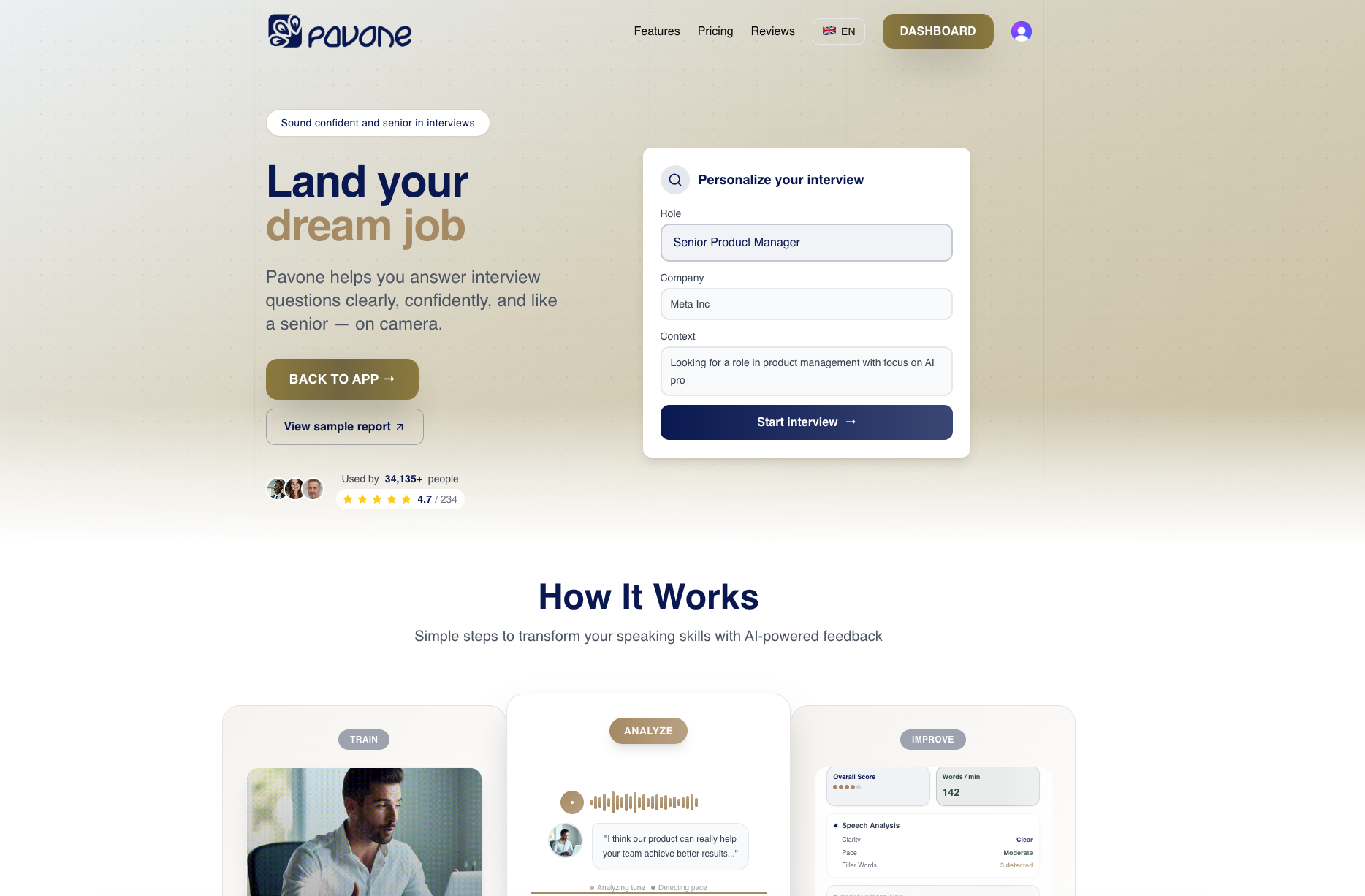
Pavone.ai is built for exactly this. You can record your answers to Apple-style questions on camera, receive immediate feedback on your clarity, pacing, structure, and confidence, and track how your delivery improves over time. Whether you are working on your behavioural stories or refining how you walk through a system design, Pavone gives you the kind of honest, actionable feedback that a practice run in your head simply cannot. Learn how to master interview online practice, explore top platforms for mid-senior professionals, or start immediately with the free interview question generator.
Frequently asked questions
How difficult are Apple interview questions compared to other big tech firms?
Apple contrasts with FAANG peers through more rounds, greater decentralisation, and a higher weighting on behavioural and cross-functional fit alongside technical ability.
What is the pass rate for mid-to-senior Apple roles?
Fewer than 10% of external candidates succeed for top ICT6 roles, making thorough, structured preparation essential rather than optional.
What behavioural questions should I expect in an Apple interview?
Expect questions on collaboration, navigating ambiguity, cross-team influence, and STAR-structured stories that demonstrate Apple value alignment through specific, results-driven examples.
How can non-native speakers excel in Apple interviews?
Slower pacing, clear signposting, and recording your answers for review are the most effective techniques, alongside framing your multilingualism as a genuine professional strength.
How can I get realistic practice for Apple interview questions?
Use platforms that offer video-based practice, structured feedback, and Apple-style scenarios tailored to mid-to-senior roles, so your preparation reflects the real conditions of the interview loop.
Recommended
Ready to practice?
Start improving your speaking skills with AI-powered feedback and analysis.
Try Pavone Free