
Amazon interview questions: master technical & behavioural rounds

TL;DR:
- Success at Amazon interviews depends on clear communication and behavioral responses aligned with Leadership Principles.
- Practicing on-camera mock interviews improves confidence, reduces anxiety, and enhances structured storytelling.
- Focus on articulating structured answers using the STAR method and maintaining composure under pressure.
Landing a role at Amazon is genuinely competitive. Amazon’s technical interviews require mastering both coding challenges and Leadership Principles under pressure, and that combination catches even experienced professionals off guard. It is not enough to solve a LeetCode problem fluently if your explanation is muddled or your body language signals panic. With more rounds moving to video, your on-camera presence has become as important as your algorithm. This guide walks you through the full process, the most common question types, and proven strategies to practise with clarity and confidence.
Table of Contents
- Understanding the Amazon interview process
- Top technical and behavioural question types to expect
- Practising STAR stories for Leadership Principles
- Building interview confidence: on-camera practice strategies
- What most guides miss about Amazon interviews: it’s about clarity under pressure
- Take your Amazon interview prep to the next level
- Frequently asked questions
Key Takeaways
| Point | Details |
|---|---|
| Master the process | Understand Amazon’s multi-stage interview loop and prepare for both technical and behavioural questions. |
| Build STAR stories | Develop a bank of stories structured with metrics and mapped to Leadership Principles. |
| Practise on camera | Rehearse mock interviews on video to improve delivery and reduce stress. |
| Prioritise clarity | Focus on clear, structured communication and think-aloud techniques for every answer. |
Understanding the Amazon interview process
With the stakes clear, let’s examine how Amazon structures its interview process and where communication matters most.
The Amazon interview process includes an Online Assessment, phone screens, and a loop of 4 to 5 interviews covering both technical and behavioural aspects. Each stage has a distinct purpose, and understanding that purpose changes how you prepare.
Here is a quick breakdown of what to expect at each stage:
| Stage | Format | Focus |
|---|---|---|
| Online Assessment | Timed coding problems | Algorithms, data structures |
| Phone screen | 45-60 min video/call | Coding and one or two behavioural questions |
| Interview loop | 4-5 back-to-back rounds | Coding, system design, behavioural |
The loop is where most candidates feel the pressure most acutely. You will face rounds dedicated to coding, system design (particularly for mid-senior roles), and behavioural questions tied to Amazon’s 16 Leadership Principles. Every interviewer, regardless of their technical focus, will ask at least one behavioural question. This is not optional preparation.
What does success look like across these rounds? Amazon interviewers are assessing:
- Structured communication: Can you explain your thought process step by step?
- Evidence-based answers: Do your stories include specific, measurable outcomes?
- Cultural alignment: Do your behaviours reflect Leadership Principles like Customer Obsession or Dive Deep?
- Composure under pressure: Can you stay calm and clear when a question is ambiguous?
Virtual interviews add another layer. Camera angle, lighting, and eye contact all signal confidence before you say a single word. Candidates who have practised mid-senior mock interviews consistently report feeling more grounded when the real loop begins.
“The interview is not just a test of what you know. It is a test of how clearly you can communicate what you know under real pressure.”
Building that clarity takes deliberate, structured rehearsal. The good news is that it is entirely learnable.
Top technical and behavioural question types to expect
Now that you understand the interview structure, the next step is knowing which questions Amazon will ask and how to tackle them.
Amazon interviews mix coding and system design with behavioural questions aligned to 16 Leadership Principles. Knowing the categories in advance means you can prepare targeted answers rather than scrambling on the day.
Technical question types:
- Arrays, strings, trees, graphs and dynamic programming problems
- Problem restatement: always confirm your understanding before coding
- Edge cases: null inputs, empty arrays, very large numbers
- System design: trade-offs, scalability, database choices (for senior roles)
Behavioural question types:
- Conflict resolution (Earn Trust)
- Prioritising competing demands (Bias for Action)
- Going beyond the brief to serve a customer (Customer Obsession)
- Diagnosing a complex problem from first principles (Dive Deep)
Here is a comparison of how a weak versus strong response looks in practice:
| Dimension | Weak response | Strong response |
|---|---|---|
| Structure | Rambling, no clear arc | STAR format, logical flow |
| Evidence | Vague outcomes | Specific metrics and results |
| Leadership link | Not mentioned | Explicitly tied to a principle |
| Delivery | Rushed, filler words | Calm, measured, confident |
To succeed in mid and senior interviews, you need to practise both question types together, not in isolation. Switching from a coding problem to a behavioural question mid-loop is exactly what Amazon does, and it requires mental agility.
Pro Tip: When solving coding problems on camera, narrate every step aloud. Say what you are considering, what you are ruling out, and why. This think-aloud technique shows structured reasoning even when your code is not yet complete. Use the STAR method answer builder to structure your behavioural responses before your sessions.
Practising STAR stories for Leadership Principles
Once you have mapped the question types, mastering the STAR story approach becomes your tool for memorable impact.
The STAR method stands for Situation, Task, Action, and Result. It gives your answer a clear arc that interviewers can follow without effort. Amazon expects you to prepare 10 to 12 STAR-format stories that demonstrate results and map to Leadership Principles. That number is not arbitrary. With 16 principles and 4 to 5 behavioural rounds, you need enough variety to avoid repeating the same story twice.
Here is a step-by-step process to build and deliver your STAR stories effectively:
- List all 16 Leadership Principles and identify which ones appear most in your target role’s job description.
- Brainstorm two or three experiences from your career that genuinely demonstrate each principle.
- Draft each story using the STAR structure, keeping the Situation brief and the Action detailed.
- Quantify every Result: percentages, time saved, revenue impact, team size. Vague results weaken your story.
- Record yourself on camera delivering each story. Watch it back and note filler words, pace, and whether your result lands with impact.
- Refine and repeat until each story feels natural, not rehearsed.
One critical detail: always say “I” rather than “we.” Amazon interviewers want to understand your specific contribution, not the team’s collective effort. It feels uncomfortable at first, but it is essential.
Pro Tip: Build a simple spreadsheet with one row per story and columns for each Leadership Principle it covers. This gives you a crystal clear mental roadmap before each interview round. Pair this with the STAR answer builder to structure your drafts, and take the interview confidence quiz to identify which principles need more story coverage.
Building interview confidence: on-camera practice strategies
Armed with STAR stories, your next challenge is conquering anxiety and standing out in video interviews.

Mock interviews, full-loop rehearsals, and video responses are critical in reducing anxiety and improving performance. Most candidates underestimate how different it feels to answer questions on camera compared to thinking through answers in their head.
Here is a practical checklist for your on-camera setup:
- Camera angle: position the lens at eye level so you appear engaged, not looking down
- Lighting: face a window or use a ring light to avoid shadows across your face
- Audio: use a headset or external microphone to eliminate background echo
- Eye contact: look at the camera lens, not the interviewer’s face on screen
- Background: keep it neutral and uncluttered to avoid visual distraction
Beyond the setup, the practice itself matters most. Start with individual questions, then progress to full mock loops where you alternate between a coding problem and a behavioural question without a break. This mirrors the real Amazon loop and builds the mental stamina you need.
“Most candidates see rapid, measurable progress after just three or more structured mock interviews. The shift in confidence is visible.”
Repetition is the engine of confidence. Each time you practise on camera, you reduce the novelty of the experience. The anxiety shrinks because the format feels familiar. Explore confident mock interviews to build a structured rehearsal routine that fits around your existing schedule.
Think of it this way: the interview room, even a virtual one, should feel like territory you have already visited. Familiarity breeds composure.
What most guides miss about Amazon interviews: it’s about clarity under pressure
Most preparation guides focus heavily on what to say. They give you question lists, answer templates, and principle definitions. That is all useful. But years of real interview coaching reveal something that rarely gets said plainly: the candidates who get offers are not always the most technically brilliant. They are the ones who stay calm, structured, and clear when the pressure spikes.
Experienced engineers with strong track records regularly stumble in Amazon loops because they have never practised thinking aloud on camera. When a question is ambiguous or the interviewer pushes back, the ability to pause, organise your thoughts, and respond with composure is what separates a hire from a near-miss. That skill is not innate. It is practised.
The practical shift is this: spend less time memorising question lists and more time rehearsing your delivery. Record yourself. Watch it back without cringing. Notice where you hedge, where you rush, and where your structure collapses. That honest self-observation, done consistently through online interview practice, is what builds genuine readiness. Clarity under pressure is a skill. Treat it like one.
Take your Amazon interview prep to the next level
If you are serious about landing a role at Amazon, structured on-camera practice is the single most impactful step you can take right now.
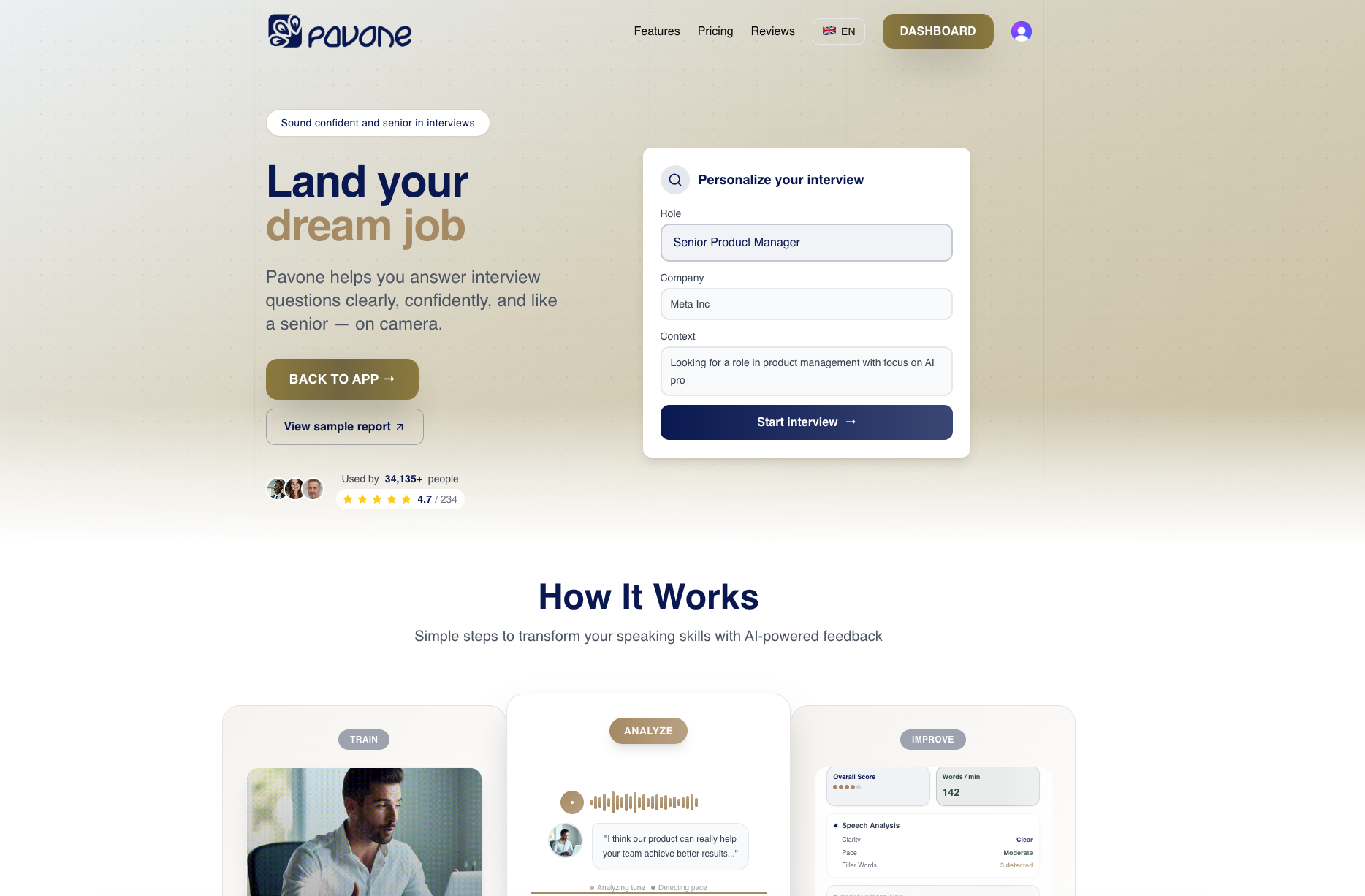
Pavone.ai gives you a private space to record real interview-style answers and receive immediate, actionable feedback on clarity, structure, pacing, and confidence. You can generate targeted questions with the interview question generator, build your delivery skills through the video interview prep course, and sharpen your on-camera presence with the on-camera practice programme. Every session is short, private, and designed to fit into an active interview loop. Start practising today and walk into your Amazon loop feeling genuinely prepared.
Frequently asked questions
How do I practise Amazon interview questions for technical roles?
Use LeetCode Amazon-tagged problems alongside full mock interviews on camera, covering both coding and behavioural rounds to build well-rounded readiness.
What are Amazon’s Leadership Principles, and why are they important?
Amazon’s 16 Leadership Principles are central to behavioural interviews and guide every hiring decision, so every answer you give should connect to at least one of them.
How many STAR stories should I prepare for an Amazon interview?
Prepare 10 to 12 STAR stories mapped to different Leadership Principles, each with specific, quantifiable results to demonstrate real impact.
How important is on-camera practice for Amazon interviews?
On-camera practice is critical because it reduces anxiety, sharpens communication, and builds the composure that virtual assessments demand from every candidate.
What mistakes do most candidates make in Amazon interviews?
Failing to link answers to Leadership Principles, giving unstructured responses, and neglecting on-camera preparation are the three most common mistakes that cost otherwise strong candidates their offers.
Recommended
Ready to practice?
Start improving your speaking skills with AI-powered feedback and analysis.
Try Pavone Free