
Excel at Google interviews: practical strategies for success

TL;DR:
- Effective communication, structure, and presence are crucial in Google’s virtual hiring process.
- Preparing for virtual coding requires practice typing in plain text without IDE features.
- Demonstrating ‘Googleyness’ through collaboration, humility, and adaptability is key alongside technical skills.
Landing a role at Google is not purely about writing flawless code or speaking perfect English. Many strong candidates stumble not because they lack ability, but because they underestimate how much communication, structure, and presence matter in Google’s virtual interview process. For non-native English speakers targeting mid-to-senior positions, this is both a challenge and an opportunity. The good news? These are learnable skills. This guide walks you through every stage of the process, from understanding the structure to mastering behavioural rounds, with practical strategies you can apply immediately.
Table of Contents
- Understanding Google’s interview structure
- Preparing your technical toolkit for the virtual format
- Communication strategies for non-native English speakers
- Mastering ‘Googleyness’ and behavioural interviews
- Why owning your story and presence matters most
- Take your Google interview confidence further
- Frequently asked questions
Key Takeaways
| Point | Details |
|---|---|
| Google interview rounds | Expect multiple rounds: technical, system design, and behavioural, all virtually assessed. |
| Virtual setup matters | Test your tech, workspace, and plain text coding skills before the interview. |
| Communication over perfection | Clear, structured answers and confidence count more than flawless language. |
| Showcase your ‘Googleyness’ | Demonstrate adaptability, teamwork, and positive leadership in your stories. |
Understanding Google’s interview structure
Let’s start by making sense of Google’s structured approach and where most candidates get lost.
Google’s process for mid-to-senior roles is methodical and multi-staged. The full pipeline runs from resume review through a recruiter screening call, followed by coding and behavioural interviews, and concludes with a hiring committee review. Each stage filters for something specific, so understanding what each round is testing gives you a real edge.
The level you are targeting shapes everything. At L4 (Software Engineer), interviewers focus on solid coding fundamentals and clear communication. At L5, they expect you to lead discussions, handle ambiguity, and demonstrate broader system thinking. By L6, the bar rises sharply: you are expected to show architectural leadership, cross-functional influence, and the ability to mentor others. The complexity of questions scales accordingly, and so does the expectation for how you communicate your reasoning.
Here is a quick comparison to help you calibrate:
| Level | Technical focus | Behavioural expectation |
|---|---|---|
| L4 | Algorithms, clean code | Clear communication, learning mindset |
| L5 | System design, trade-offs | Ownership, cross-team collaboration |
| L6 | Architecture, strategy | Leadership, mentorship, ambiguity comfort |
Google shifted heavily to virtual interviews in recent years, and this format is now standard. That shift matters more than most candidates realise. You are not just solving problems; you are doing it on camera, in a shared document, with an interviewer watching your every keystroke. The tech job process guide covers broader preparation principles, but for Google specifically, the virtual dynamic adds a layer of performance pressure that rewards preparation.
One concept you will hear repeatedly is ‘Googleyness’. This is Google’s shorthand for cultural fit, and it covers traits like:
- Comfort with ambiguity and rapid change
- Genuine intellectual curiosity
- Humility and openness to feedback
- Collaborative instincts over solo heroics
- A bias towards action and creative problem-solving
Googleyness is not assessed separately from your technical answers. It shows up in how you respond to hints, how you handle not knowing an answer, and how you treat the interviewer as a collaborator rather than an examiner.
Preparing your technical toolkit for the virtual format
With the process mapped, focus shifts to what technical preparation looks like in Google’s virtual-first world.
The environment matters enormously. Google uses Google Meet with shared Docs or CoderPad for virtual technical interviews, with no IDE, no syntax highlighting, and no autocomplete. This catches many candidates off guard. If you have been practising in a full-featured editor, you need to retrain yourself to write clean, readable code without those safety nets.
Here is a numbered checklist to get your setup interview-ready:
- Test your internet connection on the day before and the morning of the interview
- Check your webcam and microphone in Google Meet specifically, not just in general settings
- Set up your lighting so your face is clearly visible, ideally with a light source in front of you
- Clear your workspace and close unnecessary browser tabs and applications
- Open a blank Google Doc and practise typing code in plain text, using indentation manually
- Do a full mock session with a friend or a mock interview platform to simulate real conditions
The table below shows the tools you will encounter and how to prepare for each:
| Tool | What to expect | How to prepare |
|---|---|---|
| Google Meet | Video, screen share, chat | Test audio and video in advance |
| Google Docs | Plain text coding | Practise without IDE features |
| CoderPad | Runnable code, no IDE | Use CoderPad’s free practice mode |
Beyond logistics, the biggest technical differentiator is your ability to think aloud. Google interviewers are not just evaluating your final solution; they are watching how you approach the problem. Narrate your reasoning. Say what you are considering and why you are ruling options out. This is a skill that requires deliberate technical interview practice to build.

Pro Tip: Record yourself solving a coding problem from start to finish. Watch it back and ask: Is my reasoning crystal clear? Am I pausing awkwardly? Do I look engaged on camera? Most candidates are surprised by what they notice.
Communication strategies for non-native English speakers
Technical skill is only half the battle. Language, presence, and communication style tip the scales, especially for non-native speakers.
The most common mistake non-native English speakers make is trying to sound native. That is the wrong goal entirely. Google interviewers work with engineers from dozens of countries. What they need is clarity, not accent perfection. Techniques like slower speaking, signposting, and the STAR method consistently produce outstanding performance in English interviews.
Signposting means using short phrases to guide your listener through your answer. Think of it as giving your interviewer a mental roadmap before you start. Phrases like “There are two parts to my answer” or “Let me start with the context, then explain what I did” make your response feel organised and confident, even if your English is not perfect.
The STAR method (Situation, Task, Action, Result) is your best friend for behavioural questions. It gives you a reliable structure so you are not improvising under pressure. Practice telling two or three strong career stories using this format until it feels natural.
Here are practical language strategies to build into your preparation:
- Slow down by 20%. You will feel like you are speaking too slowly. You are not. Clarity improves dramatically.
- Use simple, precise vocabulary. Avoid long sentences with multiple clauses. One idea per sentence.
- Signpost before you answer. Give your structure upfront, then fill it in.
- Pause instead of filling silence. A short pause sounds thoughtful. Filler words like “um” or “like” undermine confidence.
- Treat your multilingualism as a strength. It signals cognitive flexibility, a trait Google actively values.
“Clarity and structure matter far more than accent or grammar perfection. Non-native speakers who organise their thoughts and speak with intention consistently outperform native speakers who ramble.”
Pro Tip: Use video feedback to self-assess. Record a practice answer to a behavioural question, then watch it back with the sound off first. What does your body language say? Then watch with sound. Are you tackling interview anxiety or feeding it? Regular practice on camera is the fastest way to reduce hesitation and build genuine confidence.
Mastering ‘Googleyness’ and behavioural interviews
With core skills covered, the differentiator in hiring rounds is often your mindset and values alignment.
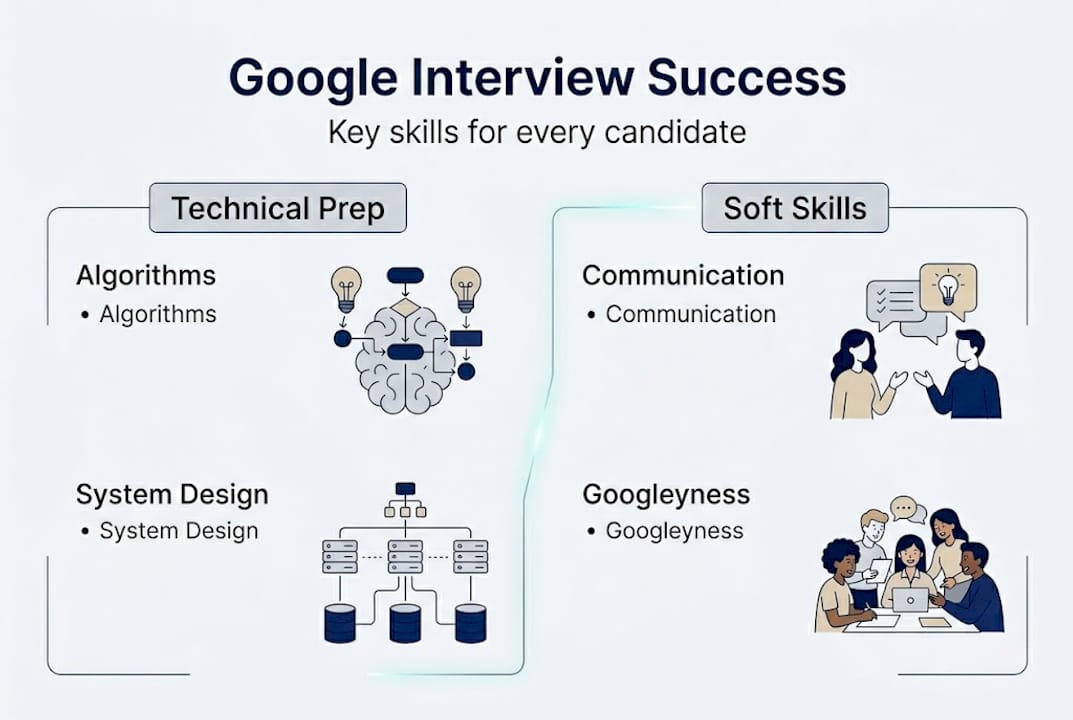
Google places significant weight on behavioural attributes and leadership alongside technical depth. This is not a box-ticking exercise. Interviewers are genuinely trying to understand how you think, how you handle failure, and whether you will make the people around you better.
In practice, Googleyness shows up in questions like:
- “Tell me about a time you disagreed with your manager. What did you do?”
- “Describe a project that failed. What was your role and what did you learn?”
- “How do you approach a problem when you have incomplete information?”
These questions are designed to surface your real behaviour, not your rehearsed answers. The values Google most wants to see demonstrated include:
- Intellectual humility: Acknowledging what you do not know
- Collaborative instinct: Sharing credit and lifting others
- Comfort with ambiguity: Moving forward without perfect information
- Bias to action: Choosing progress over paralysis
- Curiosity: Asking good questions and showing genuine interest
A useful statistic to keep in mind: at senior levels, behavioural and leadership signals account for a substantial portion of the hiring committee’s final decision. Technical ability gets you in the room; how you carry yourself determines whether you get the offer.
The best preparation for these rounds is structured self-reflection. Write down five to seven career stories that demonstrate the values above. Use the interview question generator to stress-test your answers against a wide range of behavioural prompts. Then practise delivering each story aloud until the structure is natural, not scripted.
Why owning your story and presence matters most
Here is something most interview guides will not tell you: Google interviewers remember candidates who made them feel something. Not the ones who recited the most technically correct answer, but the ones who communicated with clarity, conviction, and real ownership of their experiences.
Many candidates spend weeks perfecting their coding solutions while barely practising how they speak. That is a costly imbalance. In a virtual setting especially, your presence on camera, your pacing, and your ability to own your narrative are what separate a forgettable interview from a memorable one.
Owning a mistake openly, or walking through your thought process with genuine curiosity, is far more powerful than delivering a polished but hollow answer. Interviewers are trained to spot the difference. Your background, your non-linear path, your multilingualism: these are not weaknesses to hide. They are differentiators to own.
Authenticity and structure together are the real edge. Let your confidence on camera reflect who you actually are, not a performance of who you think Google wants. That is what lands offers at the senior level.
Take your Google interview confidence further
If you are serious about performing at your best in Google’s interview process, the next step is practising under conditions that mirror the real thing.
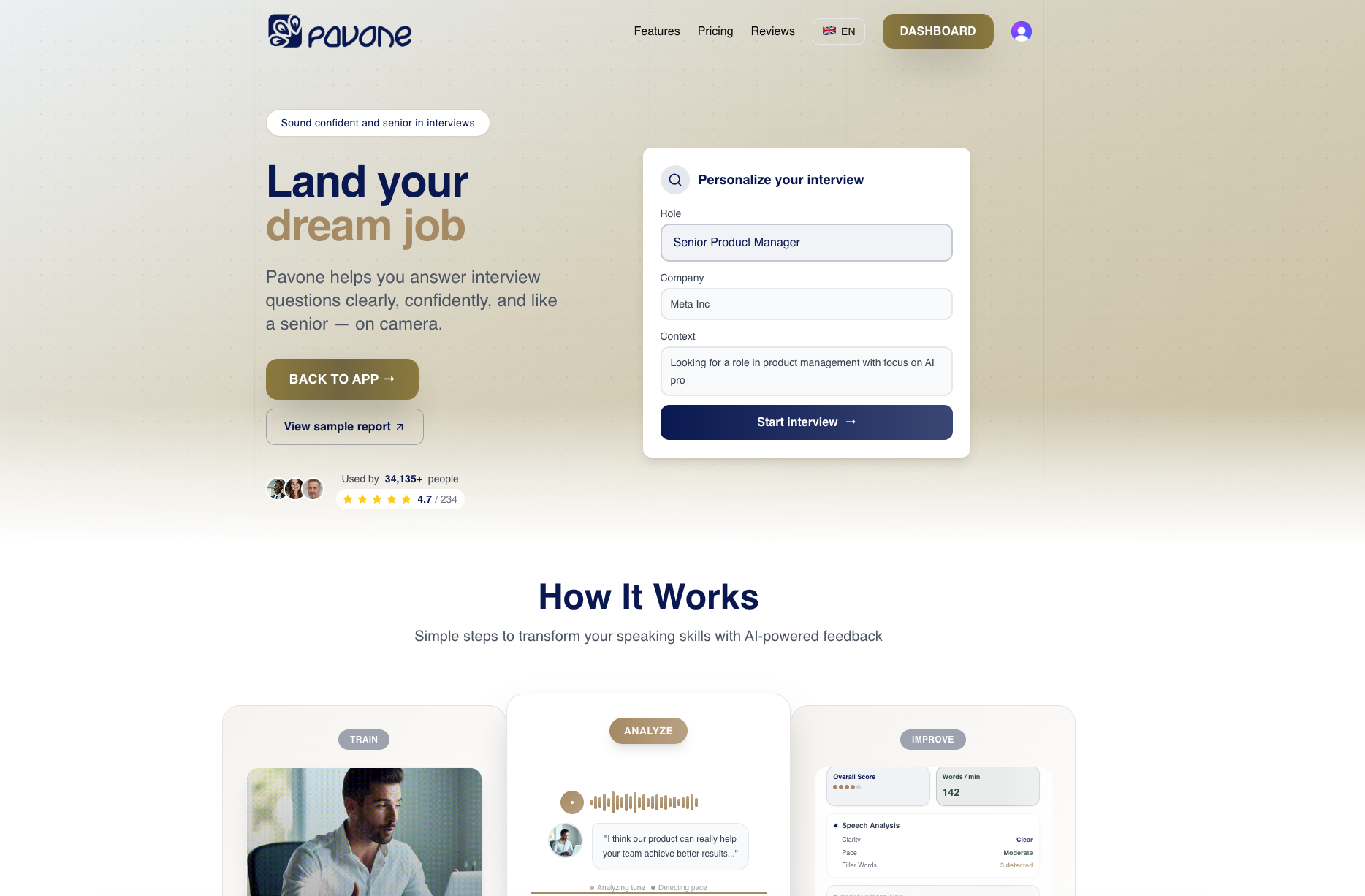
Pavone.ai is built for exactly this. You can record real interview-style answers, receive immediate feedback on your clarity, pacing, and delivery, and track your improvement over time. Whether you want to master interview practice online, build your video interview confidence, or generate targeted behavioural questions to practise, Pavone gives you a private, pressure-free space to prepare properly. Short sessions, real feedback, genuine progress.
Frequently asked questions
How many rounds are there in a typical Google mid-to-senior interview?
Usually 4 to 5 interview rounds after screening: 2 to 3 technical, 1 system design for senior levels, and 1 behavioural round. The structure includes technical and behavioural rounds assessed by separate interviewers.
How do I prepare for Google virtual coding interviews without an IDE?
Practise typing code in plain text editors and simulate real conditions using shared Google Docs or CoderPad. Interviews use Docs or CoderPad with no IDE or syntax highlighting, so building that muscle memory early is essential.
What is ‘Googleyness’ and how is it assessed?
‘Googleyness’ refers to attributes like humility, comfort with ambiguity, and collaborative instinct, assessed through behavioural questions and how you describe your problem-solving approach. Google assesses for culture fit and behavioural attributes alongside technical depth.
What language tips help non-native English speakers succeed?
Speak slowly, use signposting phrases to structure your answers, apply the STAR method for storytelling, and treat multilingualism as a strength. Clarity, structure, and signposting consistently boost interview performance regardless of accent.
Recommended
Ready to practice?
Start improving your speaking skills with AI-powered feedback and analysis.
Try Pavone Free