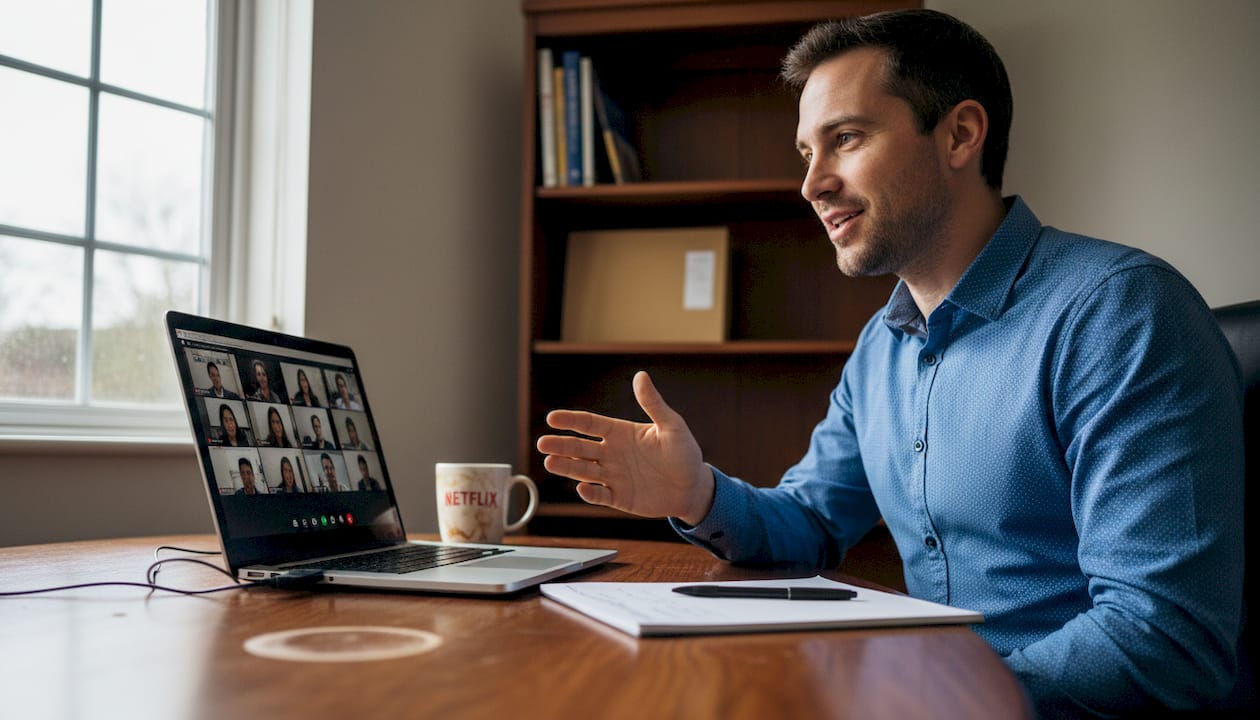
Public speaking techniques for confident interviews
TL;DR:
- Effective delivery and storytelling significantly enhance interview impressions and memorability.
- Non-verbal cues like eye contact and vocal control build trust and confidence.
- Practicing presence rather than memorization leads to authentic, adaptable interview performance.
Interviews are high-stakes moments where what you say matters, but how you say it matters just as much. Professionals preparing for mid to senior level roles often invest hours in crafting perfect answers, yet still leave the room feeling they underperformed. The difference, more often than not, comes down to delivery. Effective speakers are perceived 2.3x more positively, and stories are retained far longer than facts alone. This guide walks you through the most impactful public speaking techniques for interviews, giving you a clear, practical framework to apply whether you are preparing for a video call or a face-to-face panel.
Table of Contents
- How to evaluate public speaking techniques for interviews
- Storytelling: Turning answers into lasting impressions
- Non-verbal techniques: Eye contact, presence, and vocal control
- Comparison of public speaking techniques: What works best for interviews
- A fresh perspective: Mastering presence trumps memorisation
- Level up your interview technique with expert-led practice
- Frequently asked questions
Key Takeaways
| Point | Details |
|---|---|
| Start strong | Your opening seconds shape overall impressions and set your answer’s direction. |
| Use storytelling | Stories make interview answers 14 times more memorable than dry facts or statistics. |
| Master non-verbal cues | Small tweaks in eye contact and presence can boost engagement and trust significantly. |
| Blend and compare | Combining multiple techniques is the most effective way to stand out in interviews. |
| Practice trumps theory | Real progress happens through repeated, feedback-driven rehearsal, not memorisation alone. |
How to evaluate public speaking techniques for interviews
Not every public speaking technique translates well into an interview room. A technique that works brilliantly on a conference stage can feel overblown in a one-to-one conversation with a hiring manager. Interview settings demand something more precise: clarity, authenticity, and controlled impact.
When selecting which techniques to focus on, consider these four criteria:
- Clarity — Does the technique help you communicate your point without ambiguity?
- Conciseness — Does it support tight, focused answers rather than rambling responses?
- Relatability — Does it make you sound human and credible, not rehearsed?
- Non-verbal control — Does it help you manage your body language and vocal tone?
One of the most important and often overlooked insights from speech research is the concept of thin-slicing. Studies show that the first 10% of a speech predicts the overall perceived quality of the entire response. In practical terms, this means your opening sentence carries enormous weight. If you stumble, hedge, or start with a filler word, the interviewer’s impression is already forming.
“First impressions make or break the message.”
This is why building speaking confidence before you even enter the room is so valuable. The goal is not to sound polished for its own sake, but to open with enough clarity and energy that the interviewer leans in rather than switches off.
Pro Tip: Rehearse your first 30 seconds for every answer you prepare. A strong, direct opening sets the tone for everything that follows and signals to the interviewer that you are composed and in control.
Storytelling: Turning answers into lasting impressions
Once you understand what makes a technique effective in interviews, storytelling becomes the obvious place to start. It is the backbone of memorable communication, and it works because the human brain is wired to follow narrative.
In an interview context, storytelling does not mean telling long anecdotes. It means structuring your answers so they paint a picture, connect emotionally, and land a clear result. The most reliable framework for this is STAR: Situation, Task, Action, Result. STAR gives your answer a natural arc that is easy to follow and hard to forget.
A strong interview story has three key attributes:
- Specificity — It includes real details (a number, a name, a challenge) that make it believable and vivid.
- Relatability — It reflects a challenge the interviewer can recognise, making you easier to connect with.
- A clear result — It ends with a tangible outcome, showing that your actions had genuine impact.
The reason this matters so much is backed by data. Stories are remembered 70% of the time, compared to just 5% for standalone statistics. When an interviewer recalls your answer the next day, it will be the story they remember, not the bullet points.
Think about the essential speaking tips that apply across all professional contexts. Storytelling sits at the top of that list because it does multiple jobs at once: it demonstrates your experience, shows how you think, and makes you memorable.
Pro Tip: Prepare two or three short, vivid stories before any interview. Each story should be adaptable, meaning you can slot it into answers about leadership, problem-solving, or collaboration depending on the question asked.
Non-verbal techniques: Eye contact, presence, and vocal control
Stories give your answers substance. But it is your non-verbal delivery that determines whether the interviewer actually trusts what you are saying. This is especially true on camera, where small shifts in posture, eye contact, or vocal energy are amplified.

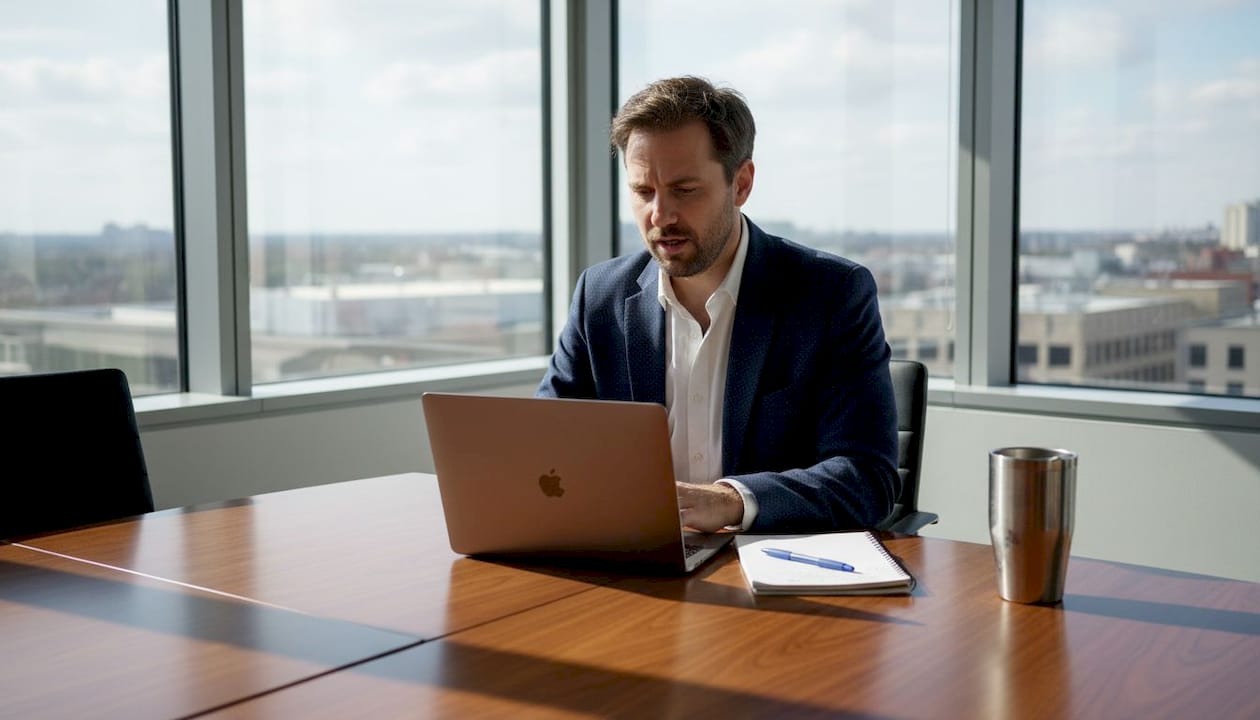
Eye contact boosts engagement by 30%, and in a video interview, that means looking directly into the camera lens rather than at the interviewer’s face on screen. It feels unnatural at first, but it replicates the experience of genuine eye contact for the person watching.
Here is a quick breakdown of the three most impactful non-verbal skills and how to sharpen each one:
| Non-verbal skill | Impact on interview | Quick tactic |
|---|---|---|
| Eye contact | Builds trust and signals confidence | Look at the camera lens, not the screen |
| Vocal modulation | Holds attention and conveys conviction | Slow down on key points, vary your pitch |
| Posture and gestures | Projects authority and openness | Sit upright, use open hand gestures |
- Eye contact: In person, hold eye contact for three to five seconds at a time. On camera, place a small sticker near your webcam as a focal point reminder.
- Vocal control: Avoid speaking at a flat, monotone pace. Pause deliberately after important statements. Silence is not weakness; it signals confidence.
- Posture: Lean slightly forward to convey engagement. Avoid crossing your arms or slouching, as both read as defensive or disengaged.
For remote interviews, improving speech clarity is equally important. A clear, well-paced voice carries far more authority through a microphone than rushed, clipped speech.
Comparison of public speaking techniques: What works best for interviews
Having explored individual methods, a direct comparison helps you decide how to combine them for maximum effect. No single technique wins every situation. The best candidates layer them intentionally.
| Technique | Strengths | Best used when |
|---|---|---|
| Storytelling (STAR) | Memorable, emotional, structured | Behavioural and competency questions |
| Non-verbal control | Builds trust, projects confidence | All interviews, especially on camera |
| Clarity and conciseness | Reduces confusion, signals seniority | Technical or complex topic questions |
To decide which technique to prioritise for your next interview, follow these steps:
- Identify the question type — Behavioural questions call for storytelling. Technical questions call for clarity and structure.
- Assess your current weak point — If you tend to ramble, focus on conciseness. If you feel flat, work on vocal modulation.
- Practise the combination — Use self-assessment tools and role of self-assessment in speaking to identify gaps you cannot hear yourself.
- Layer non-verbals onto your stories — Once your content is solid, add intentional eye contact and vocal emphasis.
The long-term case for investing in these skills is compelling. Strong speakers are promoted 15% faster and earn 20% higher salaries than their peers. That is not a marginal gain; it is a career-defining difference.
Pro Tip: Combine a vivid STAR story with deliberate non-verbal cues, such as a pause before your result and steady eye contact during it. This pairing is what separates a good answer from a genuinely stand-out one. Explore confident speaking for interviews to build this skill systematically.
A fresh perspective: Mastering presence trumps memorisation
Here is something most interview guides will not tell you: memorising your answers is often the problem, not the solution. When you memorise word for word, your delivery becomes rigid. You are no longer communicating; you are reciting. Interviewers feel the difference immediately.
The professionals who perform best in high-stakes interviews are not the ones with the most rehearsed scripts. They are the ones who are genuinely present. They listen carefully, adapt their answers in real time, and bring energy to their delivery rather than anxiety about remembering the next line.
Presence is not a vague concept. It is the product of knowing your key stories and structure well enough that you can be flexible with them. Think of it as the difference between a musician who has memorised sheet music note for note and one who understands the piece deeply enough to improvise.
The real-world impact of speaking confidence shows up most clearly in moments of unexpected follow-up questions. A memorised candidate freezes. A present, confident candidate adapts. Authentic confidence is not a bonus technique; it is the foundation that makes every other technique work.
Level up your interview technique with expert-led practice
Understanding these techniques is a strong start. Applying them under realistic conditions is where real improvement happens.
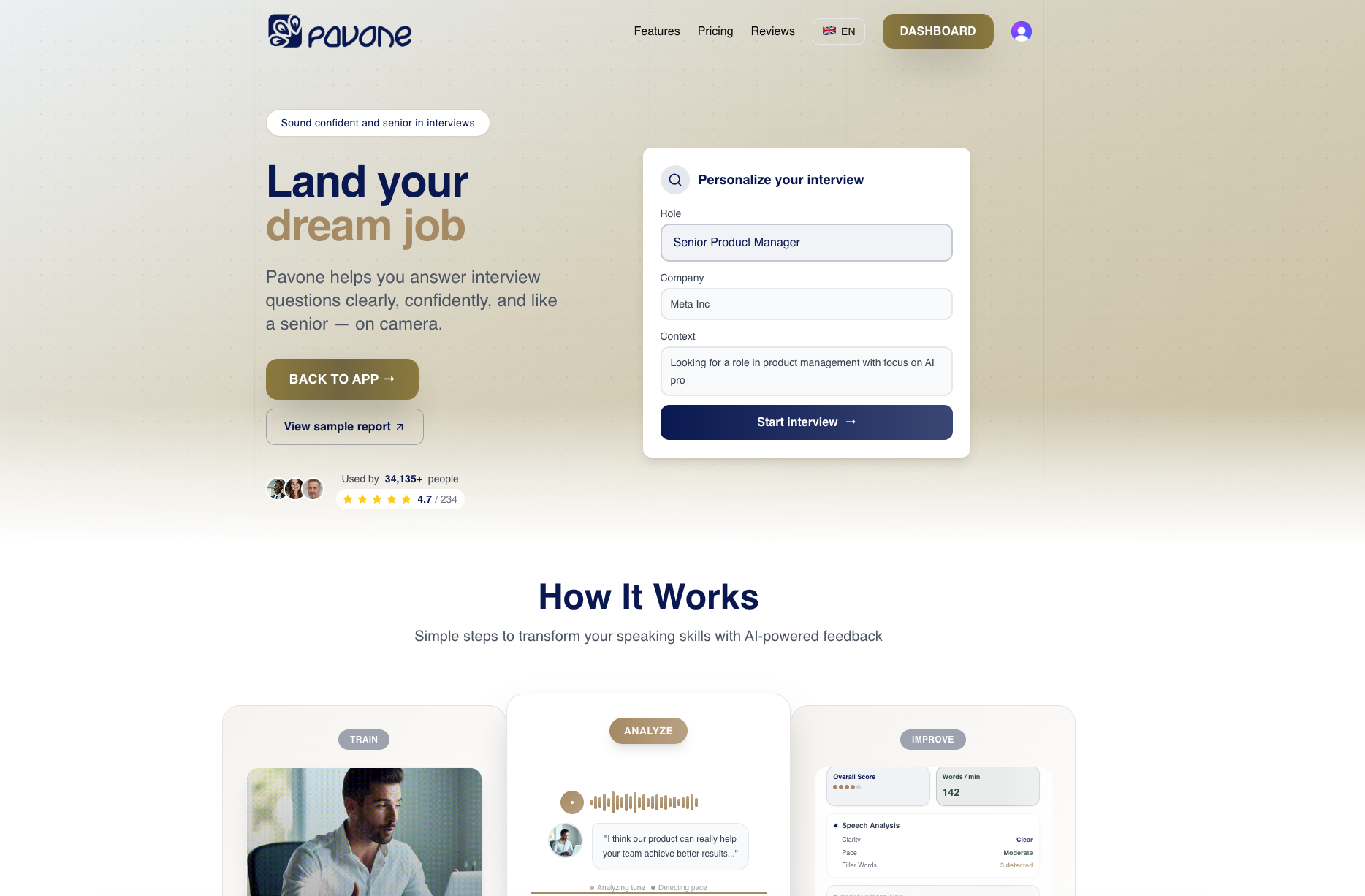
Pavone.ai is built specifically for professionals who want to practise answering interview questions on camera and receive immediate, actionable feedback on their delivery. You can work on your storytelling structure, non-verbal presence, and vocal clarity in short, focused sessions that fit around your schedule. Explore video interview practice to sharpen your on-camera delivery, or visit the guide to on-camera interview success for a structured approach. If building confidence on camera is your priority, Pavone gives you the tools to practise privately, track your progress, and walk into every interview feeling genuinely prepared.
Frequently asked questions
Which public speaking technique should I prioritise for a job interview?
Prioritise your opening and use storytelling throughout. Research confirms that the first 10% of a speech predicts overall quality, and stories are retained 70% of the time compared to just 5% for plain facts.
How can I practise public speaking techniques for interviews alone?
Record yourself answering common questions aloud, then review the footage for clarity, body language, and storytelling structure. Self-assessment is one of the most effective ways to identify and close gaps in your delivery.
Does public speaking skill lead to better interview outcomes?
Yes. Strong speakers are promoted 15% faster and earn 20% higher salaries, and they are consistently perceived more positively by interviewers and hiring panels.
What is the STAR method in interview storytelling?
STAR stands for Situation, Task, Action, Result. It is a structured framework for answering behavioural interview questions in a clear, compelling, and easy-to-follow way.
Recommended
Ready to practice?
Start improving your speaking skills with AI-powered feedback and analysis.
Try Pavone Free